
Catalogue Search | MBRL


Are you sure you want to remove the book from the shelf?

{{itemTitle}}
30
result(s) for
"Siddiqui, Faisal Zia"
Sort by:

From landfill gas to energy : technologies and challenges
\"A comprehensive description of technologies available for converting old landfills to energy producers, and capturing the green house gases emitting from them. Its key assets are the case studies of successful landfill gas (LFG) recovery for energy projects around the world, and that it highlights why this has not been done in many more landfills around the world. Technical, financial, and social challenges facing the conversion of landfills to energy producers will be detailed, and solutions offered to either remine the landfill for recovering useful land (as is planned in dense urban areas of India) or close them properly while recovering the methane for energy use. Intended as a guide with background information and instructive tools to educate, guide and establish a basis for decision-making, technical feasibility assessment, economic assessment, and market evaluation of all aspects necessary for developing successful LFG management projects. \"-- Provided by publisher.
Book

Assessment of Energy Potential from Six Landfill Sites in India
India is one of the world’s largest emitters of methane from landfill sites. In fact landfills are the second-fastest growing source for methane emissions in India after coal mining. There are close to 5,100 cities and towns in India, most of them having one or two landfills, which are a source of uncontrolled release of methane emissions. The quantification of methane from landfills is important to evaluate measures for reduction of greenhouse gas emissions. Presently, virtually none of the methane emitted from landfills in India is captured and utilized as a source of renewable energy. The main objective of the research was to estimate the methane emissions from selected urban landfills in India and to assess the energy recovery potential from these landfills. The assessment of energy potential was done using the first order decay model. The data for research analysis was gathered from US Environment Protection Agency Methane to Markets partnership program and the Central Pollution Control Board. The paper concludes that except one landfill, rest of the five landfills has the potential to recovery energy. There is a need to develop India specific landfill gas estimation model. The construction of regional landfills in place of scattered open dumps is required to properly manage the environmental impacts of landfill gas. In addition to reaping economic and health benefits, carbon credits can also be obtained.
Journal Article

Optimization of microwave treatment for dewaterability enhancement of electroplating sludge
In this study, the dewaterability characteristics of electroplating sludge have been investigated after treatment with microwave irradiation. While specific resistance to filtration (SRF) was used to evaluate sludge dewaterability, water content (WC) in sludge and soluble chemical oxygen demand (SCOD) were determined to describe the observed changes in sludge dewaterability. SRF of sludge decreased from 3.54E + 09 m/kg to 4.33E + 08 m/kg, and WC decreased from 98.56 wt.% to 94.37 wt.% after microwave treatment at 800 W and 120 s. Sludge solubilization increased with microwave power, but deteriorated at higher contact times due to adverse effects of sustained microwave irradiation. A full factorial design along with response surface analysis was applied to determine an optimum combination of microwave power and contact time for effective dewaterability enhancement. Based on statistical observations and numerical optimization using desirability function analysis, 800 W and 141 s was the optimal conditioning requirement which yielded minimum SRF and WC, while also ensuring maximum sludge disintegration.
Journal Article
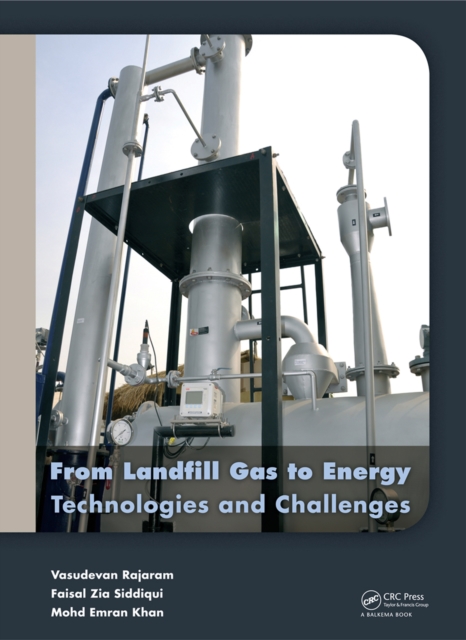
From Landfill Gas to Energy
This book provides a comprehensive description of technologies available for converting old landfills to energy producers, and capturing the green house gases emitting from them. Its key assets are the case studies of successful landfill gas (LFG) recovery for energy projects around the world, and that it highlights why this has not been done in many more landfills around the world. Technical, financial, and social challenges facing the conversion of landfills to energy producers are detailed, and solutions offered to either remine the landfill for recovering useful land (as is planned in dense urban areas of India) or close them properly while recovering the methane for energy use. The book is intended as a guide with background information and instructive tools to educate, guide, and establish a basis for decision-making, technical feasibility assessment, economic assessment, and market evaluation of all aspects necessary for developing successful LFG management projects.
eBook
Remediation of landfi ll sites
Landfi lls take a lot of valuable space in our urban areas, and as the city grows, there
is bound to be confl ict with other uses in the area surrounding the landfi ll. Societies
have been using land disposal of waste for many centuries and old cities have many
landfi lls that have to be remediated or reclaimed for other higher uses. Landfi ll owners
decide to close landfi lls under the following circumstances:The height of the landfi ll has reached an unstable height or the areal limits have
been reached;
The cost of transporting the waste or operating the landfill is uneconomic;
The local opposition to the landfill due to environmental or safety violations
cannot be surmounted;
The land values around the landfi ll make reclaiming the landfi ll economic.
Book Chapter
Landfi ll gas treatment technologies
This chapter discusses in detail several LFG fl aring technologies, from the passive to
active systems. In addition, several cleaning and upgrading technologies to treat the
LFG have been described in detail in this chapter. Case studies of LFG fl aring and
treatment technologies from various countries are provided to familiarize the reader
with current practice.
Book Chapter