
Catalogue Search | MBRL


Are you sure you want to remove the book from the shelf?

{{itemTitle}}
95
result(s) for
"Siebers, Tobin"
Sort by:


MY WITHERED LIMB
Chocolate chip cookies were sizzling on a flat pan in the oven, the linoleum floor was cool, and I could not get up off of it. Tite icon of the cripple is paralytic, a double-edged sword, but we desire role models all the same. [...]the headline,\"Kaukauna Boy Pulls Brother from Fox River,\" fed to the newspaper by the mother of a cowardly witness, made me the hero, although the article added a cautionary note in its final sentence about the limits of hobbled heroism: \"Tobin has polio of the right leg and fortunately was relatively close to his brother when the accident occurred.\" The exertion of movement is so strenuous for him, so beyond the human body and its capacity to cool itself down, that he requires no protection against the cold and must pray at times for the frost to form.
Journal Article
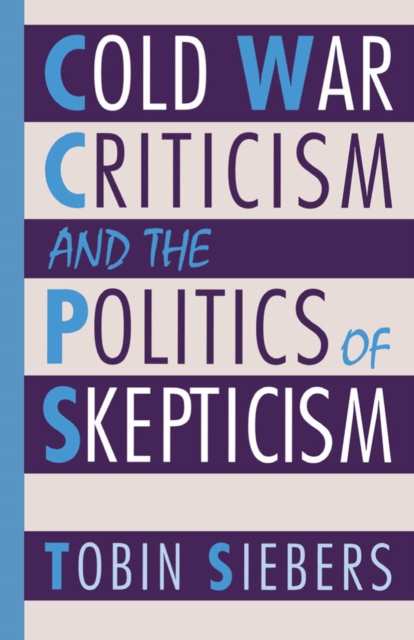
Cold War criticism and the politics of skepticism
In Cold War Criticism, Tobin Siebers claims that modern criticism is a Cold War criticism. Postwar literary theory has absorbed the scepticism, suspicion and paranoia of the Cold War mentality, and it plays them out in debates about the divided self, linguistic indeterminacy, the metaphysics of presence, multiculturalism, canon formation, power, cultural literacy and the politics of literature. The major critical movements of the postwar age, Siebers argues, belong to three dominant phases of the Cold War era. The age of charismatic leadership (Churchill, FDR, Stalin, and Hitler) lies behind the preoccupation with “intention”, “effect” and “impersonality” found in the New Criticism. The age of propaganda motivates the fascination with the guiles of language, undecidability and deconstruction. The age of superpowers provides the dominant metaphor in the new historicism’s analysis of the technology of power. All three ages of criticism reflect Cold War Scepticism as it has impaired the ability of literary theorists to talk effectively about the politics of criticism. Supporting his claims with polemical readings from such figures as Arendt, Bloom, deMan, Lyotard, Siebers offers a new and often surprising vision of what theory must do if it is to enter the post Cold War era successfully.
eBook

Disability as Masquerade
Siebers reads disability studies through the lens of queer theory in order to interrogate the epistemology of a potentially different closet. He uses Joan Riviere's 1929 essay, \"Womanliness as a Masquerade,\" contemporary notions of stigma, the American with Disabilities Act, the writings of Joe Grigely and or Irving Zola, and his own experiences of navigating crowded airplane aisles \"on wobbly legs\" in order to trouble conventional understanding of disabled identity.
Journal Article


In the Name of Pain
To be against health is to be for pain because human beings suffer from sickness. But to suffer from sickness is something of a metaphor. We supposedlysufferfrom diseases and disabilities whether or not they are painful. The man standing on the corner pointing the white cane suffers from blindness, but he has no pain in his eyes or anywhere else. The young woman walking to the local deaf club suffers from deafness, but her body does not hurt and she seems perfectly happy. The Iraq war veteran suffers from quadriplegia, although he cannot feel a thing in most
Book Chapter

Disability Aeshetics
Disability aesthetics seeks to emphasize the presence of different bodies and minds in the tradition of aesthetic representation. It refuses to recognize the representation of the healthy body and this body's definition of harmony, integrity, and beauty as the sole determination of aesthetic.
Journal Article
Words Stare like a Glass Eye: From Literary to Visual to Disability Studies and Back Again
The students of the present generation are the first in a long time who will not take their cultural identities from books. Statistics reveal that film, museum, concert, and sports attendances are up but that fewer and fewer people are reading books. Those strange moments in nineteenth-century novels when young heroes strike poses, dress, coif, and woo by the book are gone, perhaps forever. Our students are more likely to take their models from television, films, glossy magazines, video games, or the Abercrombie and Fitch catalog. My colleagues in the profession report that, thanks to the expansion of visual culture, students now possess an enviable talent for decoding images, often to the detriment of reading ability. To be frank, I am not so convinced: in my experience, the most literate students continue to be the best readers of images. But I agree that we are in the midst of an unprecedented explosion of visuality. A new era has dawned, and we are not prepared for it. We need to change our teaching and scholarship to keep up with our students.
Journal Article