
Catalogue Search | MBRL


Are you sure you want to remove the book from the shelf?

{{itemTitle}}
602
result(s) for
"Silver, Kate"
Sort by:

Frommer's Chicago day by day
\"Packed with color photos, this bestselling guide offers dozens of itineraries that show you how to see the best of Chicago in a short time -- with bulleted maps leading the way from sight to sight. Featuring a full range of thematic and neighborhood tours, plus dining, lodging, shopping, nightlife, and practical visitor info, Chicago Day by Day is the only guide that helps travelers organize their time to get the most out of a trip. Inside this book you'll find: -Full color throughout with hundreds of photos and dozens of maps -One- to three-day itineraries that include The Loop: An Architectural Tour, the Art Institute of Chicago, Bucktown & Wicker Park, Hyde Park, Navy Pier & Environs for Kids, side trips to Oak Park and Evanston, and more -Star ratings for all hotels, restaurants, and attractions to clue you in on great finds and values -Tear-resistant foldout map in a handy, re-sealable plastic wallet.\" -- Provided by publisher.
Book

Spatial resolution of the metastatic osteosarcoma tumor microenvironment using immunolabeling across murine, canine and human lung
Background
Animal models are crucial resources for studying cancer, metastasis, and the tumor microenvironment (TME). Spatial resolution improves our ability to decipher the functions and interactions of distinct components within the TME. Traditionally, this is accomplished through mapping of protein immunolabeling within tissue sections using immunohistochemistry (IHC). Emerging techniques in this field, including multiplex imaging and spatial transcriptomics, continue to rely on IHC to facilitate cell type and tissue compartment identification. Therefore, appropriate antibody validation remains part of the foundation on which sound and reproducible scientific findings are built. This is important for studies investigating tissue-based hypotheses in murine, canine, or human tissues.
Methods
In this work, we aimed to develop a panel of antibodies to label TME components of metastatic osteosarcoma across murine, canine, and human lung. Candidate antibodies were evaluated across species based on sequence homology, immunolabeling in control samples (positive, negative, isotype), and finally, by western blot.
Results
Herein we present a robust panel of antibodies that label murine, canine, and human immune cells (CD20, CD204, CD3, FOXP3, Iba1), osteosarcoma tumor cells (ALPL, RUNX2, SATB2), and other components of the TME (CD31, cytokeratin, FAPα, PROX1, TTF-1, vimentin), and outline methods in which IHC can be pursued within the context of comparative oncology.
Conclusion
The identification of antibodies that label murine, canine, and human tissues supports the investigation of cancer biology across models and patient populations, highlighting a critical strength of comparative oncology research.
Journal Article

Perspectives of autistic adults on the strategies that help or hinder successful conversations
Background & aims
There is increasing recognition of the importance of challenging deficit-focused, medical model approaches to supporting autistic people in daily life, however there is a lack of inclusion of autistic perspectives to inform approaches that may empower autistic people in conversations.
Methods
This multiple case study used a participatory approach to explore the conversation experiences and exchange in dyads of five autistic and five non-autistic adults over four to 12 months. The study was grounded in the perspectives of autistic people through a series of semi-structured interviews, observations, reflective conversations, and diary records.
Results
The findings focus on autistic participants’ existing knowledge of conversations that they reported could be useful to them, including the communication environment, and type and structure of talk. The study also helped participants to identify and use previously unrecognised metacognitive abilities (what they already knew about conversations) within naturalistic interactive contexts.
Conclusions
These findings provide novel insights as to how the ‘interactional expertise’ of non-autistic people could be strengthened to enable the effective contribution of the voices of autistic people in everyday conversations.
Implications
The identification and use of successful conversation strategies identified by autistic adults gave them a greater sense of empowerment within the conversation based on their accounts of their experiences. Understanding these strategies has valuable implications for staff training, for working with families and for learning by autistic adults.
Journal Article
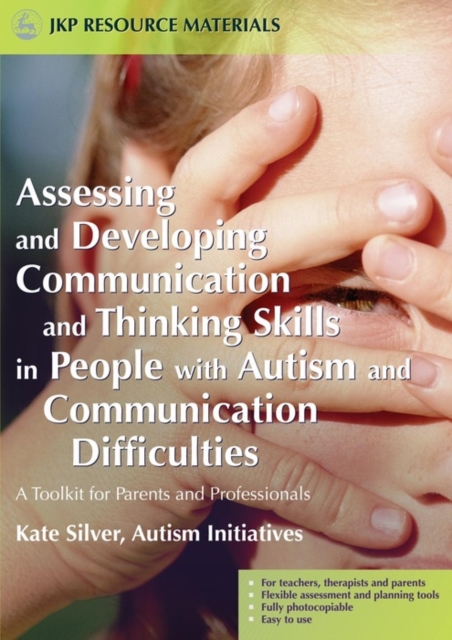
Assessing and developing communication and thinking skills in people with autism and communication difficulties : a toolkit for parents and professionals
This fully photocopiable resource offers a flexible framework for the assessment and measurement of the communication skills of children with autistic spectrum disorders (ASDs). Packed with practical assessment and planning sheets, it enables teachers, educators and other professionals to observe and record how children use and understand language, and to follow their progress over time. The completed assessment record is an accessible summary of a child's individual communication style, identifying strengths and weaknesses and the ways in which he or she is best assisted and motivated to communicate. It focuses on how children express themselves in everyday situations - for example, how they make requests or gain attention, the words they use most frequently, and how their communication is affected by different people and places. Most importantly, it provides a diagnosis of where communication skills can be developed and improved. Using the communication curriculum, educators can set appropriate targets, linked to work in other areas, such as literacy and science. A separate thinking skills curriculum aims to develop the skills and confidence necessary for social interaction, from making simple choices to understanding humour and abstract ideas. Originally devised for use with children with ASDs, this toolkit is equally effective in identifying communication problems in other children, and is an invaluable resource for teachers and speech and language therapists.
eBook

Noticing the unusual: a self-prompt strategy for adults with autism
Purpose – There is a substantial lack of research focusing on how to support the social understanding of high-functioning adults with autism (HFA). The perspectives of three adults with HFA were used to develop and implement self-prompt systems to increase knowledge and awareness of social situations. The paper aims to discuss these issues. Design/methodology/approach – Semi-structured interviews and diaries were used to support individuals to reflect on video-based and real-life social situations, within a qualitative participatory case study design. Qualitative data were analyzed thematically. Findings – Participants developed and used a self-prompt system to support their social understanding in a range of situations. “Noticing the unusual” in social situations, consideration of the potential impact of others’ behavior on them personally, and guessing the intention of others were identified as useful strategies. Basing social judgments on the facial expressions of others was not useful. Research limitations/implications – This was a small-scale study with only three high-functioning participants and so the research needs to be extended to a wider group. Practical implications – There is considerable potential for this approach to be used with adults accessing support services because the strategies identified can be easily applied and personalized. Social implications – Independent, unplanned use of the self-prompt strategy enabled participants to reduce dependence on others in social situations through supporting their independent thinking and actions. Originality/value – This study moves away from a deficit-focussed model of intervention to one that seeks to uncover strengths in order to empower individuals to use their existing knowledge.
Journal Article


When did Evanston get hip?
[...]it's hard to ignore the preciousness of the artisanal movement that is batting around the city: whole-hog meat shops where the owner can name the farmer who raised each cut (Homestead Meats); loaves of bread made by hand from local grains and sold in compostable packaging (Hewn); restaurant bars that serve liquor from distilleries within biking distance over old Johnny or Jim (Found). Since the start of 2013, nearly two dozen restaurants and breweries have opened in Evanston, and the artisanal, local-food movement influences many of them.
Journal Article
A new social club that's BYOB
Ms. Bosse, who had been director of operations at Three Headed Productions (the Chicago-based management company of dining and nightlife spots Evil Olive, Cans and Salud), along with Ms. Bosse's husband, Jeff, 34, thought the concept could be a hit in Chicago and rented the space.
Journal Article
The big chill, artisan-style
At Acadia in the South Loop, beverage director Arunas Bruzas infuses ice cubes with orange peel and pickled ramp for a drink called the Local Agent; he puts kaffir lime and cucumber ice cubes in the gin and tonic; and adds smoked peach and grappa ice to the Bellinimo.
Journal Article