
Catalogue Search | MBRL


Are you sure you want to remove the book from the shelf?

{{itemTitle}}
338
result(s) for
"Silverman, Lisa"
Sort by:


Kinship Support and Academic Efficacy Among College Students: A Cross-Sectional Examination
The study examined whether relationships with extended kin were related to higher levels of mental health and academic functioning among college students. Specifically, the study tested whether perceived emotional support from extended (non-nuclear) family was related to self-esteem, psychological distress, and academic efficacy and dedication above and beyond relationships with one’s primary caregivers, and whether these associations varied by class year in college. The sample consisted of 530 students (average age = 20.82), at a public, four-year university. The results revealed that freshmen and seniors who reported high levels of positive relationships with their extended kin also reported higher levels of academic-efficacy and dedication, as well as lower levels of psychological distress. However, the relation between kin emotional support and these outcomes were not significant for sophomores and juniors. There was also a significant association between kinship support and self-esteem for participants in all four class levels. The study underscores the need to examine extended social support systems among college students, above and beyond those maintained with primary caregivers, as well as the dynamic nature of family support during young adulthood.
Journal Article


‘Nicht jüdeln’: Jews and Habsburg Loyalty in Franz Theodor Csokor’s Dritter November 1918
This article argues that Franz Theodor Csokor’s three-act drama, Dritter November 1918: Ende der Armee Österreich-Ungarns (Third of November 1918: End of the Army in Austria-Hungary) reveals how Jewish difference played an important—if often unrecognized—role in the shaping the terms of Austrian patriotism in the years leading up to 1938. Portrayals of Habsburg loyalty as “Jewish” or “not Jewish” helped articulate how nostalgia for Austria-Hungary would figure in a new sense of Austrianness, a project that took on even more urgency under the authoritarian censors of the Ständestaat. While the play’s portrayal of a Jewish doctor as level-headed, peace-loving, and caring countered some egregious antisemitic stereotypes about disloyal and sexually perverted Jews, it also suggested that Jews were overly rational, lacking in emotional depth, and, ultimately, unable to embody a new Catholic, spiritual, Austrian patriotic ideal. Considered in its broader political context, and along with Csokor’s earlier unpublished drama Gesetz, the play reveals how labelling Habsburg loyalty as Jewish helped to clarify and critique the nature of what it meant to be Austrian under an authoritarian regime that promoted a pro-Catholic, anti-Nazi vision of Austrian patriotism. It also offers a prime example of how even anti-antisemitic authors like Csokor perpetuated negative stereotypes about Jews, even as they aimed to present them in a more positive light.
Journal Article

Stadt mit Jüdinnen: Antisemitism and Misogyny in Hans Karl Breslauer's Recently Restored Film Die Stadt ohne Juden (1924)
Unlike Hugo Bettauer's 1922 novel, on which it is based, Hans Karl Breslauer's 1924 film Die Stadt ohne Juden features Jewish women. They appear as department store customers, mothers, wives, girlfriends, and synagogue congregants, yet they never engage in dialogue and, with but one exception, are always depicted together with men. Despite its inclusion of Jewish women, the film does little to disturb stereotypical representations of them, severely limiting its ability to challenge the powerful social structures that govern their representation. This article explores how additional scenes that appear in the restored 2018 version of this film address contemporary anxieties about Jewish women's and men's appearance, behavior, and ability to pass as non-Jews. That a film intended to oppose hatred of Jews ultimately cannot confront audiences with the absurdity of antisemitism reveals the limits of interwar films in transmitting critical messages.
Journal Article
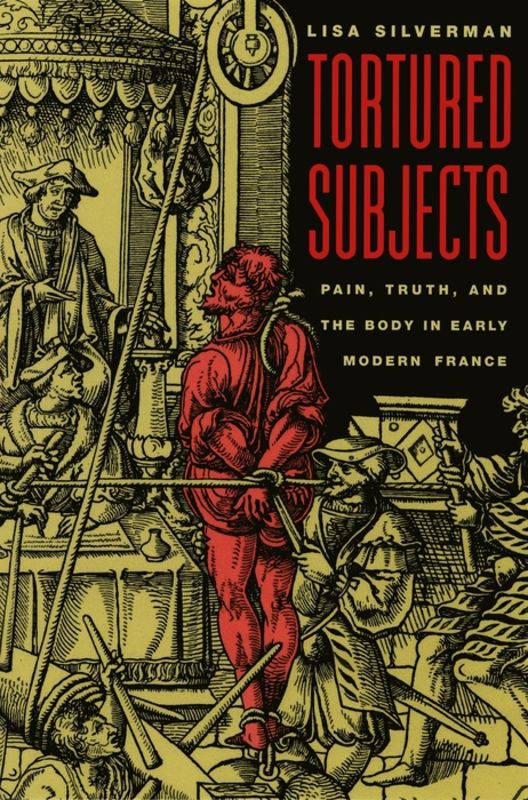
Tortured Subjects
At one time in Europe, there was a point to pain: physical suffering could be a path to redemption. This religious notion suggested that truth was lodged in the body and could be achieved through torture. In Tortured Subjects, Lisa Silverman tells the haunting story of how this idea became a fixed part of the French legal system during the early modern period.
Looking closely at the theory and practice of judicial torture in France from 1600 to 1788, the year in which it was formally abolished, Silverman revisits dossiers compiled in criminal cases, including transcripts of interrogations conducted under torture, as well as the writings of physicians and surgeons concerned with the problem of pain, records of religious confraternities, diaries and letters of witnesses to public executions, and the writings of torture's abolitionists and apologists. She contends that torture was at the center of an epistemological crisis that forced French jurists and intellectuals to reconsider the relationship between coercion and sincerity, or between free will and evidence. As the philosophical consensus on which torture rested broke down, and definitions of truth and pain shifted, so too did the foundation of torture, until by the eighteenth century, it became an indefensible practice.
eBook

Parenting and Environmental Risk
The majority of adaptationist models and research related to parenting strategies have focused on extrinsic or population-level risk as predictors of parenting. However, some researchers have called for greater consideration of cultural factors as well as on intracultural variation in parenting. This study uses a biocultural approach to examine intracultural variation in environmental risk and parenting among the Bofi foragers in Central Africa. In particular, we examine 30 mothers’ experiences of child loss as a predictor of variation in maternal involvement (proximity, holding, and affection) with their young children. Multivariate and univariate analyses indicate that child loss accounted for substantial variation in maternal behaviors and was predictive of maternal holding and the expression of physical affection. In sum, our findings indicate that intracultural variation in child loss is predictive of maternal involvement with young children and that a biocultural approach is useful in explaining this variation.
Journal Article


Absent Jews and Invisible Antisemitism in Postwar Vienna: Der Prozeß (1948) and The Third Man (1949)
After the Second World War, using culture - such as theater, film, and writing - to promote Austria as a separate nation became a helpful strategy for Austrians and the Allied Forces alike. In this context, the role of Jews and Jewish difference in revising Austrian self-definitions was particularly fraught. Antisemitic prejudices persisted after the Holocaust, even though Austrian Jews were now largely absent. However, in the early postwar years, antisemitism was more likely to rear its head via code words or backhandedly, in efforts to deny its very existence. This article investigates the presence and consequences of this 'invisible' antisemitism in postwar Vienna by juxtaposing two films made at roughly the same time: Der Prozeß (1948), a film about antisemitism that takes place in a nineteenth-century village over 300 miles away and features only innocent rural Jews and diabolical antisémites, while The Third Man (1949) features an urban tale of the black market and poisoned children set in post-1945 Vienna that does not mention either Jews or the reasons for their absence. This comparison suggests that the simultaneous repression and evocation of Jewish difference that characterized the creation of culture in Vienna before the Holocaust persisted in the immediate postwar era.
Journal Article

Making Place
Space and place have become central to analysis of culture and history in the humanities and social sciences. Making Place examines how people engage the material and social worlds of the urban environment via the rhythms of everyday life and how bodily responses are implicated in the making and experiencing of place. The contributors introduce the concept of spatial ethnography, a new methodological approach that incorporates both material and abstract perspectives in the study of people and place, and encourages consideration of the various levels-from the personal to the planetary-at which spatial change occurs. The book's case studies come from Costa Rica, Colombia, India, Austria, Italy, the United Kingdom, and the United States.
eBook