
Catalogue Search | MBRL


Are you sure you want to remove the book from the shelf?

{{itemTitle}}
8
result(s) for
"Sim, Stuart, author"
Sort by:

Manifesto for silence
Silence has played a crucial role in human history in important areas of our existence such as religion and the arts. Yet we live in an increasingly noisy society in which silence is under perpetual assault from the 24/7 lifestyle. The business world cynically exploits noise as part of its marketing strategy; the military deploys noise as a weapon. Without question, noise is a political issue on a global scale.
eBook

Post-truth, scepticism & power
This book examines the concept of post-truth and the impact it is having on contemporary life, bringing out both its philosophical and political dimensions. Post-truth is contextualised within the philosophical discourse of truth, with particular reference to theories of scepticism and relativism, to explore whether it can take advantage of these to claim any intellectual credibility. Sim argues that post-truth cannot be defended on either sceptical or relativistic grounds ? even those provided by recent iconoclastic philosophical movements such as poststructuralism and postmodernism. The affinity between post-truth and conspiracy theory is emphasised, and the extent to which post-truth plays a role in religious doctrine is also considered. Post-truth is seen to constitute a threat to liberal democratic ideals and our Enlightenment heritage, raising the question of whether we are moving into a post-liberal age where the far right would hold power. To prevent this, post-truth urgently needs to be countered.
Book
Empires of belief
Is absolute belief making a comeback? Recently the public has accepted unquestioningly certain political, economic, and scientific theories, and for sceptical people, this is a deeply worrying trend. Stuart Sim outlines the history of scepticism in both Western and Islamic traditions from the Enlightenment to today. He argues that we need less belief and more doubt-an engaged scepticism that replaces dogmatism. Addressing contemporary debates surrounding terrorism and fundamentalism, Sims suggests that scepticism can play a greater role in public and political life.
eBook
carbon footprint wars
Climate change is acknowledged to be the major problem facing the human race, and the need to reduce our carbon footprint becomes ever more urgent as the scientific predictions of the effects of climate change become increasingly dire. Whether we are fully aware of the social and political consequences of striving for a significant reduction is more questionable. The Carbon Footprint Wars identifies the many dangers inherent in the projected solutions—such as retreating from the spread of globalization, the current socio-economic paradigm for world trade. The war of words that is being waged over the appropriate way to deal with our collective carbon footprint has critical implications for us all. Stuart Sim examines the issues in detail, raising questions about the assumptions being made on both sides of the climate change divide. He argues that we must urgently address the problem of how to engineer the best possible trade-off between economic survival and ecological disaster—and he puts forward some radical suggestions about how we should set about doing so.
eBook
The eighteenth-century novel and contemporary social issues
GBS_insertPreviewButtonPopup('ISBN:9780748626007');
This study introduces readers to the eighteenth-century novel through a consideration of contemporary social issues. Eighteenth-century authors grappled with very similar problems to the ones we face today such as: what motivates a fundamentalist terrorist? What are the justifiable limits of state power? What dangers lie in wait for us when we create life artificially?
The book discusses key authors from Aphra Behn in the late seventeenth century to James Hogg in the 1820s, covering the 'long' eighteenth century. It guides readers through the main genres of the period from Realism, Gothic romance and historical romance to proto-science fiction. It also introduces a range of debates around race relations, anti-social behaviour, family values and born-again theology as well as the power of the media, surveillance, political sovereignty and fundamentalist terrorism. Each novel is shown to be directly relevant to some of the most urgent moral issues of our own time.
Key Features
Relates the novels of the eighteenth century to current social and political debatesAccessibly and engagingly written for non-specialistsCovers the key authors and texts of the period including Robinson Crusoe, Gulliver's Travels, Pamela, Northanger Abbey, Tristram Shandy and Frankenstein
eBook
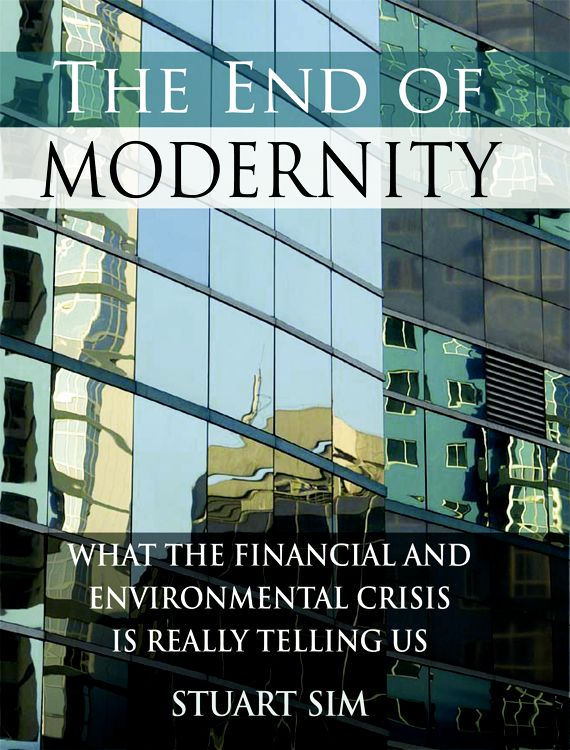
The End of Modernity
Global financial crisis, global environmental crisis - what connects them? Stuart Sim claims they are both symptoms of the end of modernity, the cultural system that has prevailed in the West from the Enlightenment onwards.
In this provocative book, Sim argues that the modern world's insatiable need for technologically-driven economic progress is unsustainable, and potentially destructive of the planet and its socio-economic systems. The new landscape this creates - socially, politically, economically, intellectually - is explored through an interdisciplinary approach, providing a wide-ranging assessment of the collapse of modernity and the challenges it poses us. Sim calls for a radical alteration in our world view and for purposeful changes both to our economic and intellectual life: we need to jettison the free market, rein in conspicuous consumption, reinvigorate public service, and develop talents other than the entrepreneurial if we are to reconstruct our society satisfactorily.
Key Features
Brings out the broader cultural dimensions of the global financial crisisReveals the contradictions at the heart of modernity and its cult of progressOffers a thought-provoking interdisciplinary analysis of late modernity and its aftermathProvides a detailed reassessment of the value of postmodern thought in the new cultural situationOutlines the ideological adjustments we shall have to make in a post-progress world
eBook
