
Catalogue Search | MBRL


Are you sure you want to remove the book from the shelf?

{{itemTitle}}
6
result(s) for
"Simanowski, Roberto, author"
Sort by:

Waste : a new media primer
\"series of essay chapters (a number of which first saw publication in German in mainstream newspapers and magazines) addresses how Facebook, Twitter, Snapchat, and other forms of social media work (and that broader \"by-product\" of the militaristic ARPANET, the internet), what they do to and with the people who use them, and how they have changed and are continuing to change cultural reality:-- Provided by publisher.
Book

Digital Art and Meaning
Digital Art and Meaning offers close readings of varied examples from genres of digital art, including kinetic concrete poetry, computer-generated text, interactive installation, mapping art, and information sculpture. Roberto Simanowski combines these illuminating explanations with a theoretical discussion employing art philosophy and history to achieve a deeper understanding of each example of digital art and of the genre as a whole.
eBook


Data love
Intelligence services, government administrations, businesses, and a growing majority of the population are hooked on the idea that big data can reveal patterns and correlations in everyday life. Initiated by software engineers and carried out through algorithms, the mining of big data has sparked a silent revolution. But algorithmic analysis and data mining are not simply byproducts of media development or the logical consequences of computation. They are the radicalization of the Enlightenment's quest for knowledge and progress.Data Loveargues that the \"cold civil war\" of big data is taking place not among citizens or between the citizen and government but within each of us.
Roberto Simanowski elaborates on the changes data love has brought to the human condition while exploring the entanglements of those who-out of stinginess, convenience, ignorance, narcissism, or passion-contribute to the amassing of ever more data about their lives, leading to the statistical evaluation and individual profiling of their selves. Writing from a philosophical standpoint, Simanowski illustrates the social implications of technological development and retrieves the concepts, events, and cultural artifacts of past centuries to help decode the programming of our present.
eBook

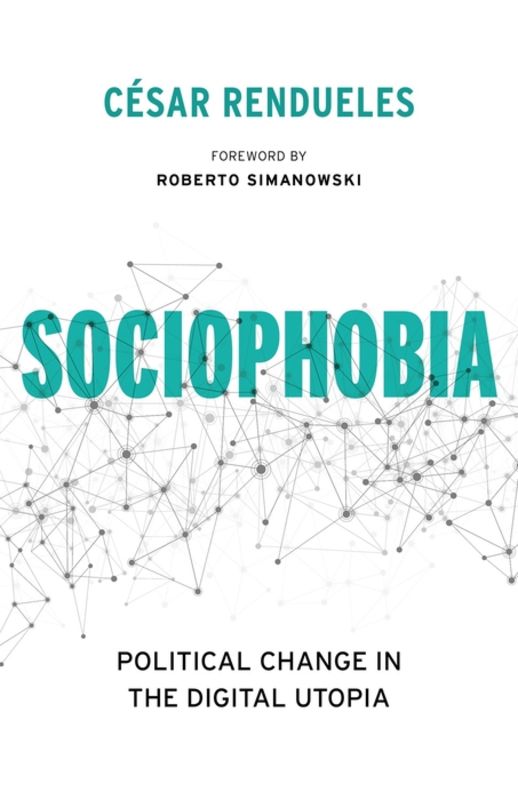
Sociophobia
The great ideological cliché of our time, César Rendueles argues inSociophobia, is the idea that communication technologies can support positive social dynamics and improve economic and political conditions. We would like to believe that the Internet has given us the tools to overcome modernity's practical dilemmas and bring us into closer relation, but recent events show how technology has in fact driven us farther apart.Named one of the ten best books of the year byBabelia El País,Sociophobialooks at the root causes of neoliberal utopia's modern collapse. It begins by questioning the cyber-fetishist dogma that lulls us into thinking our passive relationship with technology plays a positive role in resolving longstanding differences. Rendueles claims that the World Wide Web has produced a diminished rather than augmented social reality. In other words, it has lowered our expectations with respect to political interventions and personal relations. In an effort to correct this trend, Rendueles embarks on an ambitious reassessment of our antagonistic political traditions to prove that post-capitalism is not only a feasible, intimate, and friendly system to strive for but also essential for moving past consumerism and political malaise.
eBook