
Catalogue Search | MBRL


Are you sure you want to remove the book from the shelf?

{{itemTitle}}
83
result(s) for
"Skovsmose, Ole"
Sort by:


Mathematics and crises
One can identify at least three different types of relationships between mathematics and crises. First, mathematics can picture a crisis. This is in accordance with the classic interpretation of mathematical modelling, which highlights that a mathematical model provides a representation of a piece of reality, a reality that could be a critical situation such as, for instance, a pandemic. Second, mathematics can constitute a crisis, meaning that mathematics can form an intrinsic part of the very dynamics of a crisis. This phenomenon can be illustrated by the economic crises that spread around the world in 2008. Third, mathematics can format a crisis. This final formulation refers to a situation where a mathematical reading of a crisis brings about ways of acting in the critical situation that might be adequate, but also counterproductive, if not catastrophic. This is illustrated with reference to the potential crises due to climate changes. As a conclusion, the paper addresses the politics of crises, which refers to the power that can be acted out through a crisis discourse in which mathematics may come to play a deplorable role.
Journal Article


Pedagogical Imagination in Mathematics Teacher Education
After providing a brief summary of what has already been said about pedagogical imagination, data are presented showing how prospective mathematics teachers can become engaged in such imaginations. With reference to this data, the notion of pedagogical imagination is explored further by relating it to dialogue, social justice, mathematics, hope, and sociological imagination. To illustrate these relationships, different episodes from the data are highlighted. Finally, the central role that pedagogical imagination can play in mathematics teacher education is discussed.
Journal Article


Banality of mathematical expertise
Practices within research mathematics can and do serve as models for mathematics education. However, typically such inspirations impose a devastating narrowness in relation to reflections on mathematics. This narrowness I refer to as the “banality of mathematical expertise”. Reflections on mathematics can be expressed through a philosophy of mathematics that goes beyond the traditional emphasis on ontological and epistemological dimensions, to become four-dimensional by also addressing social and ethical issues. Many working philosophies of mathematics operate within a narrow scope of reflections, seemingly located within an ethical vacuum. The consequence is a cultivation of a banality, manifest in many university studies in mathematics as well as in dominant research paradigms in mathematics. This constitutes a serious limitation in providing models for mathematics education. By contrast, there exist examples of practices of mathematics education that demonstrate a richness of reflections on mathematics. Accordingly, I address the extent to which such practices of critical mathematics education could serve as models for research mathematics and mathematics education at the university level.
Journal Article


Students’ foregrounds: Hope, despair, uncertainty
A foreground is formed through the possibilities, tendencies, propensities, obstructions, barriers, hindrances, et cetera, which his or her context provides for a person. Simultaneously, a foreground is formed through the person’s interpretations of these possibilities, tendencies, propensities, obstructions, barriers, hindrances. A foreground is a fragmented, partial, and inconsistent constellation of bits and pieces of aspirations, hopes, and frustrations. It might be both promising and frightening; it is always being rebuilt and restructured. Foregrounds are multiple as one person might see very different possibilities; at the same time they are collective and established through processes of communication. In this article educational meaning is discussed in terms of relationships between the students’ foregrounds and activities in the classroom. I illustrate how students’ dreams might be kept in cages, and how this has implications for how they engage or do not engage in learning processes. I investigate how a foreground might be ruined, and in what sense a ruined foreground might turn into a learning obstacle. Finally, I discuss processes of inclusion and exclusion with reference to the notion of foreground.
Journal Article

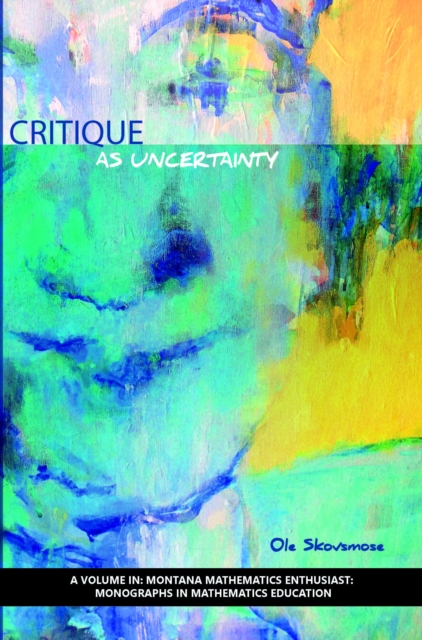
Critique as Uncertainty
Critique as Uncertainty emphasizes uncertainty in critical approaches, rejecting fixed blueprints for social and political improvements. The book, explores topics like landscapes of investigations, students' perspectives, democracy in mathematics education, and the relationship between mathematics and power.
eBook