
Catalogue Search | MBRL


Are you sure you want to remove the book from the shelf?

{{itemTitle}}
94
result(s) for
"Smith, Dallas J"
Sort by:

Increased Rates of Purpureocillium lilacinum Mold among Laboratory Culture Results, United States
Purpureocillium lilacinum, a common environmental mold and bionematicide, can cause human infections. At a major US commercial laboratory during March 2019-February 2025, P. lilacinum culture rates increased; rates were highest in the South Atlantic and Pacific states. Nonculture-based diagnostic tools such as microscopy may help identify and confirm clinical infection earlier.
Journal Article
Potential Sexual Transmission of Antifungal-Resistant Trichophyton indotineae
We describe a case of tinea genitalis in an immunocompetent woman in Pennsylvania, USA. Infection was caused by Trichophyton indotineae potentially acquired through sexual contact. The fungus was resistant to terbinafine (first-line antifungal) but improved with itraconazole. Clinicians should be aware of T. indotineae as a potential cause of antifungal-resistant genital lesions.
Journal Article

Chromoblastomycosis and phaeohyphomycotic abscess-associated hospitalizations, United States, 2016–2021
Chromoblastomycosis and phaeohyphomycotic abscesses are infections of the skin and subcutaneous tissues caused by dematiaceous fungi; more rarely, phaeohyphomycotic brain abscesses can occur. The epidemiology and clinical outcomes of chromoblastomycosis and phaeohyphomycotic abscesses are not well-understood in the United States.
We used data from the Healthcare Cost and Utilization Project's National Inpatient Sample to obtain yearly national estimates of chromoblastomycosis and phaeohyphomycotic abscess-associated hospitalizations. We examined age group, sex, Census region, season of hospital admission, clinical form of chromoblastomycosis, and presence of selected concurrent conditions. An estimated 690 chromoblastomycosis and phaeohyphomycotic abscess-associated hospitalizations occurred during 2016-2021. Rates were highest in 2016 (0.5/1,000,000) and lowest in 2020 (0.2/1,000,000). Overall, higher hospitalization rates occurred among males (0.4/1,000,000) versus females (0.3/1,000,000). Rates increased with age, with patients aged ≥65 years having the highest rate (0.9/1,000,000). The Northeast had the highest hospitalization rate (0.5/1,000,000) followed by the South (0.4/1,000,000). Hypertension (34%), diabetes (33%), dyslipidemia (28%), and chronic kidney disease (21%) were the most common concurrent conditions. Nine percent had autoimmune inflammatory disease or solid malignancy. Seven percent had solid organ or stem cell transplantation. Subsequently, five percent had lymphedema. Mean hospitalization length was 9.9 days; in-hospital death occurred in 3%.
Substantial in-hospital mortality and complications like lymphedema can occur from chromoblastomycosis and phaeohyphomycotic abscesses. Our analysis provides a baseline to monitor hospitalizations and mortality along with comorbidities that may change these outcomes. Public health and clinical partnerships could improve understanding of these fungal diseases caused by dematiaceous fungi through registries, enhanced surveillance, and increased awareness.
Journal Article
Persistence of Symptoms among Commercially Insured Patients with Coccidioidomycosis, United States, 2017–2023
Some patients with coccidioidomycosis experience prolonged respiratory and systemic symptoms. However, data on prevalence and persistence of most symptoms are lacking. Using an insurance claims database, we identified patients with coccidioidomycosis diagnoses in the United States during 2017-2023. We assessed prevalence of associated symptoms from 6 months before to 1 year after first diagnosis code (index date) and compared post-index date prevalence to baseline (within 6 to 4 months before index date). Among 2,640 patients, cough (20.8%), dyspnea (13.0%), and fatigue (8.8%) were the most common symptoms at index date. Dyspnea and erythema nodosum were elevated 3-6 months post-index date (p<0.03), and fatigue, headache, joint pain, and weakness were elevated 9-12 months post-index date compared with baseline (p<0.05).These findings demonstrate that symptoms can persist in coccidioidomycosis patients, which could help inform clinical management and refine estimates of the health and economic burden of coccidioidomycosis.
Journal Article
Emerging Infections Network Survey of Screening for Cryptococcal Antigenemia, United States, 2024
We polled infectious disease specialists about cryptococcal antigen screening for patients initiating HIV antiretroviral therapy. Of 215 respondents, 33% reported typically obtaining screening for patients with CD4 counts <200 cells/mm
and 63% for counts <100 CD4 cells/mm
. Uncertainty about cryptococcal antigen screening benefits and recommendations suggests opportunities for education and increased screening.
Journal Article
Hope amidst neglect: Mycetoma Research Center, University of Khartoum. A holistic management approach to achieve the United Nations’ Sustainable Development Goals
Mycetoma is a debilitating neglected tropical disease that affects individuals worldwide, particularly in regions where there is poverty and limited health care access. The Mycetoma Research Center (MRC), based in Khartoum, Sudan, provides a sustainable, holistic approach to patient care as the only World Health Organization collaborating center for mycetoma. We describe MRC activities that align with the United Nations’ Sustainable Development Goals to control mycetoma in Sudan and globally.
Journal Article
Recognition of Antifungal-Resistant Dermatophytosis by Infectious Diseases Specialists, United States
Antifungal-resistant dermatophyte infections have recently emerged as a global public health concern. A survey of US infectious diseases specialists found that only 65% had heard of this issue and just 39% knew how to obtain testing to determine resistance. Increased clinician awareness and access to testing for antifungal-resistant dermatophytosis are needed.
Journal Article

Integrated action for skin NTDs: Deconstructing transmission, addressing knowledge gaps, and championing one health strategies
Skin Neglected Tropical Diseases (skin NTDs) are a critical, underestimated source of chronic pathology, severely impacting vulnerable, rural populations with poor healthcare access. These diseases heighten the risk of systemic infection, amputation, and premature mortality. Their visibility and co-endemic nature present a pivotal opportunity for integrated diagnostics and management at the primary care level. Aligned with the WHO roadmap, this review advocates for a robust One Health framework, examining the complex interplay of human, animal, and environmental transmission factors. We contrast diseases with understood transmission against those requiring research. Leveraging the skin as a common pathway, we argue for strategic, integrated public health action to substantially improve patient outcomes globally.
This review calls for integrated Skin NTD action, using One Health to analyze complex human, animal, and environmental transmission. It highlights knowledge gaps and urges expanded, standardized diagnostics and systematic data collection on social/financial barriers for patient-centered control.
Journal Article
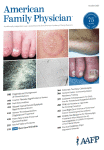
Diagnosis and Management of Tinea Infections
Tinea infections (often called ringworm) are caused by dermatophyte fungi and classified by the body site involved. Tinea corporis and tinea capitis are most common in prepubertal children, and tinea cruris, tinea pedis, and tinea unguium (most common type of onychomycosis) are more likely in adolescents and adults. Clinical diagnosis without testing may be unreliable because other conditions can resemble tinea infections (eg, tinea corporis can be confused with eczema, and onychomycosis with dystrophic toenails from repeated low-level trauma or psoriasis). Tinea corporis, tinea cruris, and tinea pedis generally respond to inexpensive topical antifungal agents, but oral antifungal agents may be indicated for patients with extensive disease, lack of response to topical treatment, immunocompromise, or hair follicle involvement (eg, tinea capitis). Oral terbinafine is considered first-line therapy for tinea capitis and onychomycosis because it is well tolerated, effective, and inexpensive. Emerging tinea infections may be more severe than classic tinea infections and generally do not improve with first-line topical or oral antifungals. These infections may require prolonged oral antifungal therapy and specialized diagnostic testing. Antifungal stewardship, including avoiding the use of combination antifungal-corticosteroids, should be emphasized to optimize outcomes and help prevent resistance.
Journal Article
Global sociodemographic, clinical, and epidemiological profiling of patients with mycetoma: A systematic review
Mycetoma is a neglected tropical disease that affects subcutaneous tissues. This chronic granulomatous inflammatory disease often leads to high morbidity rates, including amputation, disability and social stigma. Despite its substantial impact, the epidemiology of mycetoma remains largely unknown. This systematic review aimed to establish a global sociodemographic and clinical profile of affected patients and characterise the geographic patterns of the causative organisms of mycetoma.
The study followed the 'Preferred Reporting Items for Systematic Review and Meta-Analysis' (PRISMA). The search strategy covered all key databases without restriction on language, setting, or year of publication. All observational studies in which the mycetoma patients' sociodemographic profile was described were included. Study quality was evaluated using a modified Newcastle-Ottawa Quality Assessment Scale. We calculated the mean percentage of patients reporting sociodemographic and clinical characteristics. We also determined the geographic patterns of the identified causative organism for reported mycetoma patients based on actinomycetoma and eumycetoma aetiology and genus-level taxonomic classifications. The included studies were heterogeneous in terms of population source, data collection method, and reported data from demographic characteristics to outcomes. This, in turn, can be due to the absence of a standardised data reporting form for mycetoma, which has limited the data analysis and our ability to compare patient characteristics and disease epidemiology over time and between regions.
Of 16,564 studies identified, 72 met the inclusion criteria, covering 35,004 persons, of which 29,328 were patients with mycetoma. We found that most cases originated from Sudan, India, and Mexico. The disease primarily affected males (74%) and rural residents (73%), with farmers being the most common occupation. Most patients were adults aged between 20 and 50 years (mean 36.2 years), and the lower limb was affected most (77%). Thirty-three percent of patients were cured on treatment, 15% had amputations, and 18% experienced recurrence. Eumycetoma was predominantly identified in Africa and the Arabian Peninsula, and actinomycetoma was more common in India and Mexico. The most common causative species were Madurella mycetomatis and Actinomadura madurae.
This review provides a current understanding of the sociodemographic and clinical characteristics of patients with mycetoma worldwide. Most affected cases were adult males and rural residents, with the lower limb involvement being the most common. The distribution of causative organisms varied by region. The variability in outcomes and organisms underscores the complexity of the disease, highlighting the need for further research to understand its global impact.
Journal Article