
Catalogue Search | MBRL


Are you sure you want to remove the book from the shelf?

{{itemTitle}}
99
result(s) for
"Smith, Norval"
Sort by:

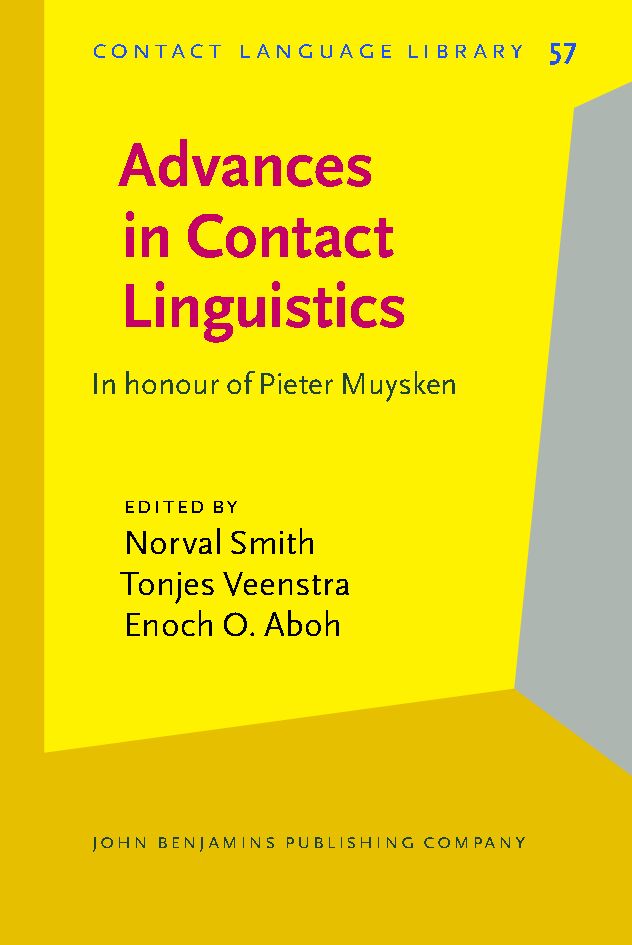
Advances in contact linguistics : in honour of Pieter Muysken
Issues in multilingualism and its implications for communities and society at large, language acquisition and use, language diversification, and creative language use associated with new linguistic identities have become hot topics in both scientific and popular debates. A ubiquitous aspect of multilingualism is language contact. This book contains twelve articles that discuss specific aspects of Contact Linguistics. These articles cover a wide range of topics in the field, including creoles, areal linguistics, language mixing, and the sociolinguistic aspects of interactions with audiences. The book is dedicated to Pieter Muysken whose work on pidgin and creole languages, mixed languages, code-switching, bilingualism, and areal linguistics has been ground-breaking and inspirational for the authors in this book, as well as numerous other scholars working on the various facets of this rapidly expanding field.
eBook

Saramaccan, a very mixed language: Systematicity in the distribution of function words?
Saramaccan is the descendant of a mixed creole language formerly spoken on Portuguese Jewish-owned plantations in Surinam, South America. Its mixed nature reveals itself in roughly equal numbers of monomorphemic English-derived and Portuguese-derived lexical items. In terms of function words, however, English-derived function words dominate to the proportion of 4:1. This still leaves us with a significant number of Portuguese function words. Here I make a preliminary study of spatial adpositions and question words. This reveals a strong correlation between words referring to “place” and words derived from Portuguese. I take account of the presence of Jewish-owned plantations and large-scale marronnage towards the end of the 17th century, the latter leading to formation of the Saramaccan tribe.
Journal Article

Surviving the Middle Passage
The series publishes state-of-the-art work on core areas of linguistics across theoretical frameworks as well as studies that provide new insights by building bridges to neighbouring fields such as neuroscience and cognitive science. The series considers itself a forum for cutting-edge research based on solid empirical data on language in its various manifestations, including sign languages. It regards linguistic variation in its synchronic and diachronic dimensions as well as in its social contexts as important sources of insight for a better understanding of the design of linguistic systems and the ecology and evolution of language.
eBook
Saramaccan, a very mixed language: Systematicity in the distribution of function words?
Saramaccan is the descendant of a mixed creole language formerly spoken on Portuguese Jewish-owned plantations in Surinam, South America. Its mixed nature reveals itself in roughly equal numbers of monomorphemic English-derived and Portuguese-derived lexical items. In terms of function words, however, English-derived function words dominate to the proportion of 4:1. This still leaves us with a significant number of Portuguese function words. Here I make a preliminary study of spatial adpositions and question words. This reveals a strong correlation between words referring to “place” and words derived from Portuguese. I take account of the presence of Jewish-owned plantations and large-scale marronnage towards the end of the 17th century, the latter leading to formation of the Saramaccan tribe.
Saramaccan is the descendant of a mixed creole language formerly spoken on Portuguese Jewish-owned plantations in Surinam, South America. Its mixed nature reveals itself in roughly equal numbers of monomorphemic English-derived and Portuguese-derived lexical items. In terms of function words, however, English-derived function words dominate to the proportion of 4:1. This still leaves us with a significant number of Portuguese function words. Here I make a preliminary study of spatial adpositions and question words. This reveals a strong correlation between words referring to “place” and words derived from Portuguese. I take account of the presence of Jewish-owned plantations and large-scale marronnage towards the end of the 17th century, the latter leading to formation of the Saramaccan tribe.
Journal Article
Autosegmental Studies on Pitch Accent
No detailed description available for \"Autosegmental Studies on Pitch Accent\".
eBook

The Morphosyntax of Reiteration in Creole and Non-Creole Languages
Pichi, an Afro-Caribbean English-lexifier Creole spoken on the island of Bioko, Equatorial Guinea, features four types of reiteration. Amongst them, reduplication and repetition can be distinguished on formal and semantic grounds. Reduplication is a derivational operation consisting of self-compounding and tone deletion. It is restricted to dynamic verbs and yields iterative, dispersive and attenuative meanings. Repetition occurs with all major word classes, renders more iconic meanings and is analyzed as semi-morphological in nature. A comparison with verbal reiteration in a cross-section of West African languages and two of its sister languages in the Caribbean allows the conclusion that Pichi reduplication reflects an areal pattern. I conclude further that Pichi reduplication is not exceptionally iconic nor specifically \"creole\" in nature.
eBook
Autosegmental Studies on Pitch Accent
No detailed description available for \"Autosegmental Studies on Pitch Accent\".
eBook
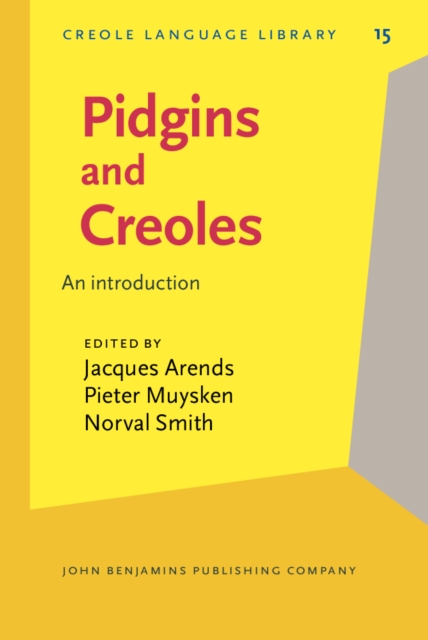
Pidgins and creoles : an introduction
This introduction to the linguistic study of pidgin and creole languages is clearly designed as an introductory course book. It does not demand a high level of previous linguistic knowledge. Part I: General Aspects and Part II: Theories of Genesis constitute the core for presentation and discussion in the classroom, while Part III: Sketches of Individual Languages (such as Eskimo Pidgin, Haitian, Saramaccan, Shaba Swahili, Fa d'Ambu, Papiamentu, Sranan, Berbice Dutch) and Part IV: Grammatical Features (such as TMA particles and auxiliaries, noun phrases, reflexives, serial verbs, fronting) can form the basis for further exploration. A concluding chapter draws together the different strands of argumentation, and the annotated list provides the background information on several hundred pidgins, creoles and mixed languages.Diversity rather than unity is taken to be the central theme, and for the first time in an introduction to pidgins and creoles, the Atlantic creoles receive the attention they deserve. Pidgins are not treated as necessarily an intermediate step on the way to creoles, but as linguistic entities in their own right with their own characteristics. In addition to pidgins, mixed languages are treated in a separate chapter.Research on pidgin and creole languages during the past decade has yielded an abundance of uncovered material and new insights. This introduction, written jointly by the creolists of the University of Amsterdam, could not have been written without recourse to this new material.
eBook
