
Catalogue Search | MBRL


Are you sure you want to remove the book from the shelf?

{{itemTitle}}
108
result(s) for
"Smolla, Rodney A"
Sort by:


Content and Context: The Contributions of William Van Alstyne to First Amendment Interpretation
William Van Alstyne's contributions to First Amendment interpretation, like his contributions to all of American constitutional law, are characterized by a piercing intellectual honesty and an impish play of intelligence. One feels relentlessly pulled by the elegant currents of Professor Van Alsytne's arguments, yet, at the same time, restlessly resistant, a resistance borne of the vague but certain wariness that one is but an apprentice forever consigned to a level of awareness several moves behind the master, who almost certainly will produce surprises at the end.
Journal Article

Information as contraband: The First Amendment and liability for trafficking in speech
Smolla explores the treatment of information as contraband in arenas as diverse as privacy, official secrets, intellectual property, defamation, and liability for facilitating criminal or tortious conduct. Smolla also explores the tensions in policy and law that will continue to animate debate over the propriety and constitutionality of making it illegal to traffic in proscribed categories of speech.
Journal Article


The Constitutionality of Mandatory Public School Community Service Programs
Examines the constitutionality of service-learning programs that require student participation. Adoption of these programs is usually based on the belief that education should include some community service. Constitutional challenges have typically either objected to the requirement, or to the criteria used to determine which organizations or agencies are eligible to participate. The right-privilege distinction is discussed in relation to the contention that community service programs pose no constitutional problems because they are simply conditions attached to the privilege of a free public education. Specific constitutional challenges are examined, including those based on arguments of involuntary servitude, substantive due process, or First Amendment rights of free association, free speech, or the free exercise of religion. It is contended that none of these claims are strong enough to eliminate mandatory service programs. In addition, although education officials must be careful to avoid viewpoint-based discrimination, it is constitutional to refuse the participation of organizations whose mission is contrary to that of the public schools. J. Lindroth
Journal Article

The Life of the Mind and a Life of Meaning: Reflections on \Fahrenheit 451\
The future is not what it used to be. Ray Bradbury's classic novel, Fahrenheit 451, published in 1953, is a cultural time marker, helping us to locate the past, evaluate the present, and imagine the future. Fahrenheit 451 still vexes our conscience and consciousness, just as other imaginative time markers do--George Orwell's novel 1984,' or Stanley Kubrick's film 2001: A Space Odyssey, or the lyrics from Prince's 1982 funk classic 1999:
Book Review
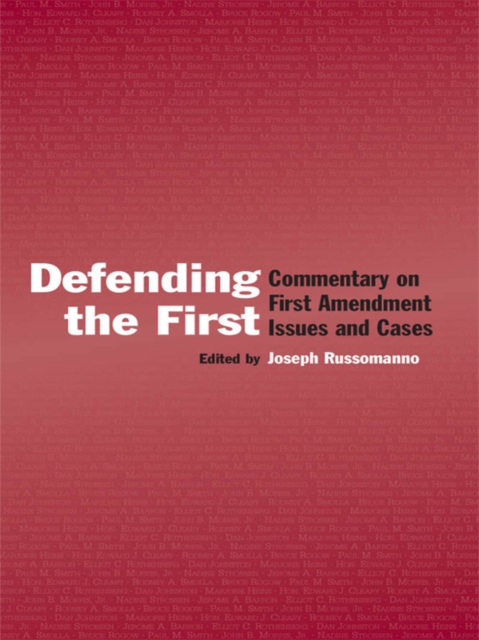
Defending the First
Defending the First provides a collection of new perspectives on the First Amendment in legal and communication contexts. Editor Joseph Russomanno brings together a roster of major figures who have participated in the shaping of First Amendment law over the past 30 years. Readers are taken into a realm of personal experience and analysis through the stories of these attorneys at the forefront of the battle to defend the \"First.\" The contributors to this volume--all of whom have argued cases before the Supreme Court--tell about their experiences appearing before the highest court in the United States. Some write many years after being there, while others offer insights from a more recent vantage point. One Supreme Court Attorney offers a historical analysis of a case replete with a variety of First Amendment issues.
This work contributes to a deeper understanding of First Amendment issues and the types of expression that the First Amendment protects, and why these rights must be protected. In addition, it provides readers with the unique perspective of those who have been on the front lines of some of the most important and influential cases in this era. The challenges of presenting an argument in this venue become clear, and it is evident that understanding one's own case, its lineage, and its likely impact all become part of the formula for success.
This distinctive collection provides personal and compelling insights into the making of communication law, and it will be engaging reading for students in communication law courses. It will also appeal to any reader interested in First Amendment law.
Contents: N. Strossen, Foreword. Preface. J.A. Barron, Creating a New First Amendment Right: Miami Herald Publishing Co. v. Tornillo and the Story of Access to the Media. E.C. Rothenberg, Whose First Amendment? Cohen v. Cowles Media Co. D. Johnston, Freedom of Speech: A Casualty of War. M. Heins, The \"Miracle\" of Burstyn v. Wilson. E.J. Cleary, Suppressing Hateful Ideas by Force of Law: Reflections on R.A.V. v. St. Paul and Virginia v. Black. R.A. Smolla, Anatomy of an Oral Argument. B.S. Rogow, A First Amendment Life. P.M. Smith, The First Amendment in the Age of the Internet: The U.S. Supreme Court Takes on the Challenge of a New Communication Medium. J.B. Morris, Jr., The Past, Present, and Future of Internet Censorship and Free Speech Advocacy.
eBook
Academic Freedom, Hate Speech, and the Idea of a University
First amendment jurisprudence regarding hate speech, & its relationship to academic freedom, are examined. The affirmative first amendment thinker wishes to expand protection of free speech to its widest bounds, emphasizing its social & private value. This position is supported by such legal doctrines as neutrality, protection of the emotional components of speech & symbolism, & the harm, causation, & precision principles. The negative first amendment thinker accepts free speech as a constitutional right, but wishes to limit it, & argues that hate speech can be penalized according to such doctrines as the two-class theory, the fighting words doctrine, content-neutral protection of persons or property, discriminatory conduct, the relational harm doctrine, & the public/private speech dichotomy. In the past three decades, the US Supreme Court has consistently sided with affirmative first amendment thinking, placing education in a quandry because it must make a firm commitment to freedom of expression while at the same time taking a stand against hate speech by emphasizing the academic values of tolerance, civility, & respect for human dignity. D. Generoli
Journal Article

