
Catalogue Search | MBRL


Are you sure you want to remove the book from the shelf?

{{itemTitle}}
22
result(s) for
"Snarr, Hal W"
Sort by:
Learning Basic Macroeconomics
Traditional macroeconomic principles textbooks are theoretically based, and require students to apply definitions, analyze charts, graphs and tables, and use logic and reasoning skills to evaluate the effects of economic shocks or policy changes. Recognizing how challenging this is, economics instruction has adopted video, simulation, and other methods to aid in learning. These methods, however, while possibly stimulating students' imagination, may also stifle it and contribute to a dependent learning style. It may also fail to connect topics and models in cohesive and meaningful ways. This book presents macroeconomic principles in a logical and concise order, and uses the Maple© mathematics program to build and analyze macroeconomic models. The method outlined in this book teaches readers with basic algebraic skill levels how to build a model of the macro-economy from the ground up. The method uses models derived from typical principles textbooks using Maple as a platform. Maple's interface is as easy to use as typing a simple math problem in Microsoft Word using keys on a standard keyboard. The Maple syntax is kept simple, which allows readers to be proficient in Maple in a matter of minutes. In short, this book allows executives, advanced degree students, undergraduate students, business executives, managers, policy makers, and others to gain a fuller understanding of how the macro-economy works. Topics covered in the book range from individual demand and firm supply to aggregate demand and supply, and fiscal and monetary policy from the Austrian to Keynesian schools of thought.
eBook
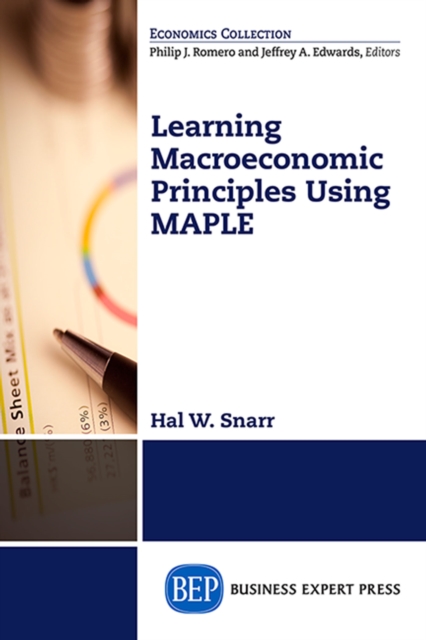
Learning macroeconomic principles using MAPLE
Economics has been dubbed the \"dismal science\" since Thomas Carlyle coined the phrase in 1849. The 2008 presidential candidate who said, \"Economics is something that I've really never understood,\" probably sides with this view. So, why is economics so dismal to so many? Is it because it has become too mathematical? Is it because traditional textbooks fail to connect topics and models in a concise, cohesive, and meaningful way? Is it because the computer simulations that are used to teach economic principles \"stifle students' imagination, contribute to a dependent learning style, and fail to stimulate interest in the subject matter\" (Wetzstein 1988)? Or, is it because economists from different schools of economic thought rarely agree on anything? This book uses MAPLE and the simulation models that I developed in Learning Basic Macroeconomics (2014) to make teaching or learning economics not so dismal. MAPLE is ideally suited for this because it allows users to assemble and systematically combine the various models that form the aggregate market model, frees users from doing tedious calculations and algebraic manipulations, and is as easy to use as Microsoft Word. Building and analyzing the macroeconomic model using MAPLE is a fun way to learn the dismal science.
eBook

Does the Minimum Wage Make Young Adult Labor More Attractive to Firms?: A Panel Data Analysis That Controls for Spatial Heterogeneity
Adverse effects of minimum wage policy on labor markets materialize only if the new rate is binding. Annual data from the Current Population Survey indicate that the minimum wage is effectively non-binding for young adults (19-29) who have at least one year of college and are not enrolled in school. Hence, a minimum wage hike would have no effect on young adult workers… or does it? The authors investigate this using dynamic panel data that accounts for spatial heterogeneity, which must be controlled for because minimum wage coefficients are biased otherwise (Allegretto, Dube, and Reich 2011). The authors find that accounting for spatial heterogeneity and the inertia that is present in labor market variables affects the results dramatically. Average unemployment in adjacent states has a large net positive cumulative impact on young adult male employment but a large negative cumulative effect on young adult female employment. Though both cohorts are sensitive to market wages and weekly earnings, males are more geographically mobile while female employment is negatively linked to having children, poverty, welfare participation, and urbanity but positively associated with welfare reform. While the minimum wage was insignificant in the young adult male employment model, its anticipatory effect is associated with higher young adult female employment. This is perhaps due to firms substituting teen (16-18) labor with young adult females who possess longer employment tenure, slightly better job skills, and greater personal responsibility.
Journal Article

Does income support increase abortions?
Currently, Temporary Assistance for Needy Families (TANF) programs in 32 American states allow low-income childless pregnant single women (CPSW) to receive monthly cash assistance, while 28 states and the District of Columbia use lump-sum payments to divert low-income families from TANF. Past research has not investigated the possible consequences on abortions of these two welfare policies. We construct a theoretical model of low-income CPSW to investigate them. The results of the theory yields the following hypotheses: (1) diversion payments to low-income mothers lower abortion incidence; and (2) diversion payments and CPSW eligibility together raise abortion incidence. We use data from the US Centers for Disease Control and Prevention's Abortion Surveillance, and a system GMM dynamic panel, two-way fixed-effects empirical model to test our hypotheses. Our empirical results provide statistically significant evidence for the first hypothesis, but not the second.
Journal Article