
Catalogue Search | MBRL


Are you sure you want to remove the book from the shelf?

{{itemTitle}}
2
result(s) for
"Sobering, Katherine, author"
Sort by:

The ambivalent state : police-criminal collusion at the urban margins
\"Over the last few decades, debates about policing in poor urban areas have shifted analysing the state's neglect and abandonment to documenting its harsh interventions and punishing presence. Most of this research has focused on the overt actions and inactions. Yet we know very little about the covert world of state action that is hidden from public view. The Ambivalent State offers an unprecedented look into the clandestine relationships between cops and drug dealers in Argentina. Drawing on a unique combination of ethnographic research and documentary evidence, including hundreds of pages of wiretapped phone conversations, sociologists Javier Auyero and Katherine Sobering analyse the inner-workings of \"police-criminal collusion\" and its connections to drug markets and the depacification of daily life. Through rich descriptions of the actual clandestine interactions between drug dealers and police, they argue that an up-close examination of covert state action exposes the workings of an \"ambivalent state\": one that enforces the rule of law while at the same time and in the same place functions as a partner to what it defines as criminal behaviour. The Ambivalent State develops a political sociology of violence that focuses not only on takes place in police stations, criminal courts, and poor neighbourhoods, but also the clandestine actions and interactions of police agents, judges, and politicians that structure daily life at the urban margins. By way of empirical demonstration, the book makes an urgent call for scholars to incorporate clandestine action into explanations of the state. Collusion, policing, the state, crime, violence, urban marginality, legal cynicism, Argentina, ethnography\"-- Provided by publisher.
Book
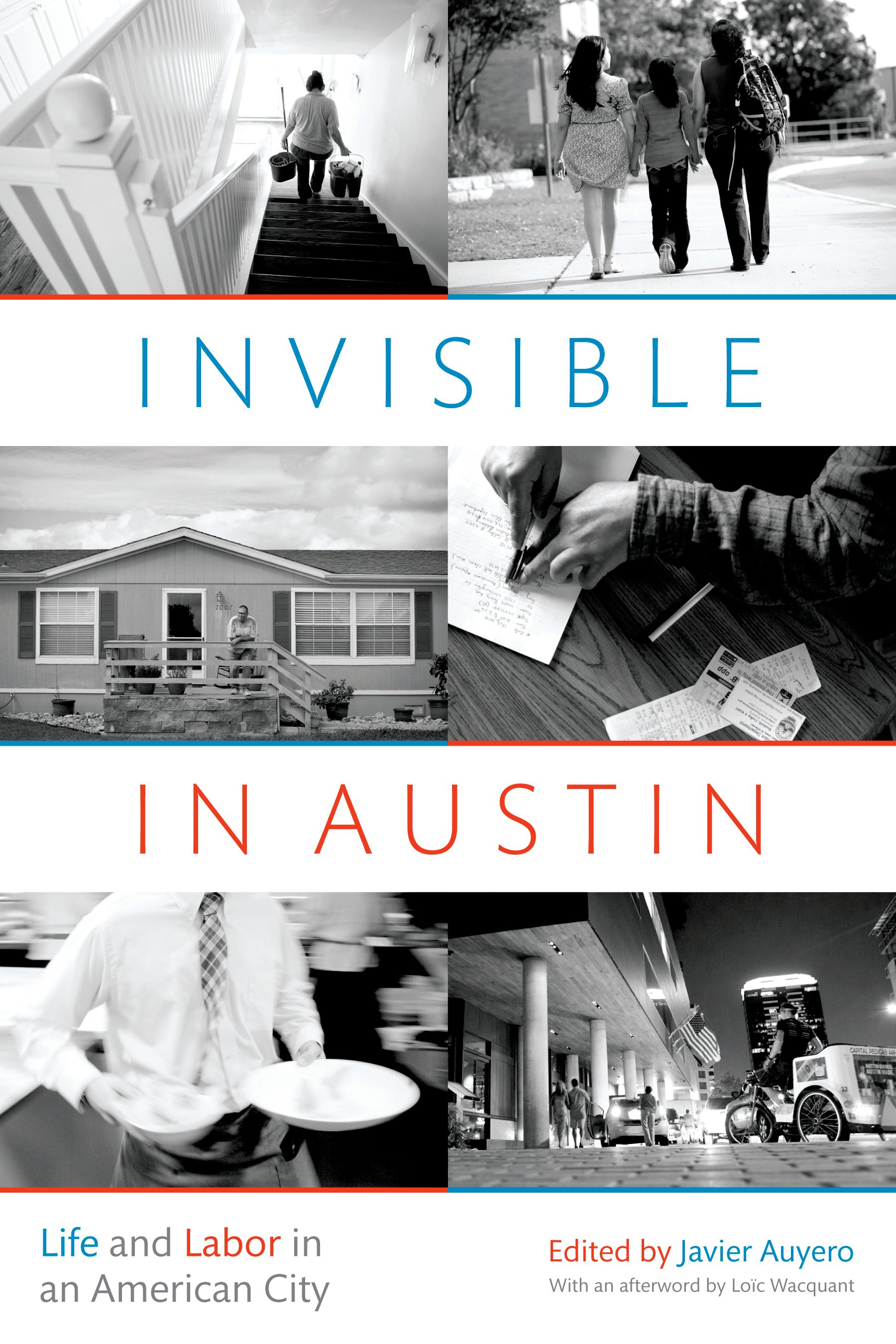
Invisible in Austin
Austin, Texas, is renowned as a high-tech, fast-growing city for the young and creative, a cool place to live, and the scene of internationally famous events such as SXSW and Formula 1. But as in many American cities, poverty and penury are booming along with wealth and material abundance in contemporary Austin. Rich and poor residents lead increasingly separate lives as growing socioeconomic inequality underscores residential, class, racial, and ethnic segregation. In Invisible in Austin, the award-winning sociologist Javier Auyero and a team of graduate students explore the lives of those working at the bottom of the social order: house cleaners, office-machine repairers, cab drivers, restaurant cooks and dishwashers, exotic dancers, musicians, and roofers, among others. Recounting their subjects’ life stories with empathy and sociological insight, the authors show us how these lives are driven by a complex mix of individual and social forces. These poignant stories compel us to see how poor people who provide indispensable services for all city residents struggle daily with substandard housing, inadequate public services and schools, and environmental risks. Timely and essential reading, Invisible in Austin makes visible the growing gap between rich and poor that is reconfiguring the cityscape of one of America’s most dynamic places, as low-wage workers are forced to the social and symbolic margins.
eBook