
Catalogue Search | MBRL


Are you sure you want to remove the book from the shelf?

{{itemTitle}}
782
result(s) for
"Somerville, Margaret"
Sort by:

Bird on an ethics wire : battles about values in the culture wars
\"Our physical ecosystem is not indestructible and we have obligations to hold it in trust for future generations. The same is true of our metaphysical ecosystem--the values, principles, attitudes, beliefs, and shared stories on which we have founded our society. In Bird on an Ethics Wire, Margaret Somerville explores the values needed to maintain a world that reasonable people would want to live in and pass on to their descendants. Somerville addresses the conflicts between people who espouse \"progressive\" values and those who uphold \"traditional\" ones by casting her attention on the debates surrounding \"birth\" (abortion and reproductive technologies) and \"death\" (euthanasia) and shows how words are often used as weapons. She proposes that we should seek to experience amazement, wonder, and awe to enrich our lives and helps us to find meaning. Such experiences, Somerville believes, can change how we see the world and live our lives, and affect the decisions we make, especially regarding values and ethics. They can help us to cope with physical or existential suffering, and, ultimately put us in touch with the sacred--in either its secular or religious form--which protects what we must not destroy. Experiencing amazement, wonder and awe, Somerville concludes, can also generate hope, the oxygen of the human spirit, without which our spirit dies. Both individuals and societies need hope, a sense of connection to the future, if the world is to make the best values decisions in the battles that constitute the current culture wars.\"-- Provided by publisher.
Book

Water in a dry land : place-learning through art and story
Water in a Dry Land is a story of research about water as a source of personal and cultural meaning. The site of this exploration is the iconic river system which forms the networks of natural and human landscapes of the Murray-Darling Basin, Australia. In the current geological era of human induced climate change, the desperate plight of the system of waterways has become an international phenomenon, a symbol of the unsustainable ways we relate to water globally. The Murray-Darling Basin extends west of the Great Dividing Range that separates the densely populated east coast of Australia from the sparsely populated inland. Aboriginal peoples continue to inhabit the waterways of the great artesian basin and pass on their cultural stories and practices of water, albeit in changing forms. A key question informing the book is: What can we learn about water from the oldest continuing culture inhabiting the world's driest continent? In the process of responding to this question a team of Indigenous and non-Indigenous researchers formed to work together in a contact zone of cultural difference within an emergent arts-based ethnography. Photo essays of the artworks and their landscapes offer a visual accompaniment to the text on the Routledge Innovative Ethnography This book is perfect for courses in environmental sociology, environmental anthropology, and qualitative methods.
eBook


Bioethics in the news: the values at stake
Bioethical issues are complex, often involve factual uncertainty, and have broad and long-term potential consequences for individuals, institutions and society. Simplification is a strategy used by so-called 'progressive' values advocates to promote acceptance of their values. It results from excluding consideration of complexity, uncertainty and potentiality in the values disputes around bioethical issues. In order to engage effectively in public debates of bioethics issues, it is necessary to understand the current societal values zeitgeist and how it differs from a traditional societal values zeitgeist. Since words are weapons in the values battles, it is necessary to identify how they are being used in the presentation of ethical issues in the media and ethical decision making and, when that use leads to unethical decisions and situations, offer alternatives. Moreover, bioethicists must also identify the causes of biased media coverage of ethics issues, including the phenomenon of 'post-truth', and work to eliminate them. In particular, Catholic communicators could play a leading role in defending ethical values which further the 'common good' in society, including by protecting vulnerable people. As an example, the current euthanasia debate is examined in some detail.
Journal Article


Becoming-with fire and rainforest: Emergent curriculum and pedagogies for planetary wellbeing
In this paper we propose the concept of ‘becoming-with’ in relation to the experience of the catastrophic fires in the summer of 2019–2020 in Australia, and their implications for research into young children’s response to bushfires, and their learning about bushfire recovery, which resulted in the development of an arts-based project to explore emergent curriculum and pedagogies for planetary wellbeing. We draw on Deleuze and Guattari’s theorising that ‘the self is only a threshold, a door, a becoming between two multiplicities’; and ‘Spatio-temporal relations’ as ‘not predicates of the thing but dimensions of multiplicities of events as encounters’ to theorise how ‘becoming-with’ fires enabled the development of emergent curriculum and pedagogies in an early learning centre, which can ultimately contribute to planetary wellbeing.
Journal Article

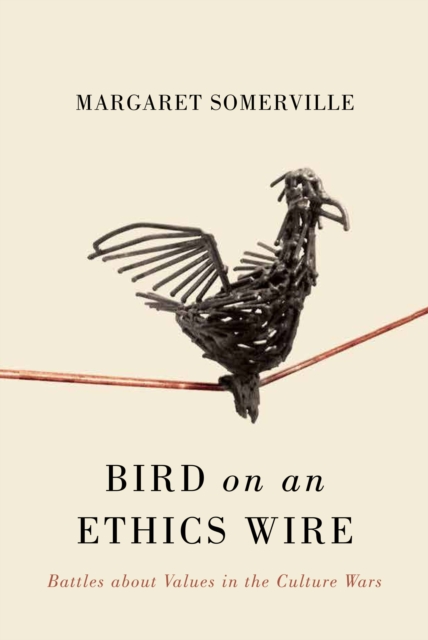
Bird on an Ethics Wire
Our physical ecosystem is not indestructible and we have obligations to hold it in trust for future generations. The same is true of our metaphysical ecosystem - the values, principles, attitudes, beliefs, and shared stories on which we have founded our society. In Bird on an Ethics Wire, Margaret Somerville explores the values needed to maintain a world that reasonable people would want to live in and pass on to their descendants. Somerville addresses the conflicts between people who espouse \"progressive\" values and those who uphold \"traditional\" ones by casting her attention on the debates surrounding \"birth\" (abortion and reproductive technologies) and \"death\" (euthanasia) and shows how words are often used as weapons. She proposes that we should seek to experience amazement, wonder, and awe to enrich our lives and help us to find meaning. Such experiences, Somerville believes, can change how we see the world and live our lives, and affect the decisions we make, especially regarding values and ethics. They can help us to cope with physical or existential suffering, and ultimately put us in touch with the sacred - in either its secular or religious form - which protects what we must not destroy. Experiencing amazement, wonder, and awe, Somerville concludes, can also generate hope, without which our spirit dies. Both individuals and societies need hope, a sense of connection to the future, if the world is to make the best decisions about values in the battles that constitute the current culture wars.
eBook


Healthcare worker access to molnupiravir: A case series
Molnupiravir, an oral antiviral shown to reduce COVID-19 severity, is available in Australia via the Pharmaceutical Benefits Scheme (PBS) for treatment of mild-moderate COVID-19. For people less than 70 years of age it is only available with risk factors for severe disease, hence the majority of healthcare workers do not qualify. Currently, Australian health services are under considerable strain due to COVID-related staff shortages. Thirty staff members of a tertiary hospital, not eligible under the PBS, were offered molnupiravir within the first five days of COVID-19 illness. Their median age was 43 years, and 73% were female. All completed treatment with rates of adverse events that were low and comparable with clinical trial data. The reported duration of illness ranged from 1–16 days with a median of four days. A negative rapid antigen test on the final day of treatment was reported in 81% of people, and 73% reported being well enough to return to work at the completion of mandatory isolation. Only 22% of people reported transmission in their household after they commenced treatment. The implementation of a policy allowing access to molnupiravir outside of PBS recommendations for healthcare workers with mild-moderate COVID-19 may have important individual benefits to workers health and wellbeing and help alleviate the acute staff shortages experienced currently by the Australian healthcare workforce.
Journal Article