
Catalogue Search | MBRL


Are you sure you want to remove the book from the shelf?

{{itemTitle}}
54
result(s) for
"Souza Filho, Antônio Pedro da Silva"
Sort by:

Chemical Composition of Volatile Compounds in Apis mellifera Propolis from the Northeast Region of Pará State, Brazil
Propolis is a balsamic product obtained from vegetable resins by exotic Africanized bees Apis mellifera L., transported and processed by them, originating from the activity that explores and maintains these individuals. Because of its vegetable and natural origins, propolis is a complex mixture of different compound classes; among them are the volatile compounds present in the aroma. In this sense, in the present study we evaluated the volatile fraction of propolis present in the aroma obtained by distillation and simultaneous extraction, and its chemical composition was determined using coupled gas chromatography, mass spectrometry, and flame ionization detection. The majority of compounds were sesquiterpene and hydrocarbons, comprising 8.2–22.19% α-copaene and 6.2–21.7% β-caryophyllene, with additional compounds identified in greater concentrations. Multivariate analysis showed that samples collected from one region may have different chemical compositions, which may be related to the location of the resin’s production. This may be related to other bee products.
Journal Article
In Silico Evaluation of the Antimicrobial Activity of Thymol—Major Compounds in the Essential Oil of Lippia thymoides Mart. & Schauer (Verbenaceae)
In this paper, we evaluated the drug-receptor interactions responsible for the antimicrobial activity of thymol, the major compound present in the essential oil (EO) of Lippia thymoides (L. thymoides) Mart. & Schauer (Verbenaceae). It was previously reported that this EO exhibits antimicrobial activity against Candida albicans (C. albicans), Staphylococcus aureus (S. aureus), and Escherichia coli (E. coli). Therefore, we used molecular docking, molecular dynamics simulations, and free energy calculations to investigate the interaction of thymol with pharmacological receptors of interest to combat these pathogens. We found that thymol interacted favorably with the active sites of the microorganisms’ molecular targets. MolDock Score results for systems formed with CYP51 (C. albicans), Dihydrofolate reductase (S. aureus), and Dihydropteroate synthase (E. coli) were −77.85, −67.53, and −60.88, respectively. Throughout the duration of the MD simulations, thymol continued interacting with the binding pocket of the molecular target of each microorganism. The van der Waals (ΔEvdW = −24.88, −26.44, −21.71 kcal/mol, respectively) and electrostatic interaction energies (ΔEele = −3.94, −11.07, −12.43 kcal/mol, respectively) and the nonpolar solvation energies (ΔGNP = −3.37, −3.25, −2.93 kcal/mol, respectively) were mainly responsible for the formation of complexes with CYP51 (C. albicans), Dihydrofolate reductase (S. aureus), and Dihydropteroate synthase (E. coli).
Journal Article
Chemical Evaluation, Phytotoxic Potential, and In Silico Study of Essential Oils from Leaves of Guatteria schomburgkiana Mart. and Xylopia frutescens Aubl. (Annonaceae) from the Brazilian Amazon
The essential oils (EOs) of Guatteria schomburgkiana (Gsch) and Xylopia frutescens (Xfru) (Annonaceae) were obtained by hydrodistillation, and their chemical composition was evaluated by gas chromatography-mass spectrometry (GC/MS). Herbicide activity was measured by analyzing the seed germination percentage and root and hypocotyl elongation of two invasive species: Mimosa pudica and Senna obtusifolia. The highest yield was obtained for the EO of Xfru (1.06%). The chemical composition of Gsch was characterized by the presence of the oxygenated sesquiterpenes spathulenol (22.40%) and caryophyllene oxide (14.70%). Regarding the EO of Xfru, the hydrocarbon monoterpenes α-pinene (35.73%) and β-pinene (18.90%) were the components identified with the highest concentrations. The germination of seeds of S. obtusifolia (13.33 ± 5.77%) showed higher resistance than that of seeds of M. pudica (86.67 ± 5.77%). S. obtusifolia was also more sensitive to the EO of Xfru in terms of radicle (55.22 ± 2.72%) and hypocotyl (71.12 ± 3.80%) elongation, while M. pudica showed greater sensitivity to the EO of Gsch. To screen the herbicidal activity, the molecular docking study of the major and potent compounds was performed against 4-hydroxyphenylpyruvate dioxygenase (HPPD) protein. Results showed good binding affinities and attributed the strongest inhibitory activity to δ-cadinene for the target protein. This work contributes to the study of the herbicidal properties of the EOs of species of Annonaceae from the Amazon region.
Journal Article
Phytochemical Profile and Herbicidal (Phytotoxic), Antioxidants Potential of Essential Oils from Calycolpus goetheanus (Myrtaceae) Specimens, and in Silico Study
The essential oil (EO) of Calycolpus goetheanus (Myrtaceae) specimens (A, B, and C) were obtained through hydrodistillation. The analysis of the chemical composition of the EOs was by gas chromatography coupled with mass spectrometry CG-MS, and gas chromatography coupled with a flame ionization detector CG-FID. The phytotoxic activity of those EOs was evaluated against two weed species from common pasture areas in the Amazon region: Mimosa pudica L. and Senna obtusifolia (L.) The antioxidant capacity of the EOs was determined by (DPPH•) and (ABTS•+). Using molecular docking, we evaluated the interaction mode of the major EO compounds with the molecular binding protein 4-hydroxyphenylpyruvate dioxygenase (HPPD). The EO of specimen A was characterized by β-eudesmol (22.83%), (E)-caryophyllene (14.61%), and γ-eudesmol (13.87%), while compounds 1,8-cineole (8.64%), (E)-caryophyllene (5.86%), δ-cadinene (5.78%), and palustrol (4.97%) characterize the chemical profile of specimen B’s EOs, and specimen C had α-cadinol (9.03%), δ-cadinene (8.01%), and (E)-caryophyllene (6.74%) as the majority. The phytotoxic potential of the EOs was observed in the receptor species M. pudica with percentages of inhibition of 30%, and 33.33% for specimens B and C, respectively. The EOs’ antioxidant in DPPH• was 0.79 ± 0.08 and 0.83 ± 0.02 mM for specimens A and B, respectively. In the TEAC, was 0.07 ± 0.02 mM for specimen A and 0.12 ± 0.06 mM for specimen B. In the results of the in silico study, we observed that the van der Waals and hydrophobic interactions of the alkyl and pi-alkyl types were the main interactions responsible for the formation of the receptor–ligand complex.
Journal Article

PHYTOTOXIC POTENTIAL OF THE GEOPROPOLIS EXTRACTS OF THE JANDAIRA STINGLESS BEE ( Melipona subnitida ) IN WEEDS
ABSTRACT The objective of the present research is to characterize the phytotoxic activity of geopropolis from the Jandaira bee (Melipona subnitida Ducke) in the state of Ceará in Northeast Brazil and to analyze its effects. Extracts were prepared in 80% v/v grain alcohol at 0.25, 0.5, 0.75, and 1.0%. Their effects were determined on seed germination, radicle elongation, and hypocotyl growth of the pasture weeds malícia (Mimosa pudica) and mata-pasto (Senna obtusifolia). Extract phytotoxicity varied as functions of plant species, application dosage, and plant organ. M. pudica was more sensitive to the inhibitory effects of geopropolis than S. obtusifolia. There was a phytotoxic effect of 50% (PE50) for S. obtusifolia in terms of seed germination and in rootlet development near the maximum applied concentrations. M. pudica had PE50 and PE90 at the minimum concentration (0.25%) and near the maximum (1.00%), respectively. Thus, geopropolis extracts from the Jandaira bee (M. subnitida) are potentially phytotoxic to certain plant species. RESUMO Este trabalho teve por objetivo caracterizar a atividade fitotóxica da geoprópolis de abelhas jandaira (Melipona subnitida Ducke), nativas do estado do Ceará, e analisar, comparativamente, seus efeitos. Os extratos obtidos com álcool cereal foram preparados em concentrações de 0,25, 0,5, 0,75 e 1,0%, tendo como eluente o etanol 80%, e testados sobre a germinação de sementes, alongamento da radícula e do hipocótilo das plantas daninhas de área de pastagens cultivadas, malícia (Mimosa pudica) e mata-pasto (Senna obtusifolia). Os extratos testados evidenciaram atividade fitotóxica em intensidades que variaram em função da planta receptora, concentração, e da parte da planta analisada. A espécie M. pudica apresentou maior sensibilidade aos efeitos inibitórios do que S. obtusifolia. A espécie S. obtusifolia, quando analisada isoladamente, apresentou Efeito Fitotóxico EF50 na germinação das sementes e no desenvolvimento da radícula em concentrações próximas à máxima utilizada, enquanto que a espécie M. pudica apresentou EF50 e EF90 nas concentrações mínimas e próximas à máxima, 0,25% e 1,00%. Os extratos da geoprópolis da abelha jandaira (M. subnitida) avaliados possuem em sua composição bioativos com potencial efeito fitotóxico às plantas daninhas estudadas.
Journal Article

Terpenoids
Terpenoids are commercially important chemicals found in essential oils and other natural plant sources. They are used in solving issues that affect agricultural production, making them a key component of sustainable agronomy. Terpenoids: Recent Advances in Extraction, Biochemistry and Biotechnology provides information about the varied use of terpenoids in the control of pests, microbial diseases, ticks, and weeds. Chapters have prioritized terpenoids produced by plants, endophytic fungi, propolis, and geopropolis. The book also provides focused information about the functions of terpenoids in plants, as well as their biosynthetic pathways of production. The reference provides readers with a broad and diverse picture of the applications of terpenoids in plant safety, and creates an awareness of the possibilities for innovative biotechnological approaches for their extraction that make all the difference to agricultural production. Professionals and scholars involved in chemical technology, biotechnology and agriculture will benefit from the information provided in the book. It also serves as a comprehensive update for general readers interested in terpenoids and their current impact on the agricultural industry.
eBook
Chemical Evaluation, Phytotoxic Potential, and In Silico Study of Essential Oils from Leaves of IGuatteria schomburgkiana/I Mart. and IXylopia frutescens/I Aubl. from the Brazilian Amazon
The essential oils (EOs) of Guatteria schomburgkiana (Gsch) and Xylopia frutescens (Xfru) (Annonaceae) were obtained by hydrodistillation, and their chemical composition was evaluated by gas chromatography-mass spectrometry (GC/MS). Herbicide activity was measured by analyzing the seed germination percentage and root and hypocotyl elongation of two invasive species: Mimosa pudica and Senna obtusifolia. The highest yield was obtained for the EO of Xfru (1.06%). The chemical composition of Gsch was characterized by the presence of the oxygenated sesquiterpenes spathulenol (22.40%) and caryophyllene oxide (14.70%). Regarding the EO of Xfru, the hydrocarbon monoterpenes α-pinene (35.73%) and β-pinene (18.90%) were the components identified with the highest concentrations. The germination of seeds of S. obtusifolia (13.33 ± 5.77%) showed higher resistance than that of seeds of M. pudica (86.67 ± 5.77%). S. obtusifolia was also more sensitive to the EO of Xfru in terms of radicle (55.22 ± 2.72%) and hypocotyl (71.12 ± 3.80%) elongation, while M. pudica showed greater sensitivity to the EO of Gsch. To screen the herbicidal activity, the molecular docking study of the major and potent compounds was performed against 4-hydroxyphenylpyruvate dioxygenase (HPPD) protein. Results showed good binding affinities and attributed the strongest inhibitory activity to δ-cadinene for the target protein. This work contributes to the study of the herbicidal properties of the EOs of species of Annonaceae from the Amazon region.
Journal Article
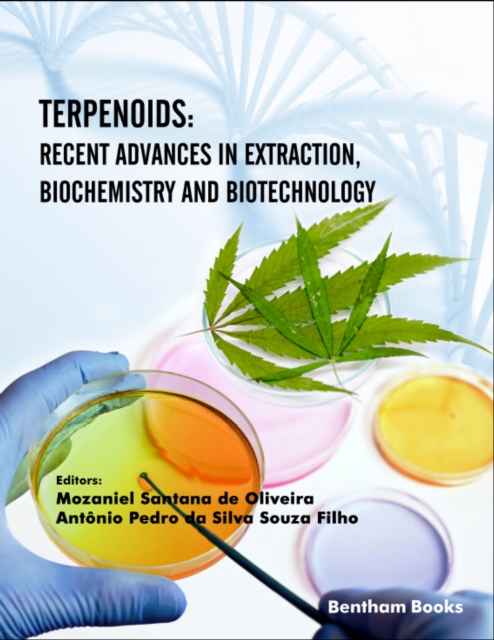
Terpenoids: Recent Advances in Extraction, Biochemistry and Biotechnology
Terpenoids are commercially important chemicals found in essential oils and other natural plant sources. They are used in solving issues that affect agricultural production, making them a key component of sustainable agronomy. Terpenoids: Recent Advances in Extraction, Biochemistry and Biotechnology provides information about the varied use of terpenoids in the control of pests, microbial diseases, ticks, and weeds. Chapters have prioritized terpenoids produced by plants, endophytic fungi, propolis, and geopropolis. The book also provides focused information about the functions of terpenoids in plants, as well as their biosynthetic pathways of production. The reference provides readers with a broad and diverse picture of the applications of terpenoids in plant safety, and creates an awareness of the possibilities for innovative biotechnological approaches for their extraction that make all the difference to agricultural production. Professionals and scholars involved in chemical technology, biotechnology and agriculture will benefit from the information provided in the book. It also serves as a comprehensive update for general readers interested in terpenoids and their current impact on the agricultural industry.
eBook