
Catalogue Search | MBRL


Are you sure you want to remove the book from the shelf?

{{itemTitle}}
61
result(s) for
"Spier, Fred"
Sort by:

Big history and the future of humanity
\"Provides an accessible and original overview of the entire sweep of history that places human history within the context of the history of life, the Earth, and the universe\"-- Provided by publisher.
Book
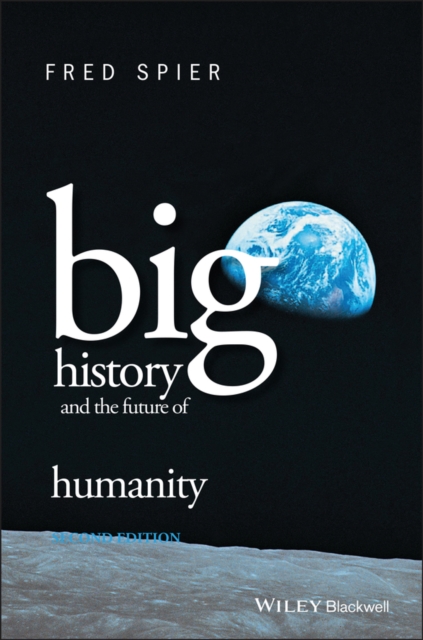
Big history and the future of humanity
big history and the future of humanity \"This remains the best single attempt to theorize big history as a discipline that can link core concepts and paradigms across all historical disciplines, from cosmology to geology, from biology to human history. With additional and updated material, the Second Edition also offers a fine introduction to the history of big history and a superb introductory survey to the big history story. Essential reading for anyone interested in a rapidly evolving new field of scholarship that links the sciences and the humanities into a modern, science-based origin story.\" —David Christian, Macquarie University \"Notable for its theoretic approach, this new Second Edition is both an indispensable contribution to the emerging big history narrative and a powerful university textbook. Spier defines words carefully and recognizes the limits of current knowledge, aspects of his own clear thinking.\" —Cynthia Brown, Emerita, Dominican University of California Reflecting the latest theories in the sciences and humanities, this new edition of Big History and the Future of Humanity presents an accessible and original overview of the entire sweep of history from the origins of the universe and life on Earth up to the present day. Placing the relatively brief period of human history within a much broader framework – one that considers everything from vast galaxy clusters to the tiniest sub-atomic particles – big history is an innovative theoretical approach that opens up entirely new multidisciplinary research agendas. Noted historian Fred Spier reveals how a thorough examination of patterns of complexity can offer richer insights into what the future may have in store for humanity. The second edition includes new learning features, such as highlighted scientific concepts, an illustrative timeline and comprehensive glossary. By exploring the cumulative history from the Big Bang to the modern day, Big History and the Future of Humanity, Second Edition, sheds important historical light on where we have been – and offers a tantalizing glimpse of what lies ahead.
eBook
Big history and the future of humanity, 2nd edition
Featuring a variety of updates and revisions, Big History and the Future of Humanity, Second Edition, presents an accessible and original overview of the entire sweep of history from the origins of the universe and origins of life on Earth up to the present day.
eBook


Interpreting the history of 'big history'
Von Humboldt first outlined his approach during two extremely well-attended lecture series in Berlin in 1827-28, and later in his famous multi-tome book series Kosmos, published between 1845 and 1862. Because von Humboldt did not know the ages of rocks and fossils, while the universe was generally considered static and timeless, he refused to phrase his analysis in a systematic historical perspective. [...]the view, prevalent among astronomers around 1900, of humans living in the centre of the Milky Way, thought to be the entire universe, was replaced by a view of the universe that had started with an extremely hot and dense big bang 1 3.7 billion years ago and that has expanded ever since, producing many billions of galaxies, one of which is ours.
Journal Article

THE GHOST OF BIG HISTORY IS ROAMING THE EARTH 1
M aps of T ime : A n I ntroduction to B ig H istory . By David Christian.
Journal Article


Nature Does Not Care Indeed, But Humans Do
I would like to start by saying that Jan Smit raised many excellent points with which I wholeheartedly agree. I will therefore concentrate on raising a few questions and discussing a minor point of disagreement.
Book Chapter
