
Catalogue Search | MBRL


Are you sure you want to remove the book from the shelf?

{{itemTitle}}
114
result(s) for
"Spinner-Halev, Jeff"
Sort by:

Enduring injustice
\"Governments today often apologize for past injustices and scholars increasingly debate the issue, with many calling for apologies and reparations. Others suggest that what matters are victims of injustice today, not injustices in the past. Spinner-Halev argues that the problem facing some peoples is not just the injustice of the past, but that they still suffer from injustice today. They experience what he calls enduring injustices, and it is likely that these will persist without action to address them. The history of these injustices matters, not as a way to assign responsibility or because we need to remember more, but in order to understand the nature of the injustice and to help us think of possible ways to overcome it. Suggesting that enduring injustices fall outside the framework of liberal theory, Spinner-Halev spells out the implications of arguments for conceptions of liberal justice and progress, reparations, apologies, state legitimacy and post-nationalism\"-- Provided by publisher.
BOOK
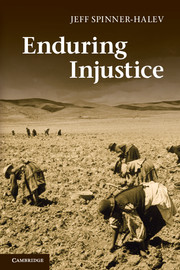
Enduring Injustice
Governments today often apologize for past injustices and scholars increasingly debate the issue, with many calling for apologies and reparations. Others suggest that what matters is victims of injustice today, not injustices in the past. Spinner-Halev argues that the problem facing some peoples is not only the injustice of the past, but that they still suffer from injustice today. They experience what he calls enduring injustices, and it is likely that these will persist without action to address them. The history of these injustices matters, not as a way to assign responsibility or because we need to remember more, but in order to understand the nature of the injustice and to help us think of possible ways to overcome it. Suggesting that enduring injustices fall outside the framework of liberal theory, Spinner-Halev spells out the implications of his arguments for conceptions of liberal justice and progress, reparations, apologies, state legitimacy, and post-nationalism.
eBook

Feminism, Multiculturalism, Oppression, and the State
Reviews recent feminist criticisms of multicultural theorists, particularly against what Ayelet Schacar (1998) terms \"strong\" & \"weak\" multiculturalism. The former promotes group autonomy & justice between rather than within groups, giving power to certain groups over their members. It is argued that the feminist argument is flawed by its failure to distinguish between oppressed & nonoppressed groups in opposing group autonomy. The latter, also termed \"integrative\" multiculturalism, grants rights to some groups, but does not include the right of power over members; rather, members are integrated into a body politic & some excluded from certain laws or afforded differential privileges. Feminists argue that this allows immigrant families to discriminate against their daughters. Feminist objections to both brands of multiculturalism are challenged here, considering the role of the liberal state in guaranteeing & protecting rights & justice in relations between the state & oppressed groups. Taking the case of discrimination against women, the injustices involved in imposing reform on oppressed groups are explored. These arguments are illustrated via case studies of Muslims in India, as well as Native Americans & Israeli Muslim groups in the US. K. Hyatt Stewart
Journal Article
Surviving diversity : religion and democratic citizenship
While liberal advocates of multiculturalism frequently call for tolerance of those with diverse views, this tolerance is often not extended to members of religious groups. This lack is perhaps not surprising, since the liberal ideals of autonomy, equality, and inclusiveness are the very ones that many religious groups—particularly the more conservative ones—reject. Yet, as Jeff Spinner-Halev argues in Surviving Diversity, any theory of multiculturalism that fails to take religious groups into account is incomplete.
Spinner-Halev proposes three principles on which accommodation of exclusive religious groups should be based. First, they must provide their children with a basic education and allow adults to leave the community if they wish. Second, with some exceptions they should be welcomed to participate in the public sphere, since such participation often bolsters citizenship. Third, they should be free to exclude others from their institutions, except when doing so substantially harms the citizenship of others. While not condoning such extremist groups as the Branch Davidians or the Christian Identity movement, Spinner-Halev stresses that most religious conservatives have chosen to live a life that, in a permissive Western democracy, requires considerable restraint and thought. He concludes by demonstrating how the ideals of multiculturalism can be extended to such citizens, creating a society tolerant of even greater diversity.
eBook

Why Political Philosophy Should Be Robust
Political philosophers and theorists make arguments about high-stakes problems. This article shows that those theories would be more credible if political philosophers ensured their work was robust: capable of withstanding reasonable changes to their assumptions and to the cases to which their arguments apply. The world is varied and inconstant. As a result, scientists and social scientists recognize the virtue of robustness. This article shows why political philosophers should also do so. It defines robustness, demonstrates its value, and shows how it can be evaluated. Illustrating the stakes of robustness, the article assesses prominent arguments concerning multiculturalism and open borders. Avoiding misunderstanding and confusion should be a central aim of political philosophy. To sidestep these outcomes and to reassure scholars that one’s theory is not subject to concerns about its credibility, it will often be reasonable for philosophers to explicitly test their theories for robustness.
Journal Article

Liberalism, Markets, and Responsibility
The specter of individual responsibility is ever present in many liberal theories of distributive justice, yet these “responsibilitarian” arguments ignore the unpredictability of markets, misunderstand the role of luck that nearly everyone faces in a market economy, and overvalue (while not defining) prudent or responsible behavior. Nearly all economic behavior in market societies is risky—there is no baseline of prudent or responsible behavior. Further, the idea of individual responsibility is normative in ways that responsibility theorists fail to recognize; they rarely take into account our responsibility to other people, like our obligations to one’s spouse, parents, and children. I argue here that instead of focusing on when an individual is acting responsibly or not, contemporary theories of justice should focus on the ways in which political and social institutions can help people be responsible, in both econonomic and noneconomic ways.
Journal Article


Hinduism, Christianity, and Liberal Religious Toleration
The Protestant conception of religion as a private matter of conscience organized into voluntary associations informed early liberalism's conception of religion and of religious toleration, assumptions that are still present in contemporary liberalism. In many other religions, however, including Hinduism (the main though not only focus of this article), practice has a much larger role than conscience. Hinduism is not a voluntary association, and the structure of its practices, some of which are inegalitarian, makes exit very difficult. This makes liberal religious toleration an awkward fit for Hinduism; granting religious toleration in India undermines equality and autonomy in severe ways. Yet Hinduism is not without its virtues, and has historically been what I call externally tolerant-it has been relatively tolerant of other religions. Liberal toleration, by contrast, is internally tolerant-it is tolerant of religions that fit the Protestant model, while its tolerance of others is considerably more qualified. I briefly speculate at the end of the article about how to combine these two models of toleration.
Journal Article
Rawls, Mill, and the Puzzle of Political Liberalism
This article examines John Rawls’s turn toward a purely political liberalism by comparing and contrasting it with the comprehensive liberalism he imputes to John Stuart Mill. We argue that Mill and Rawls have similar views about individual autonomy, despite Rawls’s insistence to the contrary. We contend that Rawls accords a much larger role to the state in enforcing justice than does Mill. Whereas Rawls’s view of justice rests ultimately on state enforcement, Mill sees justice reaching into many institutions, but accords the state a lesser role in this. Mill’s view of justice rests on a view of progress and moral psychology not shared by Rawls. In the service of stability, Rawls demands more agreement from citizens about justice than does Mill, but these demands undermine the stability that Rawls so desires. The differences between Rawls and Mill discussed here are not elucidated by the distinction between political and comprehensive liberalisms.
Journal Article