
Catalogue Search | MBRL


Are you sure you want to remove the book from the shelf?

{{itemTitle}}
5
result(s) for
"Spiro, Peter J., author"
Sort by:

Citizenship : what everyone needs to know
\"Citizenship is a like the air we breathe; it's all around us but often goes unnoticed. That is not a historically ordinary situation. Citizenship was once an exceptional status, a kind of aristocracy of the ancient world in which freedom and political voice were not taken for granted. Even as the nation-state emerged as the primary form of human association, citizenship remained an anomalous status, reserved for the few who were privileged as such in republican democracies. More recently, it has been the individual marker of membership in all national communities. It is generic; almost everyone has it, hence the ubiquity that has made it sometimes unseen. Most people never change the citizenship that they are unthinkingly born into; they have no cause to consider it any more critically than their choice of parents. Insofar as citizenship during the twentieth century came to be aligned with national community on the ground and in the public imagination, there was even less reason to look at it searchingly\"-- Provided by publisher.
Book
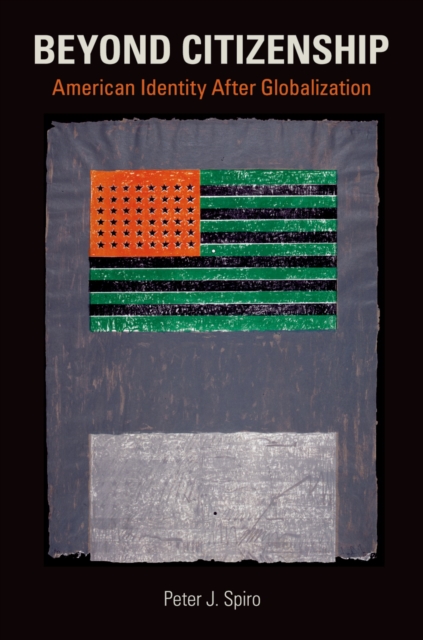
Beyond citizenship : American identity after globalization
American identity has always been capacious as a concept but narrow in its application. Citizenship has mostly been about being here, either through birth or residence. The territorial premises for citizenship have worked to resolve the peculiar challenges of American identity. But globalization is detaching identity from location. What used to define American was rooted in American space. Now one can be anywhere and be an American, politically or culturally. Against that backdrop, it becomes difficult to draw the boundaries of human community in a meaningful way. Longstanding notions of democratic citizenship are becoming obsolete, even as we cling to them. Beyond Citizenship charts the trajectory of American citizenship and shows how American identity is unsustainable in the face of globalization. Peter J. Spiro describes how citizenship law once reflected and shaped the American national character. Spiro explores the histories of birthright citizenship, naturalization, dual citizenship, and how those legal regimes helped reinforce an otherwise fragile national identity. But on a shifting global landscape, citizenship status has become increasingly divorced from any sense of actual community on the ground. As the bonds of citizenship dissipate, membership in the nation-state becomes less meaningful. The rights and obligations distinctive to citizenship are now trivial. Naturalization requirements have been relaxed, dual citizenship embraced, and territorial birthright citizenship entrenched--developments that are all irreversible. Loyalties, meanwhile, are moving to transnational communities defined in many different ways: by race, ethnicity, gender, religion, age, and sexual orientation. These communities, Spiro boldly argues, are replacing bonds that once connected people to the nation-state, with profound implications for the future of governance. Learned, incisive, and sweeping in scope, Beyond Citizenship offers a provocative look at how globalization is changing the very definition of who we are and where we belong.
eBook


Environmental Impact of Power Generation
In today's automated world, the need for economic generation of power is of vital importance. However, the industry is commonly perceived as being responsible for pollution of the atmosphere and contamination of land and water. Encompassing areas as diverse as current performance standards, the use of nuclear fuel and a historical overview of electricity supply, this 11th volume of Issues in Environmental Science and Technology aims to contribute to the public understanding of science in this important area. The emotive issues of air pollution and the ecological effects of overhead power lines are tackled, along with energy efficiency and conservation.
eBook

Air Pollution and Health
This 10th volume in the Issues in Environmental Science and Technology series provides a comprehensive review of air pollution and health that complements the 9th volume covering air quality management. Dealing with the common gaseous and particulate air pollutants, including chemical carcinogens, this volume reviews the epidemiological and exposure chamber study research and considers mechanistic studies in the case of particulate matter.
eBook