
Catalogue Search | MBRL


Are you sure you want to remove the book from the shelf?

{{itemTitle}}
61
result(s) for
"Sprigman, Christopher"
Sort by:

The knockoff economy : how imitation sparks innovation
\"Conventional wisdom holds that intellectual property rights are essential for innovation. But are copyright and patents really necessary to spark creativity? In The Knockoff Economy, Kal Raustiala and Christopher Sprigman provocatively argue that creativity can not only survive in the face of copying, but can thrive. The Knockoff Economy approaches the question of incentives and innovation in a wholly new way--by exploring creative fields that do not rely on legal monopolies, such as fashion, cuisine, and even professional football. By uncovering these important but rarely studied creative worlds, Raustiala and Sprigman reveal a nuanced and fascinating relationship between imitation and innovation. In some creative fields copying is kept in check through informal industry norms enforced by private sanctions. In other cases, the freedom to copy actually promotes creativity. High fashion gave rise to the very term \"knockoff,\" yet imitation only makes the fashion cycle run faster--and forces the fashion industry to be ever more creative. Raustiala and Sprigman carry their analysis from food to font design to football plays to finance, examining how and why each of these vibrant fields remains innovative, even in the face of sometimes extensive imitation. There is an important thread that ties all these instances together--successful creative industries can evolve to be resistant to, and even to profit from, piracy. And there are important lessons here for copyright-focused industries, like music and film, that have struggled with piracy. Raustiala and Sprigman's arguments have been making headlines in The New Yorker, the New York Times, the Financial Times, the Boston Globe, Le Monde, and elsewhere. By looking where few had looked before--at industries that fall outside normal IP law--The Knockoff Economy opens up fascinating creative worlds. And it demonstrates that not only is a great deal of innovation possible without IP, but that IP's absence is sometimes better for innovation\"-- Provided by publisher.
Book

The Piracy Paradox: Innovation and Intellectual Property in Fashion Design
It is surprising that in this tremendous field [of fashion], ranking conservatively among the first five in the United States, such unregulated and primitive conditions obtain that unreserved pilfering is tolerated and openly permitted. The leaders of this gigantic segment of our commercial life... have completely ignored a situation that is eating away at the very roots of its existence. Style and creation constitute the life blood of this multi-billion dollar business. Without them, the industry would fade into obscurity. Yet, for some unknown reason, style piracy is treated more indulgently than much lesser offenses involving deprivation of one's rights and property.
Journal Article

The Creativity Effect
This Article reports the first experiment to demonstrate the existence of a valuation anomaly associated with the creation of new works. To date, a wealth of social science research has shown that the least amount of money that owners of goods are willing to accept to part with their possessions is often far greater than the amount that purchasers would be willing to pay to obtain them. This phenomenon, known as the endowment effect, may create substantial inefficiencies in many markets. Our experiment demonstrates the existence of a related \"creativity effect. \"We show that creators of works value their creations substantially more than do both potential purchasers of their works and mere owners of the works. The creators in our study valued their works (in this case, paintings) more than four times higher than potential buyers did and almost twice as high as did owners of the works. Further, we provide evidence that these differences are the result of creators' irrational optimism about the quality of their works. We conclude by discussing the implications of these findings for intellectual property (IP) theory in general and IP licensing in particular. Our findings challenge the classical economic approach to IP rights, and they suggest that IP markets may be less efficient than previously recognized.
Journal Article
Testing for Trademark Dilution in Court and the Lab
Federal courts are currently split, even within particular districts, on the basic question of what a plaintiff must show to establish that a defendant's conduct constitutes trademark dilution by blurring. Federal trademark law defines \"dilution by blurring\" as \"association arising from the similarity between a mark or trade name and a famous mark that impairs the distinctiveness of the famous mark.\" In construing this statutory language, a majority of courts have held that to establish blurring, a plaintiff need only show that consumers associate the defendant's mark with the plaintiff's famous mark. These courts appear to assume that to the extent that there is consumer association, this association alone will \"impair[ ] the distinctiveness\" of the famous mark. A minority of courts have held that the plaintiff must show both consumer association and that the consumer association \"impairs the distinctiveness\" of the famous mark. In this Article, we make three contributions to the current debate over what must be shown to establish dilution by blurring. First, we report the results of a set of experiments that reveal that the majority approach is fundamentally deficient. These experiments demonstrate that even when consumers associate a junior mark with a famous senior mark, this association does not necessarily result in any impairment of the ability of the senior mark to identify its source and associations. Second, we set forth a new method for determining when association is likely to lead to impairment. This method, which we term the \"association strength test,\" evaluates changes in how strongly survey respondents associate a mark with its source or attributes upon exposure to a diluting stimulus. Third, we evaluate the current state of the art in trademark dilution survey methodology: response time surveys. These surveys purportedly show both consumer association and impairment. Through a set of experiments, we demonstrate that these surveys currently use the wrong control and are invalid. In light of our findings, we reflect more generally on the question of whether dilution by blurring ever occurs and on how the blurring cause of action may be reconfigured to better comport with courts' intuitions about the true nature of the harm that the cause of action seeks to address.
Journal Article

The Piracy Paradox Revisited
For over two centuries the United States has used copyright and patent to stimulate the production of many forms of creativity. Over time these rights have grown more economically significant; today intellectual property (IP) law is rightly seen not as a fringe topic, but as part of the core of contemporary economic and cultural policy debates. Increasingly, both lawyerly and lay discussions about creativity in the arts and sciences touch upon issues of ownership, control, and incentives, which together comprise the foundational questions of IP law.
Journal Article
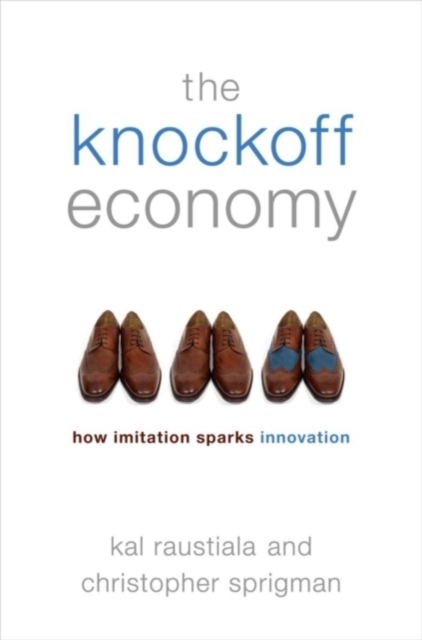
The Knockoff Economy
From the shopping mall to the corner bistro, knockoffs are everywhere in today's marketplace. Conventional wisdom holds that copying kills creativity, and that laws that protect against copies are essential to innovation—and economic success. But are copyrights and patents always necessary? This book argues that creativity can not only survive in the face of copying, but can thrive. The book approaches the question of incentives and innovation in a wholly new way—by exploring creative fields where copying is generally legal, such as fashion, food, and even professional football. By uncovering these important but rarely studied industries, the text reveals a nuanced and fascinating relationship between imitation and innovation. In some creative fields, copying is kept in check through informal industry norms enforced by private sanctions. In others, the freedom to copy actually promotes creativity. High fashion gave rise to the very term “knockoff,” yet the freedom to imitate great designs only makes the fashion cycle run faster—and forces the fashion industry to be even more creative. The book carries the analysis from food to font design to football plays to finance, examining how and why each of these vibrant industries remains innovative even when imitation is common. There is an important thread that ties all these instances together—successful creative industries can evolve to the point where they become inoculated against—and even profit from—a world of free and easy copying. And there are important lessons here for copyright-focused industries, like music and film, that have struggled as digital technologies have made copying increasingly widespread and difficult to stop.
eBook

The knockoff economy
\"Conventional wisdom holds that intellectual property rights are essential for innovation. But are copyright and patents really necessary to spark creativity? In The Knockoff Economy, Kal Raustiala and Christopher Sprigman provocatively argue that creativity can not only survive in the face of copying, but can thrive. The Knockoff Economy approaches the question of incentives and innovation in a wholly new way--by exploring creative fields that do not rely on legal monopolies, such as fashion, cuisine, and even professional football. By uncovering these important but rarely studied creative worlds, Raustiala and Sprigman reveal a nuanced and fascinating relationship between imitation and innovation. In some creative fields copying is kept in check through informal industry norms enforced by private sanctions. In other cases, the freedom to copy actually promotes creativity. High fashion gave rise to the very term \"knockoff,\" yet imitation only makes the fashion cycle run faster--and forces the fashion industry to be ever more creative. Raustiala and Sprigman carry their analysis from food to font design to football plays to finance, examining how and why each of these vibrant fields remains innovative, even in the face of sometimes-extensive imitation. There is an important thread that ties all these instances together--successful creative industries can evolve to be resistant to, and even to profit from, piracy. And there are important lessons here for copyright-focused industries, like music and film, that have struggled with piracy. Raustiala and Sprigman's arguments have been making headlines in The New Yorker, the New York Times, the Financial Times, the Boston Globe, Le Monde, and elsewhere. By looking where few had looked before--at industries that fall outside normal IP law--The Knockoff Economy opens up fascinating creative worlds. And it demonstrates that not only is a great deal of innovation possible without IP, but that IP's absence is sometimes better for innovation\"--
Book
Reform(aliz)ing Copyright
The recent debate between those who oppose the current trend of expanding the duration and breadth of copyright control over creative works and those who welcome it has focused on large and abstract questions. This article argues that a few relatively modest and realistically implementable changes to the copyright laws could help address some of the legitimate concerns of the copyright critics while preserving the basic structure of the law that copyright proponents argue has served us well.
Journal Article
Fix Prices Globally, Get Sued Locally? U.S. Jurisdiction over International Cartels
The American antitrust laws do not regulate the competitive conditions of other nations' economies. But it is well established that the Sherman Act reaches foreign conduct that was meant to produce and did in fact produce some substantial effect in the US. Yet just because a court may exercise jurisdiction over such conduct doesn't mean that it should in every instance. There are cases for which other nations should be bearing the burdens of enforcement, at least for the claims of their own nationals. The infirmities of the Supreme Court's opinion in Empagran make clear that the current one-dimensional test for subject matter jurisdiction cannot be solely relied upon to allocate responsibility. It is too early still to forecast the revival of a jurisdictional rule of reason, but the DC Circuit and other courts may be obliged by circumstances to begin a path back to the case-specific, comity-based analysis that the Supreme Court has slighted.
Journal Article