
Catalogue Search | MBRL


Are you sure you want to remove the book from the shelf?

{{itemTitle}}
6
result(s) for
"Standaert, N., author"
Sort by:


The Interweaving of Rituals
The death of the Italian Jesuit Matteo Ricci in China in 1610 was the occasion for demonstrations of European rituals appropriate for a Catholic priest and also of Chinese rituals appropriate to the country hosting the Jesuit community. Rather than burying Ricci immediately in a plain coffin near the church, according to their European practice, the Jesuits followed Chinese custom and kept Ricci's body for nearly a year in an air-tight Chinese-style coffin and asked the emperor for burial ground outside the city walls. Moreover, at Ricci's funeral itself, on their own initiative the Chinese performed their funerary rituals, thus starting a long and complex cultural dialogue in which they took the lead during the next century.
The Interweaving of Rituals explores the role of ritual - specifically rites related to death and funerals - in cross-cultural exchange, demonstrating a gradual interweaving of Chinese and European ritual practices at all levels of interaction in seventeenth-century China. This includes the interplay of traditional and new rituals by a Christian community of commoners, the grafting of Christian funerals onto established Chinese practices, and the sponsorship of funeral processions for Jesuit officials by the emperor. Through careful observation of the details of funerary practice, Nicolas Standaert illustrates the mechanics of two-way cultural interaction. His thoughtful analysis of the ritual exchange between two very different cultural traditions is especially relevant in today's world of global ethnic and religious tension. His insights will be of interest to a broad range of scholars, from historians to anthropologists to theologians.
eBook
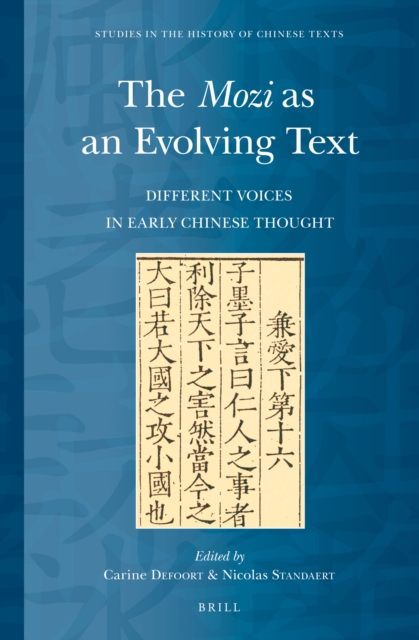
The Mozi As an Evolving Text
The book Mozi, named after master Mo, was compiled in the course of the fifth-third centuries BCE. The seven studies included in the The Mozi as an Evolving Text analyse the Core Chapters, Dialogues, and Opening Chapters of the Mozi as an evolving text.
eBook

The Intercultural Weaving of Historical Texts
In The Intercultural Weaving of Historical Texts Nicolas Standaert analyses an early case of \"intercultural historiography,\" in which various Chinese views on marvellous births are interwoven with their European interpretations in the seventeenth and eighteenth century.
eBook

Eurocentrisch Denken Voorbij
Didactische gids voor een brede blik in geschiedenisonderwijs In het geschiedenisonderwijs in Vlaanderen wordt nog al te vaak een eurocentrisch perspectief gehanteerd.Dit eurocentrisch denken stelt voorop dat de belangrijkste ontwikkelingen in de wereldgeschiedenis te vinden zijn in de evolutie van de Europese en Westerse wereld, en gebruikt het.
eBook

Eurocentrisch denken voorbij
Didactische gids voor een brede blik in geschiedenisonderwijs
In het geschiedenisonderwijs in Vlaanderen wordt nog al te vaak een eurocentrisch perspectief gehanteerd. Dit eurocentrisch denken stelt voorop dat de belangrijkste ontwikkelingen in de wereldgeschiedenis te vinden zijn in de evolutie van de Europese en Westerse wereld, en gebruikt het Westen als maatstaf om andere beschavingen te beoordelen. De eurocentrische blik is het resultaat van de polariserende wig die vanaf het begin van de Europese koloniale expansie werd gedreven tussen the West and the rest . Een eurocentrisch denkkader is uiterst problematisch. Het belemmert een genuanceerde historiografische blik om vanuit verschillende perspectieven historisch te denken. Daarnaast dreigt ook de onwetendheid over andere culturen de vorming van een superioriteitsgevoel over de eigen geschiedenis te bevorderen. Dit derde volume in de reeks Historisch denken presenteert inhoudelijk-didactische alternatieven en toont hoe eurocentrisme kan worden overstegen. Case studies over Chinees-Westerse en Belgisch-Congolese geschiedenis maken dit concreet.
Eurocentrisch denken voorbij is een aanrader voor geschiedenisleerkrachten en historici en al wie geïnteresseerd is in de relatie tussen Westerse en niet-Westerse geschiedenis en in denken over cultuur en cultuurverschillen.
eBook