
Catalogue Search | MBRL


Are you sure you want to remove the book from the shelf?

{{itemTitle}}
228
result(s) for
"Stanovich, Keith E."
Sort by:


The Cognitive Reflection Test as a predictor of performance on heuristics-and-biases tasks
The Cognitive Reflection Test (CRT; Frederick,
2005
) is designed to measure the tendency to override a prepotent response alternative that is incorrect and to engage in further reflection that leads to the correct response. In this study, we showed that the CRT is a more potent predictor of performance on a wide sample of tasks from the heuristics-and-biases literature than measures of cognitive ability, thinking dispositions, and executive functioning. Although the CRT has a substantial correlation with cognitive ability, a series of regression analyses indicated that the CRT was a unique predictor of performance on heuristics-and-biases tasks. It accounted for substantial additional variance after the other measures of individual differences had been statistically controlled. We conjecture that this is because neither intelligence tests nor measures of executive functioning assess the tendency toward miserly processing in the way that the CRT does. We argue that the CRT is a particularly potent measure of the tendency toward miserly processing because it is a performance measure rather than a self-report measure.
Journal Article

Rationality and the reflective mind
\"In this book, Keith Stanovich attempts to resolve the Great Rationality Debate in cognitive science-the debate about how much irrationality to ascribe to human cognition. Stanovich shows how the insights of dual-process theory and evolutionary psychology can be combined to explain why humans are sometimes irrational even though they possess cognitive machinery of remarkable adaptiveness. Using a unique individual differences approach, Stanovich shows that to fully characterize differences in rational thinking, the traditional System 2 of dual-process theory must be partitioned into the reflective mind and the algorithmic mind. He posits that we need to supersede dual-process theories with tripartite models of cognition. The key operations of the algorithmic mind and the reflective mind that support human rationality are discussed in the book. The key function of the algorithmic mind is to sustain the processing of decoupled secondary representations in cognitive simulation. The key function of the reflective mind, in contrast, is to detect the need to interrupt autonomous processing and to begin simulation activities. Stanovich uses the algorithmic/reflective distinction to develop a taxonomy of cognitive errors that are made on tasks in the heuristics and biases literature. He presents empirical data to show that the tendency to make these thinking errors is only modestly related to intelligence. Using the new tripartite model of mind, Stanovich shows how rationality is a more encompassing construct than intelligence-when both are properly defined-and that IQ tests fail to assess individual differences in rational thought. Stanovich discusses the types of thinking processes that would be measured in an assessment of rational thinking\"--Provided by publisher.
Book

Actively Open-Minded Thinking and Its Measurement
Actively open-minded thinking (AOT) is measured by items that tap the willingness to consider alternative opinions, sensitivity to evidence contradictory to current beliefs, the willingness to postpone closure, and reflective thought. AOT scales are strong predictors of performance on heuristics and biases tasks and of the avoidance of reasoning traps such as superstitious thinking and belief in conspiracy theories. Nevertheless, AOT is most commonly measured with questionnaires rather than performance indicators. Questionnaire contamination becomes even more of a danger as the AOT concept is expanded into new areas such as the study of fake news, misinformation, ideology, and civic attitudes. We review our 25-year history of studying the AOT concept and developing our own AOT scale. We present a 13-item scale that both is brief and accommodates many previous criticisms and refinements. We include a discussion of why AOT scales are such good predictors of performance on heuristics and biases tasks. We conclude that it is because such scales tap important processes of cognitive decoupling and decontextualization that modernity increasingly requires. We conclude by discussing the paradox that although AOT scales are potent predictors of performance on most rational thinking tasks, they do not predict the avoidance of myside thinking, even though it is virtually the quintessence of the AOT concept.
Journal Article
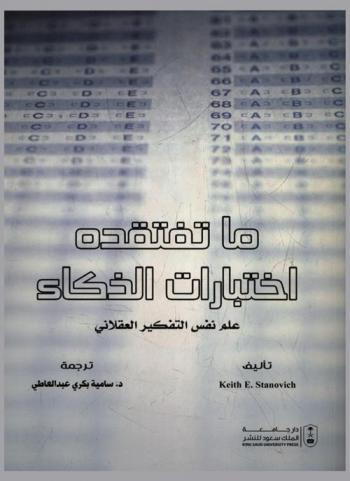
ما تفتقده اختبارات الذكاء : علم نفس التفكير العقلاني
وقد جاءت \"كيث ستانوفيتش\" بمؤلفها الحالي الذي يعد من أكثر الكتب رواجا على مستوى العالم في السنوات الأخيرة لتضيف أفتقاد تلك الأختبارات ما هو أهم في المجال المعرفي إذ تؤكد على أن أختبارات الذكاء إنما هي مقاييس غير كاملة للوظيفة المعرفية لإهمالها قياس مهارات التفكير العقلاني التي تعد مساوية في أهميتها للقدرات التي تقيسها هذه الأختبارات. إن الشخص الذكي وفقا لأختبارات الذكاء التقليدية قد لا يتسم بمهارات التفكير الجيد كالحكم واتخاذ القرارات وفقا لوجهة نظر ستانوفيتش التي تستعرض مبرراتها.
Book

What Intelligence Tests Miss
Critics of intelligence tests-writers such as Robert Sternberg, Howard Gardner, and Daniel Goleman-have argued in recent years that these tests neglect important qualities such as emotion, empathy, and interpersonal skills. However, such critiques imply that though intelligence tests may miss certain key noncognitive areas, they encompass most of what is important in the cognitive domain. In this book, Keith E. Stanovich challenges this widely held assumption.
Stanovich shows that IQ tests (or their proxies, such as the SAT) are radically incomplete as measures of cognitive functioning. They fail to assess traits that most people associate with \"good thinking,\" skills such as judgment and decision making. Such cognitive skills are crucial to real-world behavior, affecting the way we plan, evaluate critical evidence, judge risks and probabilities, and make effective decisions. IQ tests fail to assess these skills of rational thought, even though they are measurable cognitive processes. Rational thought is just as important as intelligence, Stanovich argues, and it should be valued as highly as the abilities currently measured on intelligence tests.
eBook
ما تفتقده اختبارات الذكاء : علم نفس التفكير العقلاني
وقد جاءت \"كيث ستانوفيتش\" بمؤلفها الحالي الذي يعد من أكثر الكتب رواجا على مستوى العالم في السنوات الأخيرة لتضيف أفتقاد تلك الأختبارات ما هو أهم في المجال المعرفي إذ تؤكد على أن أختبارات الذكاء إنما هي مقاييس غير كاملة للوظيفة المعرفية لإهمالها قياس مهارات التفكير العقلاني التي تعد مساوية في أهميتها للقدرات التي تقيسها هذه الأختبارات. إن الشخص الذكي وفقا لأختبارات الذكاء التقليدية قد لا يتسم بمهارات التفكير الجيد كالحكم واتخاذ القرارات وفقا لوجهة نظر ستانوفيتش التي تستعرض مبرراتها.
BOOK

Mind, rationality, and cognition: An interdisciplinary debate
This article features an interdisciplinary debate and dialogue about the nature of mind, perception, and rationality. Scholars from a range of disciplines-cognitive science, applied and experimental psychology, behavioral economics, and biology-offer critiques and commentaries of a target article by Felin, Koenderink, and Krueger (2017): \"Rationality, Perception, and the All-Seeing Eye,\" Psychonomic Bulletin & Review. The commentaries raise a number of criticisms and issues concerning rationality and the all-seeing-eye argument, including the nature of judgment and reasoning, biases versus heuristics, organism-environment relations, perception and situational construal, equilibrium analysis in economics, efficient markets, and the nature of empirical observation and the scientific method. The debated topics have far-reaching consequences for the rationality literature specifically, as well as for the cognitive, psychological, and economic sciences more broadly. The commentaries are followed by a response from the authors of the target article. Their response is organized around three central issues: (1) the problem of cues; (2) what is the question?; and (3) equilibria, $500 bills, and the axioms of rationality.
Journal Article

How to Think Rationally about World Problems
I agree with the target essay that psychology has something to offer in helping to address societal problems. Intelligence has helped meliorate some social problems throughout history, including the period of time that is covered by the Flynn effect, but I agree with Sternberg that other psychological characteristics may be contributing as well, particularly increases in rationality. I also believe that increasing human rationality could have a variety of positive societal affects at levels somewhat smaller in grain size than the societal problems that Sternberg focuses on. Some of the societal problems that Sternberg lists, however, I do not think would be remedied by increases in rationality, intelligence, or wisdom, because remedy might be the wrong word in the context of these issues. Issues such as how much inequality of income to tolerate, how much pollution to tolerate, and how much we should sacrifice economic growth for potential future changes in global temperature represent issues of clashing values, not the inability to process information, nor the lack of information, nor the failure to show wisdom.
Journal Article