
Catalogue Search | MBRL


Are you sure you want to remove the book from the shelf?

{{itemTitle}}
14
result(s) for
"Stanton, Neville A. (Neville Anthony), 1960-"
Sort by:


Modelling Command and Control
Command and control environments continue to represent a challenging domain for human factors research. Modelling Command and Control takes a broad view of command and control research, to include C2 (command and control), C3 (command, control and communication), and C4 (command, control, communication and computers) as well as human supervisory control paradigms. The book presents case studies in diverse military applications (e.g. land, sea and air) of command and control. While the domains of application are very different, many of the challenges they face share interesting similarities.
eBook


The Human Factors of Fratricide
Using case studies from the military domain, this book presents and validates a model of teamwork and decision-making factors associated with incidents of fratricide. It offers a review and evaluation of contemporary theoretical perspectives as well as a range of accident analysis approaches. The book also presents a novel theory of fratricide and a new methodology for assessing it.
eBook


Digitising Command and Control
This book presents a human factors and ergonomics evaluation of a digital Mission Planning and Battle-space Management (MP/BM) system. It emphasises the activities at the Brigade (Bde) and the Battle Group (BG) headquarters (HQ) levels, with the analysts distributing their time evenly between these two locations. The book concludes with a summary of the research project's findings. It looks forward to the next generation digital MP/BM systems and in so doing considers the human factors issues in digitising mission planning.
eBook

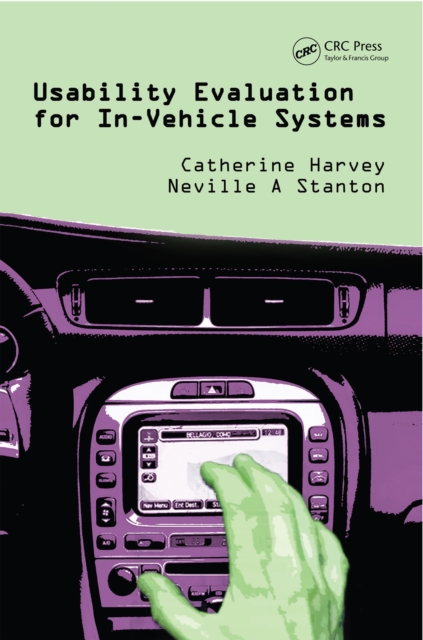
Usability Evaluation for In-Vehicle Systems
This book presents a process which will support the evaluation and modeling of driver-interface interactions in a dual-task driving context. This process consists of a framework of methods which can be used to evaluate and model the usability of In-Vehicle information Systems (IVIS). The book's focus on design and evaluation of IVIS, coupled with a systems approach to the concept of usability, sets it apart. This method presents both an autopsy and diagnostic approach to investigating usability in IVIS.
eBook

Human factors on the flight deck : a practical guide for design, modelling and evaluation
\"This book presents the Human Factors methodologies and applications thereof that can be utilized across the design, modeling and evaluation stages of the design lifecycle of new technologies entering future commercial aircraft. As advances are made to the architecture of commercial aircraft cockpits, Human Factors on the Flight Deck argues that it is vitally important that these new interfaces are safely incorporated and designed in a way that is usable to the pilot. Incorporation of Human Factors is essential to ensuring that engineering developments to avionic systems are integrated such that pilots can maintain safe interactions while gaining information of value. Case study examples of various technological advancements during their early conceptual stages are given throughout to highlight how the methods and processes can be applied across each stage. The text will be useful for professionals, graduate students, and academic researchers in the fields of aviation, human factors, and ergonomics\"-- Provided by publisher.
Book

Human Factors and Ergonomics in Consumer Product Design
Every day we interact with thousands of consumer products. We not only expect them to perform their functions safely, reliably, and efficiently, but also to do it so seamlessly that we dont even think about it. However, with the many factors involved in consumer product design, from the application of human factors and ergonomics principles to reducing risks of malfunction and the total life cycle cost, well, the process just seems to get more complex. Edited by well-known and well-respected experts, the two-volumes of Handbook of Human Factors and Ergonomics in Consumer Product Design simplify this process.
The first volume, Human Factors and Ergonomics in Consumer Product Design: Methods and Techniques, outlines the how to incorporate Human Factors and Ergonomics (HF/E) principles and knowledge into the design of consumer products in a variety of applications. It discusses the user-centered design process, starting with how mental workload affects every day interactions with consumer products and what lessons may be applied to product design. The book then highlights the ever-increasing role of information technology, including digital imaging, video and other media, and virtual reality applications in consumer product design. It also explores user-centered aspect of consumer product development with discussions of user-centered vs. task-based approach, articulation and assessment of user requirements and needs, interaction with design models, and eco design.
With contributions from a team of researchers from 21 countries, the book covers the current state of the art methods and techniques of product ergonomics. It provides an increased knowledge of how to apply the HF/E principles that ultimately leads to better product design.
eBook