
Catalogue Search | MBRL


Are you sure you want to remove the book from the shelf?

{{itemTitle}}
10
result(s) for
"Staten, Clifford L"
Sort by:

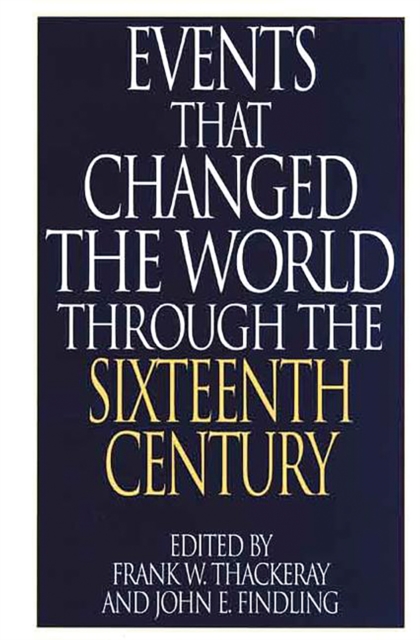
Events That Changed the World Through the Sixteenth Century
Except for the twentieth century, the period from the late Middle Ages through the sixteenth century witnessed the most significant developments in the history of the world. From the expulsion of the Muslims from Spain, through the flowering of the Renaissance, the religious strife of the Reformation, and the attempts by great empires to conquer their own continent and expand into the New World, the enormous political, religious, and social change took place on every continent of the globe are examined. These events and their impact have been carefully described and analyzed in this useful student resource. The events covered are: the Reconquista in Spain, the Renaissance, the Hundred Years' War, the Ming Dynasty Comes to Power, the Age of European Expansion Begins, the Development of Movable Type, the Fall of Constantinople, the Conquest of the New World, the Protestant Reformation, and the Spanish Armada. An introductory essay provides factual material about the event in a clear, concise, and chronological manner that makes complex history understandable. An interpretive essay, written by a recognized authority in the field, explores the short-term and long-term ramifications of the event. Each chapter concludes with a helpful annotated bibliography of further reading. A glossary, timeline of events, and table of ruling houses and dynasties across the globe provide additional reference value. Events That Changed the World Through the Sixteenth Century is an ideal addition to the high school, community college, and undergraduate reference shelf, as well as excellent supplementary reading for social studies and world history courses.
eBook

The history of Cuba
\"A thorough examination of the history of Cuba, focusing primarily on the period from the revolution in 1959 to the present day\"-- Provided by publisher.
Book

Teaching the First Amendment to 7th and 8th Graders
Describes a five-day instructional unit designed for seventh and eighth graders about the First Amendment to the U.S. Constitution. Points out that the individual rights in the First Amendment often conflict with the rights of the majority. Provides student questions and suggestions for resources and activities. (CFR)
Magazine Article

Vitamin D Supplementation and Prevention of Type 2 Diabetes
Observational studies suggest an association between a low 25-hydroxyvitamin D level and the risk of type 2 diabetes; whether vitamin D supplements reduce the risk is unknown. In this trial in which high-risk persons received either vitamin D
3
(4000 IU per day) or placebo, such supplementation did not significantly decrease the risk of type 2 diabetes.
Journal Article

Safety and tolerability of high-dose daily vitamin D3 supplementation in the vitamin D and type 2 diabetes (D2d) study—a randomized trial in persons with prediabetes
Background/ObjectivesRoutine use of vitamin D supplements has increased substantially in the United States. However, the safety and tolerability of long-term use of high-dose vitamin D are not known. We assessed the safety and tolerability of high-dose, daily vitamin D3 in the vitamin D and type 2 diabetes (D2d) study.Subjects/MethodsIn total, 2423 overweight/obese persons with prediabetes were randomized in a double-blind manner to either 4000 IU of vitamin D3 (the tolerable upper intake level for adults by the National Academy of Medicine) taken daily or matching placebo. All participants were included in this analysis. Incident adverse events (AE) were ascertained 4 times a year at in-person visits (twice a year) and interim remote encounters (twice a year) and were defined as untoward or unfavorable medical occurrences. Serious adverse events (SAE) included death, life-threatening events, and hospitalizations.ResultsA total of 8304 AEs occurred during 3 years of follow-up and were less frequent in the vitamin D group compared to placebo (Incidence Rate Ratio [IRR] = 0.94; 95% Confidence Interval (CI) 0.90, 0.98). The overall frequency of protocol-specified AEs of interest, which included nephrolithiasis, hypercalcemia, hypercalciuria, or low estimated glomerular filtration rate, was low and did not differ by group. There were no significant between-group differences in total SAEs (IRR = 0.96 (0.81, 1.14)).ConclusionVitamin D3 supplementation at 4000 IU per day was safe and well tolerated among overweight/obese participants at high risk for diabetes who were appropriately monitored for safety. In this population, this dose of vitamin D3 did not increase risk of AEs or SAEs, including those previously associated with vitamin D such as hypercalcemia, hypercalciuria, or nephrolithiasis.Clinical Trial RegistrationClinicalTrials.gov NCT01942694, prospectively registered September 16, 2013
Journal Article

Theodore Roosevelt: Dual and Cooperative Federalism
In this article it is argued that it is misleading to characterize Theodore Roosevelt's administration simply as one of dual federalism. Federalism during his administration must be viewed from both the dual and cooperative perspectives. The Supreme Court's dual federalism created an environment conducive to industrialization and modernization. The problems inherent in industrialization and modernization necessitated a cooperative, intergovernmental approach to their solutions. Dual federalism and cooperative federalism were intertwined. Theodore Roosevelt and his stewardship view of the Presidency played a major role in the promotion and establishment of cooperative federalism at the turn of the century. This study of Theodore Roosevelt's administration serves as an initial link between Daniel Elazar's (1968) classic study of 19th century federalism and Jane Perry Clark's (1938) classic study of intergovernmental relations during the first few years of Franklin Roosevelt's administration.
Journal Article