
Catalogue Search | MBRL


Are you sure you want to remove the book from the shelf?

{{itemTitle}}
911
result(s) for
"Stephens, William"
Sort by:

Comparing the cancer potencies of emissions from vapourised nicotine products including e-cigarettes with those of tobacco smoke
BackgroundQuantifying relative harm caused by inhaling the aerosol emissions of vapourised nicotine products compared with smoking combustible tobacco is an important issue for public health.MethodsThe cancer potencies of various nicotine-delivering aerosols are modelled using published chemical analyses of emissions and their associated inhalation unit risks. Potencies are compared using a conversion procedure for expressing smoke and e-cigarette vapours in common units. Lifetime cancer risks are calculated from potencies using daily consumption estimates.ResultsThe aerosols form a spectrum of cancer potencies spanning five orders of magnitude from uncontaminated air to tobacco smoke. E-cigarette emissions span most of this range with the preponderance of products having potencies<1% of tobacco smoke and falling within two orders of magnitude of a medicinal nicotine inhaler; however, a small minority have much higher potencies. These high-risk results tend to be associated with high levels of carbonyls generated when excessive power is delivered to the atomiser coil. Samples of a prototype heat-not-burn device have lower cancer potencies than tobacco smoke by at least one order of magnitude, but higher potencies than most e-cigarettes. Mean lifetime risks decline in the sequence: combustible cigarettes >> heat-not-burn >> e-cigarettes (normal power)≥nicotine inhaler.ConclusionsOptimal combinations of device settings, liquid formulation and vaping behaviour normally result in e-cigarette emissions with much less carcinogenic potency than tobacco smoke, notwithstanding there are circumstances in which the cancer risks of e-cigarette emissions can escalate, sometimes substantially. These circumstances are usually avoidable when the causes are known.
Journal Article
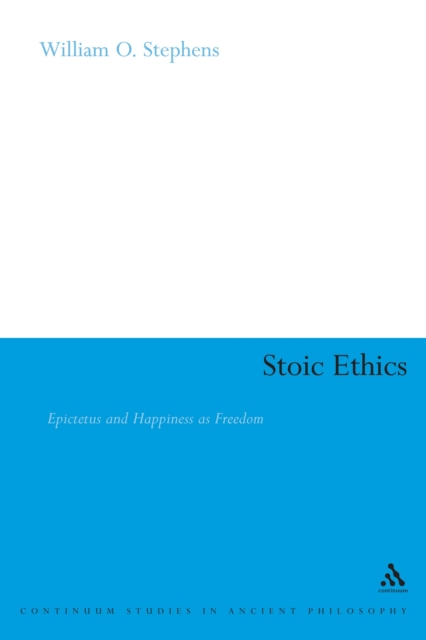
Stoic ethics : Epictetus and happiness as freedom
Soon after Aristotle's death, several schools of ancient philosophy arose, each addressing the practical question of how to live a good, happy life. The two biggest rivals, Stoicism and Epicureanism, came to dominate the philosophical landscape for the next 500 years. Epicureans advised pursuing pleasure to be happy, and Stoics held that true happiness could only be achieved by living according to nature, which required accepting what happens and fulfilling one's roles. Stoicism, more than Epicureanism, attracted followers from many different walks of life: slaves, laborers, statesmen, intellectuals, and an emperor. The lasting impact of these philosophies is seen from the fact that even today 'Stoic' and 'Epicurean' are household words. Although very little of the writings of the early Stoics survive, our knowledge of Stoicism comes largely from a few later Stoics. In this unique book, William O. Stephens explores the moral philosophy of Epictetus, a former Roman slave and dynamic Stoic teacher whose teachings are the most compelling defense of ancient Stoicism that exists. Epictetus' philosophy dramatically captures the spirit of Stoicism by examining and remedying our greatest human disappointments, such as the death of a loved one. Stephens shows how, for Epictetus, happiness results from focusing our concern on what is up to us while not worrying about what is beyond our control. He concludes that the strength of Epictetus' thought lies in his conception of happiness as freedom from fear, worry, grief, and dependence upon luck.
eBook

How Might a Stoic Eat in Accordance with Nature and “Environmental Facts”?
This paper explores how to deliberate about food choices from a Stoic perspective informed by the value of environmental sustainability. This perspective is reconstructed from both ancient and contemporary sources of Stoic philosophy. An account of what the Stoic goal of “living in agreement with Nature” would amount to in dietary practice is presented. Given ecological facts about food production, an argument is made that Stoic virtue made manifest as wisdom, justice, courage, and temperance compel Stoic practitioners to select locally sourced, low resource input, plant-based foods whenever circumstances allow.
Journal Article

ROTC Outreach Done Right
Launched by the Judge Advocate Recruiting Office (JARO) in 2018, this initiative educates cadets about the JAG Corps's mission and emphasizes the opportunity to become a judge advocate (JA) through the ROTC Educational (Ed) Delay Program and the Funded Legal Education Program (FLEP).2 Offices of the Staff Judge Advocate (OSJAs) are responsible for conducting outreach events with assigned Army ROTC battalions in their region; and, they have wide latitude to shape these engagements. If you are an active component JA, invite a U.S. Army Reserve (USAR) or Army National Guard (ARNG) JA to speaking engagements-or vice versa-and coordinate the timing of the speaking engagements with these other service component elements in your area.6 The U.S. Army Reserve Legal Command (USARLC) has twenty-eight legal operations detachments (LODs) throughout the country; their teams are dispersed throughout the community.7 The U.S Army Reserve Command has over 1,800 attorneys and paralegals dispersed throughout the country who are working in embedded slots. To expand on the theme of \"Be Ready,\" consider explaining how the JAG Corps quickly adapted to battle the novel coronoavirus pandemic while transforming to conduct future multi-domain operations against a near-peer adversary.13 You could also highlight the related Battlefield Next podcast hosted by the Future Concepts Directorate at The Judge Advocate General's Legal Center and School.14 Although the pay and benefits of joining the JAG Corps maybe of slight interest to ROTC cadets, it should be mentioned. If you are trying to ensure the juniors are in the potential population of candidates, you should either speak to them earlier in the academic year or focus on first- or second-year students when discussing the educational delay program.15 For seniors, you should switch your topics of discussion to the FLEP program or provide information on how to join the Reserve Component and pursue a law degree while serving in the military.
Journal Article

Arranging Resilience
Increasingly, teachers, youth workers, and social workers are being called on to 'build resilience to radicalisation'.But, what does this actually mean?What is resilience to radicalisation, how can it be built, and whose role is it?.
eBook
We Didn't Start the Fire: A Primer on Mutual Aid Agreements for Fire Suppression Services
Evolutionary History of Mutual Aid Agreements Prior to the enactment of Title 42 of the United States Code, Section 1856a6 in 1955, federal facilities could not expend appropriated funds for the purpose of fighting fires outside of federal reservations unless federal property was endangered. [...]federal agencies were prohibited from entering into MAAs with any non-federal firefighting units or organizations.7 Congress enacted 42 U.S.C. § 1856a to remedy this situation and enable the \"federal government to provide maximum fire protection for its installations and activities throughout the world at a minimum cost by utilizing local civilian fire protection personnel and facilities on a reciprocal basis. [...]these agreements can also help jurisdictions to coordinate planning,11 ensure timely arrival of aid,12 increase a department's ability to respond to a large scale or complex incident,13 and arrange for specialized resources.14 This is key for many Army installations that do not have the capability to respond to extraordinary events requiring aerial fire suppression or involving hazardous material or chemical warfare. While not specifically addressed, the language of the statute clearly contemplates the use of cascading MAAs as a mechanism for reciprocal fire support with local municipalities.19 Additionally, DoD policy permits installations and civilian fire departments to set their own parameters regarding mutual aid. 20 Difference Between Mutual Aid Agreements and Other Legal Authorities It is important to note that the MAA process is separate and distinct from the assistance provided under DSCA or the immediate response authority. In the absence of an MAA, installation commanders are authorized to render emergency assistance to preserve life and property in the vicinity of a DoD installation when, in their opinion, such assistance is in the best interest of the United States.21 This assistance can be provided under immediate response authorities22 or emergency response authorities,23 as described in 32 Code of Federal Regulations (CFR) Part 185.4 and Department of Defense Directive (DoDD) 3025.18.24 However, any assistance provided under these authorities must end when the necessity giving rise to the response is no longer present, or within seventy-two hours, whichever comes first.
Journal Article

On Being a Good Neighbor, or Things I Learned in the Field
This article explores the possibility of anthropology as Bildung, or self-cultivation. As an educational mode, Bildung is focused on the moral education of students, encouraging them to broaden themselves in their encounters with others. I will discuss this process in terms of a lesson I learned from the highland Maya about being a good neighbor and will demonstrate how neighborliness can offer students a possibility for their own self-cultivation.
Journal Article

Refugees, Stoicism and cosmic Citizenship
The Roman imperial Stoics were familiar with exile. I argue that the Stoics’ view of being a refugee differed sharply from their view of what is owed to refugees. A Stoic adopts the perspective of a cosmopolitēs, a ‘citizen of the world’, a rational being everywhere at home in the universe. Virtue can be cultivated and practiced in any locale, so being a refugee is an ‘indifferent’ that poses no obstacle to happiness. But other people are our fellow cosmic citizens regardless of their language, race, ethnicity, customs, or country of origin. Our natural affinity and shared sociability with all people require us to help refugees and embrace them as welcome neighbors. Failure to do so violates our common reason, justice, and the gods’ cosmic law.
Journal Article

Chemometric and trace element profiling methodologies for authenticating, crossmatching and constraining the provenance of illicit tobacco products
BackgroundIllicit tobacco products have a disproportionately negative effect on public health. Counterfeits and cheap whites as well as legal brands smuggled from countries not adopting track and trace technologies will require novel forensic tools to aid the disruption of their supply chains.MethodsData sets of trace element concentrations in tobacco were obtained using X-ray fluorescence spectrometry on samples of legal and illicit products mainly from Europe. Authentic and counterfeit products were discriminated by identifying outliers from data sets of legal products using Mahalanobis distance and graphical profiling methods. Identical and closely similar counterfeits were picked out using Euclidean distance, and counterfeit provenance was addressed using chemometric methods to identify geographical affinities.ResultsTaking Marlboro as an exemplar, the major brands are shown to be remarkably consistent in composition, in marked contrast to counterfeits bearing the same brand name. Analysis of 35 illicit products seized in the European Union (EU) indicates that 18 are indistinguishable or closely similar to Marlboro legally sold in the EU, while 17 are sufficiently different to be deemed counterfeit, among them being 2 counterfeits so closely similar that their tobaccos are likely to come from the same source. The tobacco in the large majority of counterfeits in this data set appears to originate in Asia.ConclusionsMultivariate and graphical analysis of trace elements in tobacco can effectively authenticate brands, crossmatch illicit products across jurisdictions and may identify their geographical sources.
Journal Article