
Catalogue Search | MBRL


Are you sure you want to remove the book from the shelf?

{{itemTitle}}
462
result(s) for
"Sterling, Bruce"
Sort by:


Slipstream 2
Sterling provides some of his original ideas about slipstream. Science fiction can't challenge slipstream for the cultural territory that slipstream would most like to have. Slipstream's real enemy is mainstream literature, because that's the dominant narrative that they would most like to become, and that's what they're unable to become, almost by definition. One thing that is problematic for slipstream: being based in quote, Theory, unquote, it has a very hard time taking creative effort seriously.
Journal Article

Hunting and mountain sheep: Do current harvest practices affect horn growth?
The influence of human harvest on evolution of secondary sexual characteristics has implications for sustainable management of wildlife populations. The phenotypic consequences of selectively removing males with large horns or antlers from ungulate populations have been a topic of heightened concern in recent years. Harvest can affect size of horn‐like structures in two ways: (a) shifting age structure toward younger age classes, which can reduce the mean size of horn‐like structures, or (b) selecting against genes that produce large, fast‐growing males. We evaluated effects of age, climatic and forage conditions, and metrics of harvest on horn size and growth of mountain sheep (Ovis canadensis ssp.) in 72 hunt areas across North America from 1981 to 2016. In 50% of hunt areas, changes in mean horn size during the study period were related to changes in age structure of harvested sheep. Environmental conditions explained directional changes in horn growth in 28% of hunt areas, 7% of which did not exhibit change before accounting for effects of the environment. After accounting for age and environment, horn size of mountain sheep was stable or increasing in the majority (~78%) of hunt areas. Age‐specific horn size declined in 44% of hunt areas where harvest was regulated solely by morphological criteria, which supports the notion that harvest practices that are simultaneously selective and intensive might lead to changes in horn growth. Nevertheless, phenotypic consequences are not a foregone conclusion in the face of selective harvest; over half of the hunt areas with highly selective and intensive harvest did not exhibit age‐specific declines in horn size. Our results demonstrate that while harvest regimes are an important consideration, horn growth of harvested male mountain sheep has remained largely stable, indicating that changes in horn growth patterns are an unlikely consequence of harvest across most of North America.
Journal Article

Futility and resistance
Issue Title: Special Issue on Science Fiction and Ubiquitous Computing / Special Issue on User-centric ambient information systems and applications / Special Issue on IIKI2012
Journal Article

I Must Not Think Bad Thoughts
From the cultural criticWiredcalled \"provocative and cuttingly humorous\" comes a viciously funny, joltingly insightful collection of drive-by critiques of contemporary America where chaos is the new normal. Exploring the darkest corners of the national psyche and the nethermost regions of the self-the gothic, the grotesque, and the carnivalesque-Mark Dery makes sense of the cultural dynamics of the American madhouse early in the twenty-first century.
Here are essays on the pornographic fantasies ofStar Trekfans, Facebook as Limbo of the Lost, George W. Bush's fear of his inner queer, the theme-parking of the Holocaust, the homoerotic subtext of the Super Bowl, the hidden agendas of IQ tests, Santa's secret kinship with Satan, the sadism of dentists, Hitler's afterlife on YouTube, the sexual identity of2001's HAL, the suicide note considered as a literary genre, the surrealist poetry of robot spam, the zombie apocalypse, Lady Gaga, the Church of Euthanasia, toy guns in the dream lives of American boys, and the polymorphous perversity of Madonna's big toe.
Dery casts a critical eye on the accepted order of things, boldly crossing into the intellectual no-fly zones demarcated by cultural warriors on both sides of America's ideological divide: controversy-phobic corporate media, blinkered academic elites, and middlebrow tastemakers. Intellectually omnivorous and promiscuously interdisciplinary, Dery's writing is a generalist's guilty pleasure in an age of nanospecialization and niche marketing. From Menckenesque polemics on American society and deft deconstructions of pop culture to unflinching personal essays in which Dery turns his scalpel-sharp wit on himself,I Must Not Think Bad Thoughtsis a head-spinning intellectual ride through American dreams and American nightmares.
eBook

SHAPING THINGS
\"Shaping Things is about created objects and the environment, which is to say, it's about everything,\" writes Bruce Sterling in this addition to the Mediawork Pamphlet series. He adds: \"Seen from sufficient distance, this is a small topic.\"Sterling offers a brilliant, often hilarious history of shaped things. We have moved from an age of artifacts, made by hand, through complex machines, to the current era of \"gizmos.\" New forms of design and manufacture are appearing that lack historical precedent, he writes; but the production methods, using archaic forms of energy and materials that are finite and toxic, are not sustainable. The future will see a new kind of object; we have the primitive forms of them now in our pockets and briefcases: user-alterable, baroquely multi-featured, and programmable, that will be sustainable, enhanceable, and uniquely identifiable. Sterling coins the term \"spime\" for them, these future-manufactured objects with informational support so extensive and rich that they are regarded as material instantiations of an immaterial system. Spimes are designed on screens, fabricated by digital means, and precisely tracked through space and time. They are made of substances that can be folded back into the production stream of future spimes, challenging all of us to become involved in their production. Spimes are coming, says Sterling. We will need these objects in order to live; we won't be able to surrender their advantages without awful consequences.The vision of Shaping Things is given material form by the intricate design of Lorraine Wild. Shaping Things is for designers and thinkers, engineers and scientists, entrepreneurs and financiers; and anyone who wants to understand and be part of the process of technosocial transformation.
eBook


What's in a Credo? A Critique of the Academy of Management's Code of Ethical Conduct and Code of Ethics
The Academy of Management formally adopted a Code of Ethical Conduct in 1990. During the subsequent 15 years, almost nothing had been published about it and its value as a formal document meant to guide professional practice. Rather surprisingly then, in December 2005 an entirely new Code of Ethics was introduced by the Academy's Board, to take effect in February 2006. Why was a new code promulgated? More broadly, what do the contents of these codes, the processes of their promulgation, and their expressed purposes, suggest about the value of such codes for similarly situated professional associations, in general? This article seeks to identify key strengths and weaknesses of the original code, begin an assessment of the potential value of the new code, and so stimulate debate. Further, not only is this a call to the members of the Academy to engage in some thoughtful debate and possible amendment of its new code, but also a caution to all such associations to take seriously the hurdles that must be jumped before any code can be developed and promulgated to worthwhile effect.
Journal Article
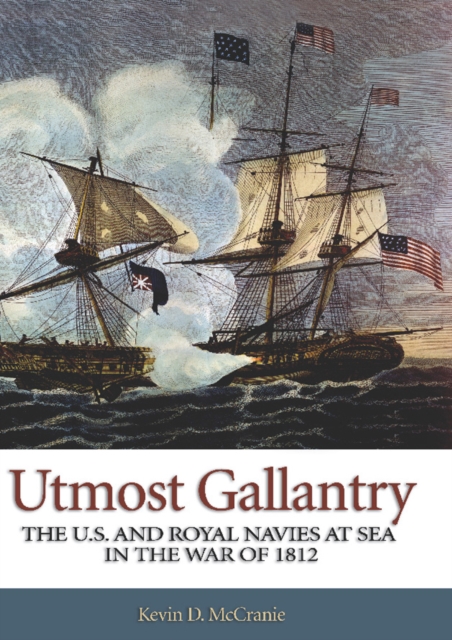
Utmost gallantry : the U.S. and Royal Navies at sea in the War of 1812
Focusing on the oceanic war rather than the war in the Great Lakes, this study charts the War of 1812 from the perspectives of the two opposing navies at seaone of the largest fleets in the world and a small, upstart navy just three decades old. While American naval leadership searched for a means of contesting Britains naval dominance, the English sought to destroy the U.S. Navy and protect its oceanic highways. Instead of describing battles between opposing warships, McCranie evaluates entire cruises by American and British men-of-war, noting both successes and failures and how they translated into broader strategies. In the process, his study becomes a history of how the two navies fought the oceanic war, linking high-level governmental decisions about strategy to the operational use of fleets in the Atlantic and Caribbean and from the South Pacific to the Indian Ocean.Unlike other books on the subject, this work offers a balanced appraisal of the oceanic war on the high seas, taking into account the strategic considerations of both combatants and how the leadership from each side assessed, planned, and implemented operational concepts. Drawing on a wealth of British and American archival sources, McCranie guides the reader through the strategic decision making processes on both sides of the Atlantic. He demonstrates vividly the impact of those decisions on the course of the war at sea, where the contest was close and deadly. Indeed, the authors action-packed accounts of battles hold special appeal.This study offers a more balanced appraisal of the war than most studies of the topic. Particularly important is the stress on understanding British strategic imperatives and the correlation between these imperatives and why Britain conducted the oceanic naval war in the manner it did. This study focuses on all cruises of American warships, not just those that terminated in battles so as to provide a more complete history of the naval war.
eBook