
Catalogue Search | MBRL


Are you sure you want to remove the book from the shelf?

{{itemTitle}}
449
result(s) for
"Stern, Scott"
Sort by:


The State of American Entrepreneurship
Assessing the state of American entrepreneurship requires not simply counting the quantity but also the initial quality of new ventures. Combining comprehensive business registries and predictive analytics, we present estimates of entrepreneurial quantity and quality from 1988 to 2014. Rather than a secular pattern of declining business dynamism, our quality-adjusted measures follow a cyclical pattern sensitive to economic and capital market conditions. Consistent with the role of investment cycles as a driver of high-growth entrepreneurship, our results highlight the role of economic and institutional conditions as a driver of both initial entrepreneurial quality and the scaling of new ventures over time.
Journal Article


Where is Silicon Valley?
Forecasting and mapping entrepreneurial quality Although economists, politicians, and business leaders have long emphasized the importance of entrepreneurship ( 1 , 2 ), defining and characterizing entrepreneurship has been elusive ( 3 , 4 ). Researchers have been unable to systematically connect the type of high-impact entrepreneurship found in regions such as Silicon Valley with the overall incidence of entrepreneurship in the population ( 5 – 7 ). This has important implications: Researchers arrive at alternative conclusions about roles and patterns of entrepreneurship ( 8 – 10 ), and policy-makers are given conflicting recommendations about whether or how to promote entrepreneurship for economic and social progress ( 11 , 12 ).
Journal Article


Climbing atop the Shoulders of Giants: The Impact of Institutions on Cumulative Research
While cumulative knowledge production is central to growth, little empirical research investigates how institutions shape whether existing knowledge can be exploited to create new knowledge. This paper assesses the impact of a specific institution, a biological resource center, whose objective is to certify and disseminate knowledge. We disentangle the marginal impact of this institution on cumulative research from the impact of selection, in which the most important discoveries are endogenously linked to research-enhancing institutions. Exploiting exogenous shifts of biomaterials across institutional settings and employing a difference-in-differences approach, we find that effective institutions amplify the cumulative impact of individual scientific discoveries.
Journal Article


The Impact of Uncertain Intellectual Property Rights on the Market for Ideas: Evidence from Patent Grant Delays
This paper considers the impact of the intellectual property (IP) system on the timing of cooperation/licensing by start-up technology entrepreneurs. If the market for technology licenses is efficient, the timing of licensing is independent of whether IP has already been granted. In contrast, the need to disclose complementary (yet unprotected) knowledge, asymmetric information or search costs may retard efficient technology transfer. In these cases, reductions in uncertainty surrounding the scope and extent of IP rights may facilitate trade in the market for ideas. We employ a data set combining information about cooperative licensing and the timing of patent allowances (the administrative event when patent rights are clarified). Although preallowance licensing does occur, the hazard rate for achieving a cooperative licensing agreement significantly increases after patent allowance. Moreover, the impact of the patent system depends on the strategic and institutional environment in which firms operate. Patent allowance plays a particularly important role for technologies with longer technology life cycles or that lack alternative appropriation mechanisms such as copyright, reputation, or brokers. The findings suggest that imperfections in the market for ideas may be important, and that formal IP rights may facilitate gains from technological trade.
Journal Article
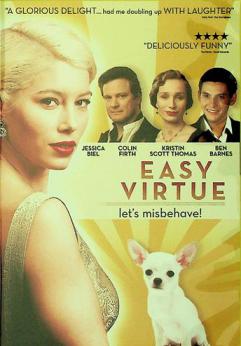
Easy virtue : let's misbehave!
A glamorous American woman enters into a spirited battle of wits with her disapproving English mother-in-law.
DVD

MORAL NUISANCE ABATEMENT STATUTES
On May 19, 2021, Texas enacted S.B. 8-also known as the Texas Heartbeat Act-which prohibits almost any abortion of a fetus once a heartbeat can be detected, effectively banning abortions after only six weeks of pregnancy. Just as controversially, S.B. 8 also specifies that it is enforceable exclusively through private civil actions, and it allows any private person to sue anyone who \"performs,\" \"induces,\" or \"knowingly . . . aids or abets the performance or inducement of an abortion,\" seeking injunctive relief and statutory damages of $10,000 per violation. The passage of S.B. 8 immediately led to calls for, and predictions of, copycat laws. Within weeks, legislators in several states had indicated their intent to pass identical bills, while others warned that the law's enforcement mechanism could be applied to a range of lawful activities, from gun possession to facilitation of same-sex marriage. Indeed, states have already passed laws enabling individuals to file suit against schools that teach \"critical race theory\" or refuse to exclude transgender students from bathrooms or athletics. Numerous legal scholars, judges, and commentators have decried this \"unprecedented\" enforcement mechanism, especially the creation of a private cause of action for uninjured individuals with no connection to the person seeking an abortion. Critics have likewise labeled as unprecedented the fact that S.B. 8 enables plaintiffs to file suit anywhere in Texas, denies defendants certain well-recognized affirmative defenses, compels losing defendants to pay plaintiffs' fees and costs, and provides a \"bounty\" for successful plaintiffs. In fact, the only truly unprecedented aspect of S.B. 8 is that it entirely displaces public enforcement with private enforcement. Virtually every other part of its enforcement scheme-the deputization of uninjured private citizens, the broad venue provision, the creation of civil \"bounties,\" the disallowance of certain defenses, and the provision for plaintiffs' fees and costs-enjoys ample precedent. Beginning in the nineteenth century and continuing throughout the twentieth, state legislatures across the country passed hundreds of laws enabling any private citizen, regardless of personal injury or interest, to bring suit to remedy a range of supposed social ills- from the sale of liquor to the sale of sex, from air and water pollution to the unlicensed practice of dentistry. Although these laws differed considerably, their hallmark was their empowerment of uninjured individuals to bypass state authorities and directly use the machinery of the courts to remedy something the legislature considered a harm to the public at large. In this Article, I argue that S.B. 8 is best understood as the latest of these laws, albeit taken to a new extreme in its foreclosure of any public enforcement. Drawing deeply on original archival research, this Article provides the first comprehensive history of these laws, which I call \"moral nuisance abatement statutes.\" The authors of these statutes took inspiration from the common law of public nuisance, but they eliminated its \"special injury\" requirement, instead allowing uninjured individuals to bring suit to abate so-called nuisances. Although citizen-suit provisions are common in state and federal statutes, moral nuisance abatement statutes go further than any other private enforcement schemes, not just by dispensing completely with the demand of injury but also by shifting burdens of proof, foreclosing common defenses, and providing financial incentives for plaintiffs-all in the name of more effectively attacking a supposed cancer on the commons. Moral nuisance abatement statutes-laws such as S.B. 8-are likely to spread. This Article thus historicizes these statutes, clarifying their past, claiming for them a significant present, and providing some clues to predict their future. The purpose of this analysis is not to minimize the real ways that S.B. 8 departs from earlier moral nuisance abatement statutes. Rather, its point is to identify these statutes as belonging to a common class, which better enables us to analyze their spread, impact, similarities, differences, and power.
Journal Article