
Catalogue Search | MBRL


Are you sure you want to remove the book from the shelf?

{{itemTitle}}
3
result(s) for
"Stevens, Martin, 1982- author"
Sort by:

Cheats and deceits : how animals and plants exploit and mislead
\"Stevens describes the remarkable range of ... adaptations in nature, and considers how they have evolved and increasingly been perfected as part of an arms race between predator and prey or host and parasite. He explores both classic and recent research of naturalists and biologists, showing how scientists find ways of testing the impact of particular behaviours and colourings on the animals it is meant to fool. Drawing on a wide range of examples, Stevens considers what deception tells us about the process of evolution and adaptation\"--Amazon.com.
Book

Sensory Ecology, Behaviour, and Evolution
Throughout their lives, animals must complete many tasks, from finding food, avoiding predators, and attracting mates to navigating through the environment. To do so, they must gather and use a range of information from the world around them and from other individuals. For this, animals have evolved a staggering diversity of sensory organs that are both fundamental to survival and reproduction and shape much of evolution and behaviour. Sensory ecology deals with how animals acquire, process, and use information in behaviour and many other aspects of their lives, and the importance of this in evolution. This book is an introduction to sensory ecology, covering the various sensory modalities across all taxonomic groups. Rather than treating each sensory modality separately, they are discussed together from a behavioural and evolutionary approach with the aim of illustrating key principles and differences across modalities and taxonomic groups. Not only does sensory ecology deal with how the senses work and their use in behaviour, but recent work has also dealt more with the role of sensory systems in evolutionary change, as well as new developments in molecular biology and phylogenetics. The book begins with an introduction to the concepts of information and behaviour, followed by a discussion of the sensory systems that exist, how they work, and features of nerve cells and circuits. It then discusses key issues in communication, and the role of sensory systems and information in larger scale evolutionary processes, such as coevolution and speciation. Throughout the book, examples are given from various modalities and taxonomic groups, relating to diverse areas ranging from anti-predator strategies, foraging, and mate choice to navigation.
eBook
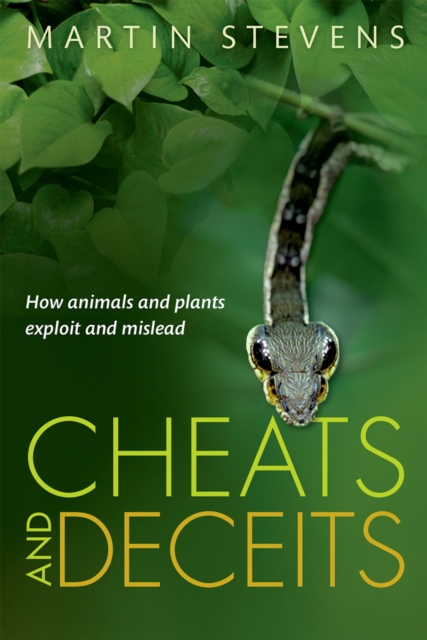
Cheats and Deceits
In Cheats and Deceits, Martin Stevens describes the remarkable range of adaptations in nature, and considers how they have evolved and increasingly been perfected as part of an arms race between predator and prey or host and parasite. He explores both classic and recent research of naturalists and biologists, showing how scientists find ways of testing the impact of particular behaviors and colorings on the animals it is meant to fool. Drawing on a wide range of examples, Stevens considers what deception tells us about the process of evolution and adaptation.--AMAZON.
eBook