
Catalogue Search | MBRL


Are you sure you want to remove the book from the shelf?

{{itemTitle}}
266
result(s) for
"Stewart, Garrett"
Sort by:


Organic Reformations in Richard Powers’s The Overstory
Richard Powers takes the literary concept of “organic form” to new exploratory lengths – and satellite heights – in his latest ecofiction. In particular, the novelist who has proselytized voice-recognition software for the dictation of novelistic prose offers with that advice an unexpected leverage on the structuring “understory” (the botanical term) for his Pulitzer Prize – winning novel The Overstory (2018). In both textual phonetics and mapped thematic links, marked patterns of recurrence are to prose, here as elsewhere, what rhyme and meter are to poetry. In a novel that seeks to attune us to the secret “semaphores” of forest life, such elicited traces of nonhuman signaling articulate a vital terrestrial network evoked through a scale of decoded pattern that, in developing its own stylistic echosystem, answers to the environing field of narrative action, and forest activism, across eight different biographical plotlines in the novel’s convergent cast of characters.
Journal Article


Verbal Fframe-Advance: Toward a Cinematographic Sentence
Everything here depends on the ways narrative prose can be understood to have its own induced motor functions in matters of pace, juxtaposition, overlap, and recurrence. My goal in moving between media is to locate and specify, in the operations of verbal style, the prose counterpart of cinema's twin frames: the big Frame of the moving screen picture, that is, together (always together) with the little frame of its composite photographic imprints, as those are subject to the traditional understanding of \"frame-advance\" in the spinning past of the celluloid reel in projection. Movies derive at base from the instantaneous replacement of these so-called photograms—and the continuous rearray of their pixel equivalents since—in generating the actual (if invisible) motion on which pictured movement depends. As with syllabic sequence in syntactic perception, within and across sentences, the two scales of screen \"action\" are in fact all but simultaneous—and functionally inseparable. Hence my heuristic coinage for the comparable momentum at stake in each \"time-based\" medium: Fframe-advance.
Journal Article

The Art of Critical Writing: A Literary Genre at Vanishing Point
The art of writing--even under deluge by matriculating Creative Writing majors here at the formerly recognizable English Department of the branded Writing University--is hardly the phrase of the hour. With the advent and supercharged event of Artificial Syntax, the fate of writing is more like the new term of engagement. All together such trends of diminishment mark the properly dwarfing context for the circumscribed, woefully minor, and every day more belated lament these remarks are meant to archive. By precisely the contrast that has so thoroughly carried the day, the championed impact of activist politics upon pedagogic practice might claim creative disruption as its own byword: proverbial floodgates thrown open, the desanctified canon as quite intended casualty, with all the downstream ripple effects, wholly foreseen or not, in the thinned tributaries of the curriculum. Where productive disruption can begin to resemble no less than creativity under destruction. So be it, in full light of what once had been.
Journal Article

The One, Other, and Only Dickens
InThe One, Other, and Only Dickens, Garrett Stewart casts new light on those delirious wrinkles of wording that are one of the chief pleasures of Dickens's novels but that go regularly unnoticed in Dickensian criticism: the linguistic infrastructure of his textured prose. Stewart, in effect, looks over the reader's shoulder in shared fascination with the local surprises of Dickensian phrasing and the restless undertext of his storytelling. For Stewart, this phrasal undercurrent attests both to Dickens's early immersion in Shakespearean sonority and, at the same time, to the effect of Victorian stenography, with the repressed phonetics of its elided vowels, on the young author's verbal habits long after his stint as a shorthand Parliamentary reporter.
To demonstrate the interplay and tension between narrative and literary style, Stewart draws out two personas within Dickens: the Inimitable Boz, master of plot, social panorama, and set-piece rhetorical cadences, and a verbal alter ego identified as the Other, whose volatile and intensively linguistic, even sub-lexical presence is felt throughout Dickens's fiction. Across examples by turns comic, lyric, satiric, and melodramatic from the whole span of Dickens's fiction, the famously recognizable style is heard ghosted in a kind of running counterpoint ranging from obstreperous puns to the most elusive of internal echoes: effects not strictly channeled into the service of overall narrative drive, but instead generating verbal microplots all their own. One result is a new, ear-opening sense of what it means to take seriously Graham Greene's famous passing mention of Dickens's \"secret prose.\"
eBook

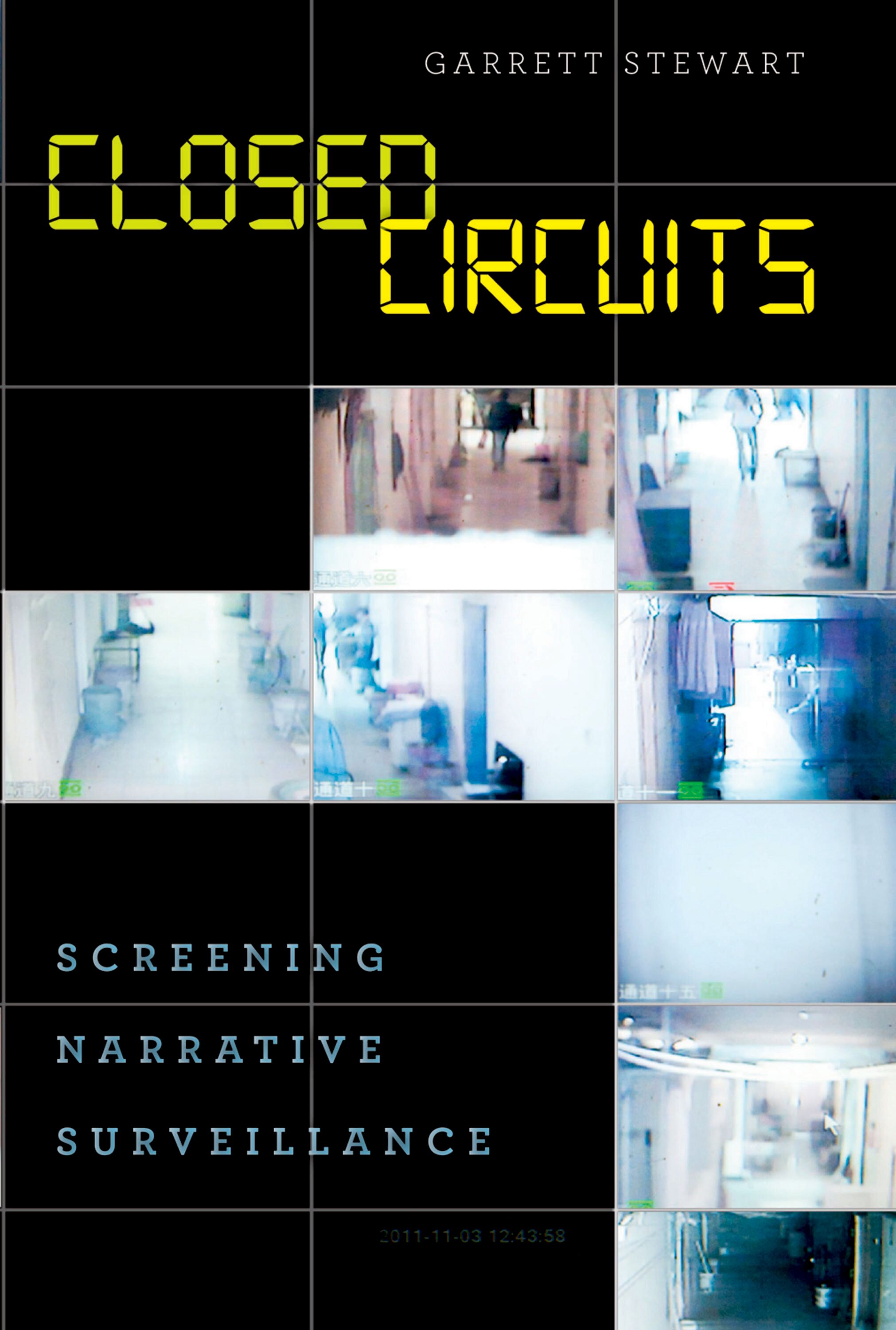
Closed circuits : screening narrative surveillance
The recent uproar over NSA dataveillance can obscure the fact that surveillance has been part of our lives for decades. And cinema has long been aware of its power—and potential for abuse.
In Closed Circuits, Garrett Stewart analyzes a broad spectrum of films, from M and Rear Window through The Conversation to Déjà Vu, Source Code, and The Bourne Legacy, in which cinema has articulated—and performed—the drama of inspection's unreturned look. While mainstays of the thriller, both the act and the technology of surveillance, Stewart argues, speak to something more foundational in the very work of cinema. The shared axis of montage and espionage—with editing designed to draw us in and make us forget the omnipresence of the narrative camera—extends to larger questions about the politics of an oversight regime that is increasingly remote and robotic. To such a global technopticon, one telltale response is a proliferating mode of digitally enhanced \"surveillancinema.\"
eBook

On the Brontëesque
The Brontë novels emerge in this way as a textbook of the fictional book as text, as writing, where the syntactic course of true love never did run smooth, nor its diction slot readily into the norms of emotional acquiescence, nor its figuration toe any going line. Rather, it is what style conveys in their work, what it carries forward in and beyond the novels themselves—evincing the tumult and numbness, avidities and repressions, of the craving mind and body in English fiction—that makes their influence so indelible: so deeply inscribed in the same Great Tradition that, in F.R. Leavis's terms, would so decidedly exclude them, even when he belatedly and rather grudgingly added Dickens to the honour roll. In Death Sentences: Styles of Dying in British Fiction (1984), I was drawn back to such moments in the Brontës as the pronominal osmosis of identity at Helen Burns's death in Jane Eyre (\"She kissed me; and I her, and we both soon slumbered\" [70]) and, at last, to the stunning double entendre of temporal frameworks in Wuthering Heights when, in the birthing of Catherine, Cathy the mother dies having \"never recovered sufficient consciousness to miss Heathcliff, or know Edgar\" (128)—that is, in emotional remission, never to have recognized, as if never to have met at all, the ill-matched husband there at her bedside in the momentary absence, rather than the prolonged earlier exile, of her primal lover. Related issues are further pursued and theorized in The Deed of Reading: Literature, Writing, Language, Philosophy (2015), in which the inheritance of contrapuntal Romantic sonority and syntax, with all their passional urgency, by Victorian novelists as well as poets offers a narratographic turning point (via the metalinguistics of Friedrich Kittler and Giorgio Agamben) in a discussion that moves from Dickens, as well Emily Brontë, Eliot, and others, to the concertedly gendered and raced cadence of witness in Toni Morrison's A Mercy.
Journal Article

Bookwork as Demediation
Stewart examines bookwork. In the normal course and discourse of literate experience, books are in the world as well as in it, populating it while repeating it by representation. And often, it would seem, they carve out counterworlds of their own, valved enclaves of worded text. Unreadable books are merely things in the given world, all description of it or its alternatives imploded or swept away, at least for a bracketing conceptual moment before they have claimed their place as texts again, gallery objects, art messages--often synecdoches at least, elsewhere manifold conceits, puns, rebuses. In that conceptual before, that transitional and purely materialist moment, that almost palpable suspension of reference, the no longer vehicular thing--the suddenly isolated hi bliobjet--does its real and demediating work.
Journal Article