
Catalogue Search | MBRL


Are you sure you want to remove the book from the shelf?

{{itemTitle}}
46
result(s) for
"Stone, C. Addison"
Sort by:


Exploring the role of morphemes in word reading
Two Studies were designed to investigate the role of morphemic structure on students' word reading. The first study asked whether familiar morphemes in words facilitate word reading for elementary students. Results showed that lower and upper elementary students read words with two morphemes (derived words with a base word and one suffix, such as shady) faster than words with one morpheme (e.g., lady). The second study was designed to investigate the effects of phonological transparency on middle and high school students' reading of derived words. Results showed that phonologically transparent words, words in which a base form is intact in the pronunciation of the derived word (e.g., classic in classical), were recognized and read faster than derived words that are less phonologically transparent (e.g., colonial), pinpointing an aspect of morphemic structure that affects reading derived words. The results indicate that reading derived words is not accomplished solely by familiarity with letter-sound associations or syllables; morphemes also play a role. Results also suggest value in emphasizing morphemic structure in models of word-reading acquisition. /// [Spanish] Se DiseŃAron dos estudios para investigar el papel de la estructura morfimica en la lectura de palabras. En el primer estudio se exploró si la presencia de morfemas familiares en las palabras facilitaba la lectura en estudiantes de escuela primaria. Los resultados mostraron que tanto los estudiantes del primer ciclo, como los del segundo ciclo de primaria leyeron con mayor rapidez palabras de dos morfemas (palabras derivadas con una base y un sufijo, e.g. shady) que palabras de un morfema (e.g. lady). El segundo estudio se diseñó para investigar el efecto de la transparencia fonológica durante la lectura de palabras derivadas en estudiantes de escuela media y superior. Los resultados mostraron que las palabras fonológicamente transparentes, palabras en las que la forma base permanece intacta en la pronunciación de la palabra derivada (e.g. classic en chsical), se reconocieron y leyeron más rápido que palabras derivadas con menor transparencia fonológica (e.g. colonial). Ello apunta al hecho de que la estructura morfémica afecta la lectura de las palabras derivadas. Los resultados indican que en la lectura de palabras derivadas no interviene sólo la familiaridad con las asociaciones letra- sonido o silabas; también los morfemas juegan un papel. Asimismo los resultados sugieren el valor de dar importancia a la estructura morfémica en los modelos de adquisición de la lectura. /// [German] Zwei Studien wurden ennvorfen, um die Rolle morphemischer Strukturen beim Wörterlesen der Schüler zu untersuchen. Die erste Untersuchung befragte, ob die in Worten bereits bekannten Morpheme das Lesen von Wörtern für Schüler der Grundstufen erleichtern. Die Ergebnisse zeigten, daß die Unterstufen- und höherstufigen Grundschüler die Wörter mit zwei Morphemen (abgeleirete Worter mit einem Basiswort und einer Endung, wie shady bzw.schattig) schneller lesen als Worter mit nur einem Morphem (2.B. ladybm. Dame). Die zweite Studie war darauf ausgerichtet, die Auswirkungen phonologischer Transparenz bei Mittel- und Oberschülern im Lesen von abgeleiteten Wörtern zu untersuchen. Die Ergebnisse zeigten, daß phonologisch transparente Wörter, Worte in denen die Basisform innerhalb der Aussprache des abgeleiteten Wörtes intakt bleibt (2.B. chsicin classical), schneller erkannt und gelesen wurden als abgeleitete Worter mit geringerer phonologischer Transparenz (2.B. colonial), unter Hinweis auf einen Aspekt morphemischer Struktur, welcher das Lesen von abgeleiteten Wörtern beeinflußt. Die Ergebnisse zeigen, daß das Lesen von abgeleiteten Wortern nicht ausschliefilich aufgrund deren Vertrautheit von Buchstaben-Lautassoziationen oder Silben erreicht wird; Morpheme spielen ebenfalls eine Rolle. Die Resultate schließen auf die Bedeutung der Hervorhebung morphemischer Strukturen in Anwendungsmodellen des Lesens von Wörtern. /// [Japanese] 生徒の単語の読みにおける 形態素構造の役割を調査す るために、2 つの研究がデザ インされた。1 つ目の研究で は、語中のありふれた形態 素によって、小学生の単語 の読みが容易になるかどう かが問われた。結果、小学 校低学年と高学年の生徒達 が、1 つの形態素を持つ語 く例、ル中)より2 つの形態 素を持つ語く例、sha中のよう な語基と接尾辞1 つを持つ派 生語)を早く読んだことが 明らかになった。2 つ目の研 究は、中高生の派生語の読 みへの音韻的透明性の影響 を調査するためにデザイン された。結果、音韻的に透 明な語、即ち派生語の発音 において語基の形が不変で ある語(例、clcmicalにおけるcl郡 sic) が、音韻的により不透明 である派生語(例、cotonial) より 早く認識され読まれたことが 明らかになり、派生語の読み に影響する形態素構造の一面 が正確に示された。こうした 結果によって、派生語の読み は、文字と音のつながりや音 節との慣れによってのみ達成 されるのではなく、形態素に も役割があることが示唆され る。また、その結果によって 、単語の読みの習得モデルに おいて形態素構造を強調する ことの有用性が示唆される。 /// [French] ON A réalisé deux études pour étudier le rôle de la structure morphémique sur la lecture de mots des élèves. La première étude s'est demandée si la présence de morphès familiers dans des mots facilite la lecture de ces mots par des élèves d'école primaire. Les résultats montrent que les élèves des grandes et des petites classes d'école primaire lisent les mots comportant deux morphèmes (mots dérivés comportant un mot de base et un suffixe, tel que shady) plus vite que des mots n'ayant qu'un seul morphème (par exemple, lady). La seconde étude a été réalisée pour étudier les effets de la transparence phonologique sur la lecture de mots dérivés par des élèves de collège et de lycée. Les résultats ont montré que les mots transparents phonologiquement, mots dans lesquels la forme de base est la même lors de la prononciation du mot dérivé (par exemple, classic dans classical) sont reconnus et lus plus vite que des mots dérivés qui sont moins transparents phonologiquement (par exemple, colonial), ce qui met en évidence un aspect de la structure morphologique qui affecte la lecture de mots dérivés. Les résultats indiquent que la lecture de mots dérivés ne dépend pas seulement de la familiarité des associations grapho-phonétiques ou des syllables mais que les morphèmes aussi jouent un rôle. Les résultats soulignent aussi l'intérêt de mettre l'accent sur la structure morphémique dans les modèles d'acquisition de la lecture des mots. /// [Russian] АΛЯ иссΛеΛова ния роΛи, которую морфоΛог ическая структура сΛов играе т нри их чте нии, быΛо преΛприня то Λва иссΛ еАования. ЦеАъю перв ого быΛо проверитъ, Λегче Λи учащимся начаΛъной шкоΛы чита тъ те сΛова, гАе встреч аются знак омые морфе мы. РезуΛът аты ноказа Λи, что и мΛаАшие, и боΛее старшие учащиеся Λу чше читают сΛова с Авумя мо рфемами (произво Аные сΛова, состоящие из корня основного сΛова и оАного суффикса, например shady), чем сΛова с оАной морфемой (например, lady). ЦеΛъ втор ого иссΛеА ования изучитъ, как вΛияет фоноΛогич еская проз рачностъ п роизвоАны х сΛов на их чтение учащимися среАней и старшей шко Λы. Резу Λътаты показаΛи, что фоноΛо гически пр озрачные сΛова, то естъ те, в которых основа ост ается сохранной в произнош ении произ воАного сΛ ова (наприм ер, classic в приΛа гатеΛъном classical), Λегче опо знаются и б ыстрее чит аются, чем менее фоно Λогически прозрачны е произвоА ные сΛова (например, colonial). Это поАче ркивает ос обую роΛъ которую играет мор фоΛогичес кая структ ура произв оАных сΛов в их чтении. РезуΛътат ы Аемонстр ируют, что чтение про извоАных с Λов проис хоАит не то Λъко на осн ове звуко буквенных связей иΛи АеΛения на сΛоги морфемы также имею т значении. ПоΛученны е вывоАы позвоΛяют рекоменАо ватъ изуч ение морфо Λогическо й структур ы сΛова в качестве составΛя ющей разΛ ичных моА еΛей осво ения навы ков чтени я.
Journal Article

The Accuracy of Academic Self-Evaluations in Adolescents with Learning Disabilities
The purpose of this study was to document the degree of overestimation of academic skills among students with learning disabilities (LD) and to evaluate the role of reference group and metacognitive awareness in such overestimation. High school students with (n = 52) and without (n = 49) LD in Grades 9 through 12 completed a self-concept scale and a survey requiring them to rate their own academic skills in 17 specific skill areas. Students were further asked to predict their performance on two academic tasks prior to actually performing the tasks. The students' mothers or fathers, their English teachers or academic advisors, and (in the case of the students with LD) their special education case managers also completed the skill rating inventory and predicted student performance on the two tests. Despite reporting significantly lower academic self-concepts, students with LD overestimated their academic skills relative to the ratings of others and to their actual test performance. Such overestimation was less pronounced among the students without LD. All participants reported using similar reference groups in making their judgments. Analyses of item-by-item accuracy judgments from the two tests revealed evidence of group differences in metacognitive awareness that may be related to the overestimation. These findings have implications for realistic goal setting and effective self-advocacy.
Journal Article

An Unfortunate Divorce
In his contribution to this special issue of this journal, Scot Danforth uses the lens of history to challenge contemporary scholars in the field of learning disabilities (LD) to think critically about their implicit epistemology and methods of inquiry. Using the specific case of Hammill and colleagues' critical reviews of the process training movement (e.g., Hammill, 1972; Hammill & Larsen, 1974), Danforth argues that a historical analysis helps scholars to understand how the sociohistorical context of their work influences that work. This line of argument is not new in the broader scientific discourse, or even in the LD field (e.g., Heshusius, 1974, 1989), but Danforth's close examination of a salient instance in the history of the field provides a useful case in point for a detailed evaluation of specific constructs and methods. At the same time, by extrapolation, he provides an implicit argument regarding the potential limitations of current approaches to the study of learning disabilities, an argument that warrants careful consideration. (Contains 1 note.)
Journal Article

The Effects of Phonological Transparency on Reading Derived Words
The purpose of this study was to determine whether poor readers have more pronounced problems than average-reading peers reading derived words the base forms of which undergo a phonological shift when a suffix is added (i.e., shift relations as in \"natural\"), as compared to derived words whose forms are phonologically and orthographically transparent (i.e., stable relations, as in \"cultural\"). Two computer-based word recognition tasks (Naming and Lexical Decision) were administered to children with reading disability (RD), peers with average reading ability, and adults. Across tasks, there was an effect for transparency (i.e., better performance on stable than shift words) for both child groups and the adults. For the children, a significant interaction was found between group and word type. Specifically, on the naming task, there was an advantage for the stable words, and this was most noteworthy for the children with RD. On the lexical decision task, trade-offs of speed and accuracy were evident for the child reader groups. Performances on the nonwords showed the poor readers to be comparable to the average readers in distinguishing legal and illegal nonwords; further analyses suggested that poor readers carried out deeper processing of derived words than their average reading peers. Additional study is needed to explore the relation of orthographic and phonological processing on poor readers' memory for and processing of derived words.
Journal Article

Initial Progress of Children Identified with Disabilities in Michigan's Reading First Schools
This 2-year longitudinal study examined initial evidence of progress in reading for 1,512 children with and without identified speech-language and/or learning disabilities (LD-SLD) in the context of the explicit literacy instruction provided in Michigan's Reading First (RF) schools. The findings suggested that children with LD-SLD labels demonstrated significantly slower growth compared to children without LD-SLD labels. Children considered more at risk also demonstrated slower progress in oral reading fluency (but not reading comprehension) compared to children considered less at risk. Implications are discussed in relationship to the extent of instructional support needed by children identified as LD-SLD in the mainstream, and in terms of the specific dimension of reading skills as a criterion.
Journal Article
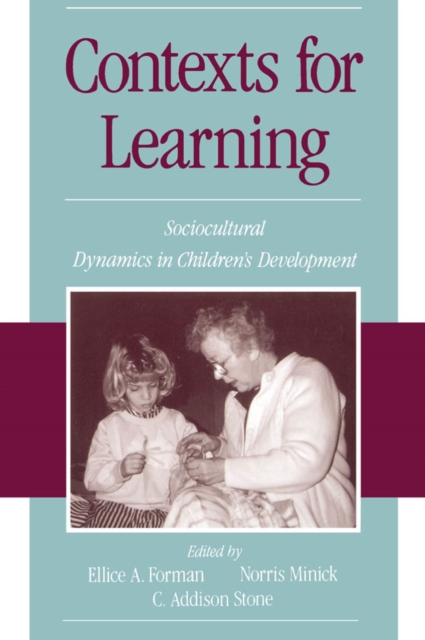
Contexts for Learning: Socio-Cultural Dynamics in Children's Development
This work presents landmark research concerning the vital dynamics of childhood psychological development. It's origin can be traced to the late 1970s, when several psychologists began to challenge existing notions of cognitive development by suggesting that such functioning is bound to specific contexts and that cognitive development is based on the mastery of culturally defined ways of speaking, thinking, and acting. About the same time, several translations weremade available in this country of the seminal work of Vygotsky, the noted theoretician, offering a conceptual base on which these workers could build. This volume, with contributions from many of the scholars who pioneered this area and translated the work of Vygotsky, looks at the complexmechanisms by which children acquire the cultural and linguistic tools to carry out cognitive activities and explores the implications of this research for education. The book is organized around three main parts: Discourse and Learning in Classroom Practice, Interpersonal Relations in Formal and Informal Education, and The Sociocultural Institutions of Formal and Informal Education. An afterword by Jacqueline Goodnow suggests new directions for sociocultural research and education. Theintended audience is composed of developmental, educational, and cognitive psychologists, along with advanced students in developmental and educational psychology.
eBook

Contexts for Learning
This work presents landmark research concerning the vital dynamics of childhood psychological development. It’s origin can be traced to the late 1970s, when several psychologists began to challenge existing notions of cognitive development by suggesting that such functioning is bound to specific contexts and that cognitive development is based on the mastery of culturally defined ways of speaking, thinking, and acting. About the same time, several translations were made available in this country of the seminal work of Vygotsky, the noted theoretician, offering a conceptual base on which these workers could build. This volume, with contributions from many of the scholars who pioneered this area and translated the work of Vygotsky, looks at the complex mechanisms by which children acquire the cultural and linguistic tools to carry out cognitive activities and explores the implications of this research for education. The book is organized around three main parts: Discourse and Learning in Classroom Practice, Interpersonal Relations in Formal and Informal Education, and The Sociocultural Institutions of Formal and Informal Education. An afterword by Jacqueline Goodnow suggests new directions for sociocultural research and education. The intended audience is composed of developmental, educational, and cognitive psychologists, along with advanced students in developmental and educational psychology.
eBook
Should We Salvage the Scaffolding Metaphor?
This response by the original author to six commentaries on his paper concerning the scaffolding metaphor for learning disabilities highlights common themes (such as the basic dynamics of meaningful learning) and revisits arguments for and against the utility of the metaphor. Suggestions for broadening the metaphor to address related issues such as the interpersonal, communicational dynamics in classrooms are offered. (DB)
Journal Article
