
Catalogue Search | MBRL


Are you sure you want to remove the book from the shelf?

{{itemTitle}}
127
result(s) for
"Strang, Veronica"
Sort by:

Water
Veronica Strang's Water digs into the rich history of human interaction with water, and is the first of its kind to give a comprehensive cultural view of water and history as well as taking in social and ecological issues. It will appeal to all of those interested in the environment and the state of the world today.
Book

Envisioning a sustainable future for water
The water sector has a major leadership role to play in addressing the global water crisis. How can it make the radical shifts in approach that are needed? This paper highlights the reality that the management of water, and the ways in which water flows are directed, reflects social relations of power, not just between human groups, but also between humankind and the non-human world. Drawing on in-depth ethnographic research with indigenous communities and other water users in river catchments around the world, it considers alternate cultural worldviews that encourage more sustainable beliefs and practices, and asks how larger societies might make imaginative use of these in contemporary and future engagements with water. In a thought experiment intended to reposition human–non-human relations, it proposes a concept of ‘re-imagined communities’ advocating more collaborative forms of conviviality – living together – with other species. Opening the door to ideas about pan-species democracy, it calls for decision-making processes in which a wide range of expertise is brought together to exchange knowledge, with an explicit and practical remit to ‘speak for’ and promote the needs and interests of the non-human inhabitants of the ecosystems on which all living kinds depend.
Journal Article
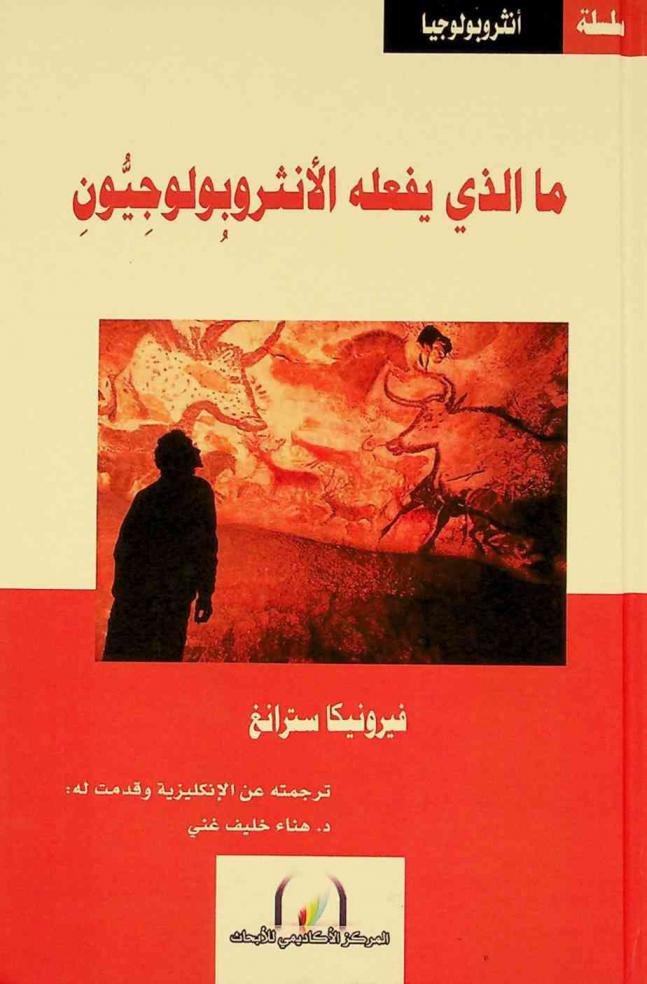
ما الذي يفعله الأنثروبولوجيون
تظهر فيرونيكا سترانغ، في مقدمة كتابها (ما الذي يفعله الأنثروبولوجيون)، حرصا شديدا على جلاء الأسباب التي تقف حائلا دون معرفة الناس حقيقة ما يفعله الأنثروبولوجيون أو، في الأقل، شعورهم بالحيرة نحوه، وهي تلقي باللائمة على الصور النمطية الشائعة في الأدب والأفلام والتلفزيون عن المغامرين الإستعماريين، بخوذهم المعدنية الذين يعيشون مع القبائل البدائية أو شبه البدائية في الغابات، أو المهووسين الملتحين الذين ينتعلون الصنادل والجوارب، ويتوجهون في رحلات إلى المناطق الغريبة والنائية. وسترانغ مصممة على تحدي هذه الصور النمطية لإيمانها أن التدريب الأنثروبولوجي -خلافا للصور النمطية الشائعة- يحوز إمكانات تطبيقية هائلة في نطاق واسع متنوع من المجالات الحياتية والمهنية، وتأسيسا على ذلك، يرمي هذا الكتاب إلى تقديم فكرة وافية عما يفعله الأنثروبولوجيون على أرض الواقع مشفوعا بأمثلة مستقاة من عدد من المجالات المختلفة، وهي تلفت إنتباه القراء إلى تعذر تقديم وصف كامل أو شامل للأعمال والمهمات التي يؤديها الأنثروبولوجيون، فهي أكثر من أن يحصيها في هذا الكتاب. فالأنثروبولوجيون، بحسب ما يؤكده الكتاب، موجودون في كل مكان، في المواقع والميادين كافة، وهم على أتم الاستعداد لتوظيف معارفهم وخبراتهم في خدمة المجتمع.
BOOK

Infrastructural relations: Water, political power and the rise of a new 'despotic regime'
It is 60 years since Karl Wittfogel highlighted a key relationship between political power and the ownership and control of water. Subsequent studies have suggested, commensurately, that exclusion from the ownership of essential resources represents a fundamental form of disenfranchisement - a loss of democratic involvement in societal direction. Several areas of theoretical development have illuminated these issues. Anthropologists have explored the recursive relationship between political arrangements and cosmological belief systems. Narrow legal definitions of property have been challenged through the consideration of more diverse ways of owning and controlling resources. Analyses of material culture have shown how it extends human agency, as well as having agentive capacities itself; and explorations of infrastructures have highlighted their role in composing socio-technical and political relations. Such approaches are readily applied to water and the material culture through which it is controlled and used. Drawing on historical and ethnographic research on water in Australia and the UK, this paper traces changing relationships between cosmological beliefs, infrastructure and political arrangements over time. It suggests that a current trend towards privatised, transnational water ownership potentially opens the door to the emergence of new 'despotic regimes'.
Journal Article

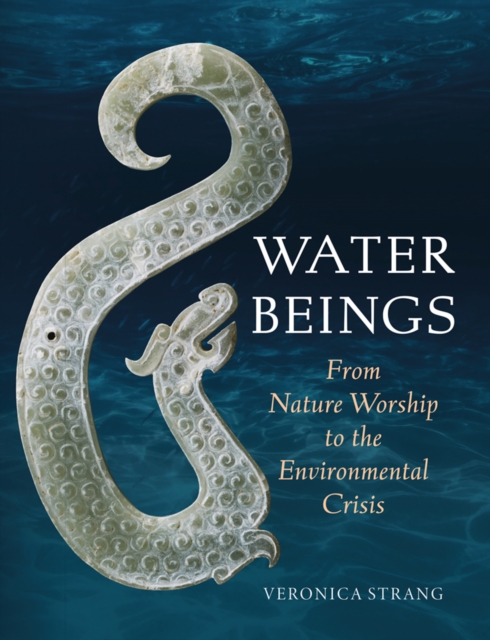
Water Beings
Looking to the vast human history of water worship, a crucial study of our broken relationship with all things aquatic—and how we might mend it. Early human relationships with water were expressed through beliefs in serpentine aquatic deities: rainbow-colored, feathered or horned serpents, giant anacondas, and dragons. Representing the powers of water, these beings were bringers of life and sustenance, world creators, ancestors, guardian spirits, and lawmakers. Worshipped and appeased, they embodied people's respect for water and its vital role in sustaining all living things. Yet today, though we still recognize that \"water is life, \" fresh- and saltwater ecosystems have been critically compromised by human activities. This major study of water beings and what has happened to them in different cultural and historical contexts demonstrates how and why some—but not all—societies have moved from worshipping water to wreaking havoc upon it and asks what we can do to turn the tide.
eBook
الماء : طبيعة وثقافة /
تحاول الأكاديمية والباحثة فيرونيكا سترانغ في كتابها توثيق سجل فريد لتاريخ الماء عبر تقديم نظرة ثقافية شاملة لعلاقات البشر به واستكشاف أهم قضاياه الثقافية والمادية والتاريخية والبيئية والسياسية وتؤكد على أن لا مادة أهم من الماء أو أكثر حيوية منه كما أنها تعاينه بوصفه مصدرا للطاقة المتجددة وأداة حملته عبر الزمان والمكان وتشدد سترانغ على الدور المهم الذي أداه ويؤديه لضمان صحة الإنسان وسلامته ابتداء من الآبار العلاجية في مجتمعات ما قبل التاريخ وانتهاء باحتياجاتنا المعاصرة لمصادر الماء والصرف الصحي.
Book

Gender and Pan-Species Democracy in the Anthropocene
There are diverse historical trajectories in human societies’ relationships with the non-human world. While many small place-based groups have tried to retain egalitarian partnerships with other species and ecosystems, larger societies have made major transitions. In religious terms, they have moved from worshipping female, male or androgynous non-human deities, to valorising pantheons of deities that, over time, became semi-human and then human in form. Reflecting Durkheimian changes in social and political arrangements, movements towards patriarchy led to declining importance in female deities, and the eventual primacy of single male Gods. With these changes came dualistic beliefs separating Culture from Nature, gendering these as male and female, and asserting male dominion over both Nature and women. These beliefs supported activities that have led to the current environmental crisis: unrestrained growth; hegemonic expansion; colonialism, and unsustainable exploitation of the non-human world. These are essentially issues of inequality: between genders, between human groups, and between human societies and other living kinds. This paper draws on a series of ethnographic research projects (since 1992) exploring human-environmental relationships, primarily in Australia, the UK, and New Zealand, and on a larger comparative study, over many years, of a range of ethnographic, archaeological, theological, and historical material from around the world. It considers contemporary debates challenging Nature-Culture dualism and promoting ‘rights for Nature’ or—rejecting anthropocentricity to recognize an indivisible world—for the non-human communities with whom we co-inhabit ecosystems. Proposing new ways to configure ethical debates, it suggests that non-human rights are, like women’s rights, fundamentally concerned with power relations, social status, and access to material resources, to the extent that the achievement of ‘pan-species democracy’ and greater equality between living kinds goes hand-in-hand with social, political and religious equality between genders.
Journal Article

Fluid consistencies. Material relationality in human engagements with water
Material things are not just passive recipients of human categories, meanings and values, nor mere subjects of human agency. Their particular characteristics and behaviours are formative of human–non-human relations. The common material properties of things, and the shared cognitive and phenomenological processes through which people interact with them, generate recurrent ideas and patterns of engagement in diverse cultural and historical contexts. Despite growing instrumentalism in human ‘management’ of the material world, and the emergence of new relational forms, these patterns persist.
Journal Article

Knowing Me, Knowing You: Aboriginal and European Concepts of Nature as Self and Other
Based on long-term fieldwork with Aboriginal groups, Euro-Australian pastoralists and other land users in Far North Queensland, this paper considers the ways in which indigenous relations to land conflate concepts of Nature and the Self, enabling subjective identification with elements of the environment and supporting long-term affective relationships with place. It observes that indigenous cultural landscapes are deeply encoded with projections of social identity: this location in the immediate environment facilitates the intergenerational transmission of knowledge and identity and supports beliefs in human spiritual transcendence of mortality. The paper suggests that Aboriginal relations to land are therefore implicitly founded on interdependent precepts of social and environmental sustainability. In contrast, Euro-Australian pastoralists' cultural landscapes, and constructs of Nature, though situated within more complex relations with place, remain dominated by patriarchal and historically adversarial visions of Nature as a feminine \"wild-ness\" or \"otherness\" requiring the civilising control of (male) Culture and rationality. Human spiritual being and continuity is conceptualised as above or outside Nature, impeding the location of selfhood and collective continuity within the immediate environment. In tandem with mobile and highly individuated forms of social identity, this positions Nature as \"other\". There is thus a subjective separation between the individualised life of the self, and the life of Nature/other that, despite an explicit discourse in which ecological well-being is valorised, inhibits affective connection with place and confounds sustainability.
Journal Article