
Catalogue Search | MBRL


Are you sure you want to remove the book from the shelf?

{{itemTitle}}
137
result(s) for
"Strike, Kenneth A"
Sort by:

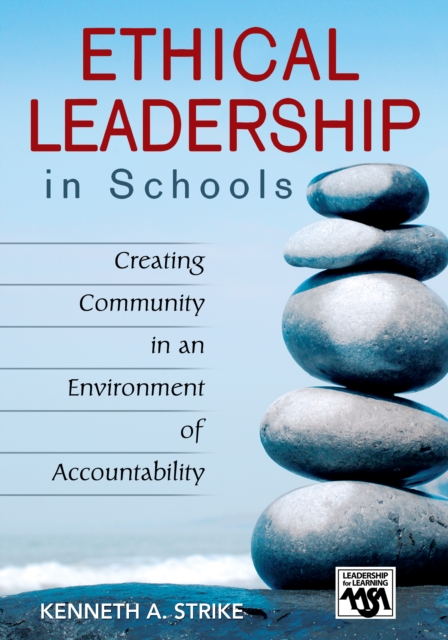
Ethical leadership in schools
Discover the link between ethical leadership and successful educational communities!In an age of accountability and transparency, principals are held responsible for everything from test scores to school finances. Because of this increased accountability, school leaders must regularly confront difficult ethical dilemmas.Ethical Leadership in Schools teaches principals and aspiring principals the concepts that inform ethical choices in leadership roles. Using brief vignettes, Kenneth A. Strike explores common situations that principals are likely to encounter and presents questions and issues to help them determine the ethical path. As part of the Leadership for Learning initiative of the American Association of School Administrators (AASA), this invaluable resource clearly explains complex ideas in an accessible, well-illustrated manner.To help resolve the dilemmas that challenge every school leader, this book: Guides readers through the process of making ethical decisions; Bridges ethics to issues of accountability; Provides scenarios that reflect the difficult choices facing principals; Supplies the tools to create ethical advice in varied contexts; Examines the central principles of fair cooperationThe study of ethics should emphasize what makes a school a good educational community. By creating communities that are competent, caring, and collegial, school leaders will be able to maximize their resources and meet the growing demands of accountability.
eBook

Small Schools: Size or Community?
Small schools are not just about size. They are also about authentic instruction, portfolio evaluation, and a thematic curriculum. Their agendas overlap with that of charter schools. They have an uncomfortable and sometimes adversarial relationship with standards, accountability, and the No Child Left Behind Act. They have migrated from their beginnings in Barker and Gump’s (1964) work on rural schools to become a significant factor in urban school reform. They face two major hurdles. The first is scaling up. Small reform movements can survive on exemptions from prevailing policy. Large reform movements need institutional change. The second is that as an enterprise becomes popular it runs the risks of co‐option and confusion. I argue that small school advocates need to work hard to maintain clarity about what is central to the movement. And I suggest that what should be central is an emphasis on creating community, not school size per se.
Journal Article

Equality of Opportunity and School Finance: A Commentary on Ladd, Satz, and Brighouse and Swift
This article discusses issues of justice concerning school finance with a focus on the development of a conception of equality of educational opportunity. Emphasis is put on discussing the views of the other contributors in this symposium. The main conclusions of the discussion are that (1) equity and adequacy are not inconsistent views because they address fundamentally different questions; (2) adequacy sets a floor under the education that the state owes to all children, but it does not relieve the state of the obligation to provide whatever additional education it chooses to provide equally; (3) equality of opportunity may be limited by conflicting rights; and (4) weighted student funding (WSF) is theoretically attractive because it emphasizes the funding of students rather than districts and is sensitive to relevant differences among them, however the level of theoretical agreement and empirical knowledge required to implement WSF in a nuanced way is not available.
Journal Article
Community, the Missing Element of School Reform: Why Schools Should Be More like Congregations than Banks
This article discusses the meaning of the idea that schools should be communities. It argues that the view that schools should be communities should be viewed as a distinct vision of school reform because it has a distinct vision of the problems that require solution (alienation and disengagement) and how they are to be solved. It contrasts this vision with standards‐based reform and with the emphasis on small schools. The article argues that schools that are communities should be rooted in a shared educational project—a conception of the vision of the education the school wishes to provide that is shared by all members of the community. There are four C's of community: coherence, cohesion, care, and contact. Coherence consists of a shared vision and a shared language—a shared educational project. Cohesion is the sense of community that results from the shared pursuit of such a project. Care is required for initiating students into this project. Contact concerns the structural features of schools, such as size, that facilitate personalization and care. Coherence is the central feature of community. In contrast, standards‐based reform privatizes educational projects and instrumentalizes education. The emphasis on small schools tends to see contact as the crucial feature of community rather than coherence.
Journal Article


Liberalism, Communitarianism and the Space Between: In praise of kindness
This paper argues that liberalism and communitarianism provide views of the moral life that are both too narrow. Communitarianism roots the moral life in the norms of particular communities. Liberals argue that communitarianism is likely to be parochial and sectarian. Liberalism has sought for norms that are universal and generalizable. Communitarians claim that liberalism is a \"view from nowhere\" that is more likely to produce rootlessness and anomie than justice . This paper seeks for a \"space between\". Its principle claim is that moral capacities such as empathy and sympathy and conceptions such as kindness and decency occupy a space between liberalism and communitarianism because, while they depend on attachments more than principles, they are evoked by characteristics of others that are not rooted in group membership or shared identities.
Journal Article

Ethical Leadership in Schools: Creating Community in an Environment of Accountability. Leadership for Learning Series
Discover the link between ethical leadership and successful educational communities! In an age of accountability and transparency, principals are held responsible for everything from test scores to school finances. Because of this increased accountability, school leaders must regularly confront difficult ethical dilemmas. This book teaches principals and aspiring principals the concepts that inform ethical choices in leadership roles. Using brief vignettes, the author explores common situations that principals are likely to encounter and presents questions and issues to help them determine the ethical path. As part of the Leadership for Learning initiative of the American Association of School Administrators (AASA), this invaluable resource clearly explains complex ideas in an accessible, well-illustrated manner. To help resolve the dilemmas that challenge every school leader, this book: (1) Guides readers through the process of making ethical decisions; (2) Bridges ethics to issues of accountability; (3) Provides scenarios that reflect the difficult choices facing principals; (4) Supplies the tools to create ethical advice in varied contexts; and (5) Examines the central principles of fair cooperation. The study of ethics should emphasize what makes a school a good educational community. By creating communities that are competent, caring, and collegial, school leaders will be able to maximize their resources and meet the growing demands of accountability. Following a series foreword, series introduction, and preface, this book is divided into seven sections: (1) Moral Principles and Moral Principals? An Introduction; (2) What Is Education For?; (3) Constitutional Essentials, Part I: Intellectual Liberty, Religious Freedom, and Intellectual Community; (4) Constitutional Essentials, Part II: Equal Opportunity and Multicultural Community; (5) Constitutional Essentials, Part III: Democracy, Community, and Accountability; (6) Ethical Decision-Making; and (7) Professional Community and the Ethics of Accountability. A list of references and an index are also included.
Book

Professionalism, Democracy, and Discursive Communities: Normative Reflections on Restructuring
This paper examines two normative interpretations, professionalism and democracy, for recent work that argues against bureaucratic control of schooling and in favor of such reforms as decentralized management, a team approach to school operation, and more autonomy for teachers. It argues that a democratic conception is both distinguishable from and preferable to a conception of teachers as professionals. However, this view can only be sustained by an understanding of democracy that emphasizes discursive decision making in local educational communities and deemphasizes the location of political sovereignty in legislative bodies.
Journal Article