
Catalogue Search | MBRL


Are you sure you want to remove the book from the shelf?

{{itemTitle}}
94
result(s) for
"Strong, Jeremy"
Sort by:


Educated Tastes
The old adage \"you are what you eat\" has never seemed more true than in this era, when ethics, politics, and the environment figure so prominently in what we ingest and in what we think about it. Then there are connoisseurs, whose approaches to food address \"good taste\" and frequently require a language that encompasses cultural and social dimensions as well. From the highs (and lows) of connoisseurship to the frustrations and rewards of a mother encouraging her child to eat, the essays in this volume explore the complex and infinitely varied ways in which food matters to all of us.
Educated Tastesis a collection of new essays that examine how taste is learned, developed, and represented. It spans such diverse topics as teaching wine tasting, food inDon Quixote, Soviet cookbooks, cruel foods, and the lambic beers of the Belgian Payottenland. A set of key themes connect these topics: the relationships between taste and place; how our knowledge of food shapes taste experiences; how gustatory discrimination functions as a marker of social difference; and the place of ethical, environmental, and political concerns in debates around the importance and meaning of taste. With essays that address, variously, the connections between food, drink, and music; the place of food in the development of Italian nationhood; and the role of morality in aesthetic judgment,Educated Tastesoffers a fresh look at food in history, society, and culture.
eBook

James Bond uncovered
This volume brings fresh perspectives to the study of James Bond. With a strong emphasis on the process of Bond's incarnation on screen and his transit across media forms, chapters examine Bond in terms of adaptation, television, computer games, and the original novels. Film nonetheless provides the central focus, with analysis of both the corpus as a whole - from Dr. No to Spectre - and of particular films, from popular and much-discussed movies such as Goldfinger and Skyfall to comparatively under-examined texts such as the 1967 Casino Royale and A View to a Kill. Contributors? expertise and interests encompass such diverse aspects of and approaches to the Bond stories as Sound Design, Empire, Food and Taste, Geo-politics, Feminism, Tarot, Landscape and Sets.
Book
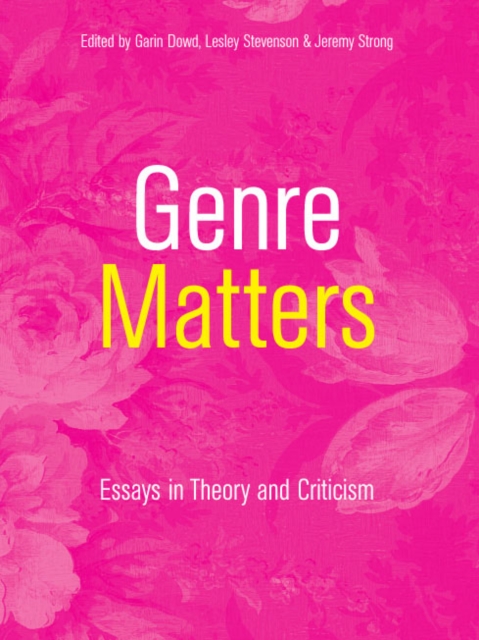
Genre Matters
This collection of new essays addresses a topic of established and expanding critical interest throughout the humanities. It demonstrates that genre matters in a manner not constrained by disciplinary boundaries and includes new work on Genre Theory and applications of thinking about genre from Aristotle to Derrida and beyond. The essays focus on economies of expectation and competency, genre as media form, recent developments in television broadcast genres, translation and genericity, the role played by genre in film publicity, gender and genre, genre in fiction, and the problematics of classification. An introductory essay places the contributions in the context of a wide range of thinking about genre in the arts, media and humanities. The volume will be of interest to both undergraduates and postgraduates, especially those following courses on Genre Theory and Genre Criticism, and to academics working in a range of subject areas such as Cultural Studies, Film Studies, Media Studies and Literary Studies.
eBook
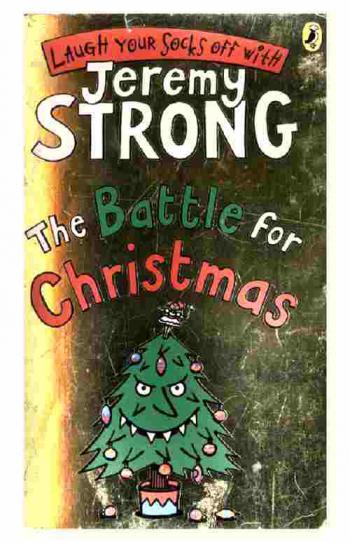
The battle for Christmas
When Ellie puts on her new pyjamas, strange things start to happen. She and her brother, Max, are whisked off to the Christmas Shop where a battle is raging between a valiant troop of toys and the scaaaarry Christmas Tree Fairy and her army of angels. Can Ellie and Max save Christmas for the world - or will they be arrested for being mince spies?
Book
Adapting Pagnol and Provence
It is nearly impossible to commence this chapter without remarking upon the coincidence that Marcel Pagnol’s birth in 1895 in Aubagne, Provence, was in the same year that his countrymen Auguste and Louis Lumière held the first public screenings of their cinematograph in Paris. Yet Brett Bowles reminds readers that this pleasing accident of chronology was not necessarily ‘a sign that Pagnol’s fate was somehow cosmically intertwined with cinema’.¹ Bowles indicates that while Pagnol’s family history did not readily suggest a nascent facility for any particular art form, including the newest, what was to prove remarkable was his success across
Book Chapter

There's a Viking in my bed
How has Sigurd the Viking come to be in Mrs Tibblethwaite's bed, in a small seaside hotel, in the twentieth century? Nobody knows, but one thing's for certain, things will never be the same again.
Book

There's a Pharaoh in our bath!
Ancient Egyptian Pharaoh Sennapod is woken from his 4,000 year sleep by dastardly Egyptologists, Grimstone and Jelly, searching for his hidden treasure map. But Sennapod and his friends the Lightspeed family have plans of their own!

Reconstructing the Rose or How Joining the Dots (Generally) Makes the Picture
Gaut finds that a case can only be made for a \"circumscribed\" or \"discretionary\" construction in which viewers enjoy a limited freedom in what they may \"imagine in respect of the fictional world in the film\" (19). Since Bordwell himself states in the opening chapter of Making Meaning that he is not arguing for \"sheer relativism or an infinite diversity of I interpretation\" and that \"Construction is not ex nihilo creation; there must be prior materials\" (3), it appears that the difference here is one of degree, albeit along a considerable spectrum.
Journal Article