
Catalogue Search | MBRL


Are you sure you want to remove the book from the shelf?

{{itemTitle}}
28
result(s) for
"Sweigart, Al"
Sort by:

Invent your own computer games with Python
\"Teaches you how to make your own versions of classic computer games\"-- Provided by publisher.
Book
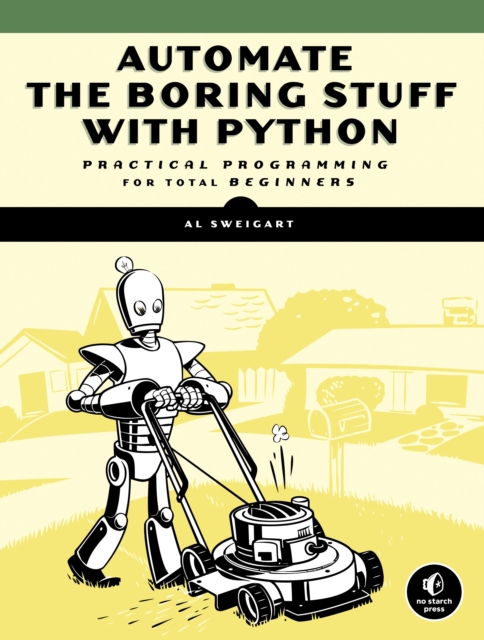
Automate the boring stuff with Python : practical programming for total beginners
If you've ever spent hours renaming files or updating hundreds of spreadsheet cells, you know how tedious tasks like these can be. But what if you could have your computer do them for you? In 'Automate the Boring Stuff with Python', you'll learn how to use Python to write programs that do in minutes what would take you hours to do by hand - no prior programming experience required.
eBook


A Simple Genetic Incompatibility Causes Hybrid Male Sterility in Mimulus
Much evidence has shown that postzygotic reproductive isolation (hybrid inviability or sterility) evolves by the accumulation of interlocus incompatibilities between diverging populations. Although in theory only a single pair of incompatible loci is needed to isolate species, empirical work in Drosophila has revealed that hybrid fertility problems often are highly polygenic and complex. In this article we investigate the genetic basis of hybrid sterility between two closely related species of monkeyflower, Mimulus guttatus and M. nasutus. In striking contrast to Drosophila systems, we demonstrate that nearly complete hybrid male sterility in Mimulus results from a simple genetic incompatibility between a single pair of heterospecific loci. We have genetically mapped this sterility effect: the M. guttatus allele at the hybrid male sterility 1 (hms1) locus acts dominantly in combination with recessive M. nasutus alleles at the hybrid male sterility 2 (hms2) locus to cause nearly complete hybrid male sterility. In a preliminary screen to find additional small-effect male sterility factors, we identified one additional locus that also contributes to some of the variation in hybrid male fertility. Interestingly, hms1 and hms2 also cause a significant reduction in hybrid female fertility, suggesting that sex-specific hybrid defects might share a common genetic basis. This possibility is supported by our discovery that recombination is reduced dramatically in a cross involving a parent with the hms1–hms2 incompatibility.
Journal Article

Automate the Boring Stuff with Python
Automate the Boring Stuff with Python teaches simple programming skills to automate everyday computer tasks.
eBook

PATTERNS OF NUCLEOTIDE DIVERSITY IN TWO SPECIES OF MIMULUS ARE AFFECTED BY MATING SYSTEM AND ASYMMETRIC INTROGRESSION
The evolutionary transition from outcrossing to self-fertilization has far-reaching implications for patterns of intraspecific genetic diversity and the potential for speciation. Using DNA sequence variation at two nuclear loci, we examined the divergence history of two closely related species of Mimulus. To investigate the effects of mating system and introgressive hybridization on the outcrossing M. guttatus and the selfing M. nasutus, we inspected nucleotide diversity within and between natural populations spanning the species' geographic ranges. High sequence similarity among populations of the selfing M. nasutus points to a single evolutionary origin for the species. Consistent with their distinct mating systems, all genetic variation in M. nasutus is distributed among populations, whereas M. guttatus exhibits appreciable levels of nucleotide diversity within populations. Silent genetic diversity is extensive in M. guttatus (mean θsil/site = 0.077) and greatly exceeds the predicted twofold elevation in neutral variation for outcrossers relative to selfers. The finding of several M. guttatus sequences that share complete identity with sequences from M. nasutus suggests that recent asymmetric introgression may have occurred. We argue that exceptionally high nucleotide diversity in M. guttatus is consistent with a long-term history of directional introgression from M. nasutus to M. guttatus throughout the divergence of these two species.
Journal Article
Patterns Of Nucleotide Diversity In Two Species Of Mimulus Are Affected By Mating System And Asymmetric Introgression
The evolutionary transition from outcrossing to self-fertilization has far-reaching implications for patterns of intraspecific genetic diversity and the potential for speciation. Using DNA sequence variation at two nuclear loci, we examined the divergence history of two closely related species of Mimulus. To investigate the effects of mating system and introgressive hybridization on the outcrossing M. guttatus and the selfing M. nasutus, we inspected nucleotide diversity within and between natural populations spanning the species' geographic ranges. High sequence similarity among populations of the selfing M. nasutus points to a single evolutionary origin for the species. Consistent with their distinct mating systems, all genetic variation in M. nasutus is distributed among populations, whereas M. guttatus exhibits appreciable levels of nucleotide diversity within populations. Silent genetic diversity is extensive in M. guttatus (mean [thetas]sil/site = 0.077) and greatly exceeds the predicted twofold elevation in neutral variation for outcrossers relative to selfers. The finding of several M. guttatus sequences that share complete identity with sequences from M. nasutus suggests that recent asymmetric introgression may have occurred. We argue that exceptionally high nucleotide diversity in M. guttatus is consistent with a long-term history of directional introgression from M. nasutus to M. guttatus throughout the divergence of these two species.
Journal Article
Natural Variation For A Hybrid Incompatibility Between Two Species Of Mimulus
Understanding the process by which hybrid incompatibility alleles become established in natural populations remains a major challenge to evolutionary biology. Previously, we discovered a two-locus DobzhanskyâMuller incompatibility that causes severe hybrid male sterility between two inbred lines of the incompletely isolated wildflower species, Mimulus guttatus and M. nasutus. An interspecific cross between these two inbred lines revealed that the M. guttatus (IM62) allele at hybrid male sterility 1 (hms1) acts dominantly in combination with recessive M. nasutus (SF5) alleles at hybrid male sterility 2 (hms2) to cause nearly complete hybrid male sterility. In this report, we extend these genetic analyses to investigate intraspecific variation for the hms1âhms2 incompatibility in natural populations of M. nasutus and M. guttatus, performing a series of interspecific crosses between individuals collected from a variety of geographic locales. Our results suggest that hms2 incompatibility alleles are common and geographically widespread within M. nasutus, but absent or rare in M. guttatus. In contrast, the hms1 locus is polymorphic within M. guttatus and the incompatibility allele appears to be extremely geographically restricted. We found evidence for the presence of the hms1 incompatibility allele in only two M. guttatus populations that exist within a few kilometers of each other. The restricted distribution of the hms1 incompatibility allele might currently limit the potential for the hms1âhms2 incompatibility to act as a species barrier between sympatric populations of M. guttatus and M. nasutus. Extensive sampling within a single M. guttatus population revealed that the hms1 locus is polymorphic and that the incompatibility allele appears to segregate at intermediate frequency, a pattern that is consistent with either genetic drift or natural selection.
Journal Article