
Catalogue Search | MBRL


Are you sure you want to remove the book from the shelf?

{{itemTitle}}
5
result(s) for
"Sykes, Naomi Jane"
Sort by:

Beastly questions : animal answers to archaeological issues
\"Zooarchaeology, or the study of ancient animal remains, is a vital but frequently side-lined subject in archaeology. Many disciplines, including anthropology, sociology, and geography, recognise human-animal interactions as a key source of information for understanding cultural ideology. Archaeological records are also composed largely of debris from human-animal relationships, be they in the form of animal bones, individual artefacts or entire landscapes. By integrating knowledge from archaeological remains with evidence from texts, iconography, social anthropology and cultural geography, Beastly Questions : Animal Answers to Archaeological Issues provides an intellectual tool-kit to enable archaeological students, researchers and those working in the commercial sector to offer more engaging interpretations of the evidence at their disposal. Going beyond the simple confines of 'what people ate', this accessible but in-depth study covers a variety of high-profile topics in European archaeology and provides novel insights into mainstream archaeological questions. This includes cultural responses to wild animals, the domestication of animals and its implications on human daily practice, experience and ideology, the transportation of species and the value of incorporating animals into landscape research, the importance of the study of foodways for understanding past societies and how animal studies can help us to comprehend issues of human identity and ideology: past, present and future\"-- Provided by publisher.
Book
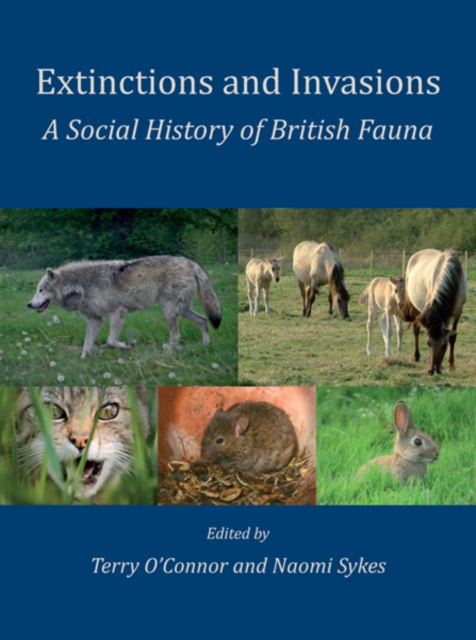
Extinctions and invasions: a social hsitory of British fauna
Eight thousand years ago, when the sea cut Britain off from the rest of the Continent, the island's fauna was very different: most of the animals familiar to us today were not present, whilst others, now extinct, were abundant. Over the course of millennia humans have manipulated Britain's fauna. For reasons of fear, suspicion, desire, or simply inadvertently, certain species were brought to extinction. In their place new animals were introduced: some transported purposefully by invading populations, others sent as royal gifts from far off lands, whilst several species arrived as stowaways. The story of each is fascinating, telling of the changing and multi-layered relationship between humans and animals. Drawing on new research in the fields of archaeology, ecology and history, this book examines how human society, culture, diet, lifestyles and even whole landscapes were fundamentally shaped by the animal extinctions and introductions that occurred in Britain since the last Ice Age. In its 22 chapters a wide range of mammal, bird, fish, snail and insect species are considered. All of the chapters include new and original research presented by authors who are acknowledged experts on their specific topic. Extinctions and Invasions advances our understanding of Britain's natural history whilst dispelling the myths that have become established in both popular and academic literature. It is written in a style accessible to the general reader, whilst providing the depth of research needed by academic researchers. Extinctions and Invasions provides a valuable single source of information for archaeologists, natural historians and conservation biologists, as well as interested laypeople.
eBook

Extinctions and Invasions
Eight thousand years ago, when the sea cut Britain off from the rest of the Continent, the island's fauna was very different: most of the animals familiar to us today were not present, whilst others, now extinct, were abundant. Over the course of millennia humans have manipulated Britain's fauna. For reasons of fear, suspicion, desire, or simply inadvertently, certain species were brought to extinction. In their place new animals were introduced: some transported purposefully by invading populations, others sent as royal gifts from far off lands, whilst several species arrived as stowaways. The story of each is fascinating, telling of the changing and multi-layered relationship between humans and animals. Drawing on new research in the fields of archaeology, ecology and history, this book examines how human society, culture, diet, lifestyles and even whole landscapes were fundamentally shaped by the animal extinctions and introductions that occurred in Britain since the last Ice Age. In its 22 chapters a wide range of mammal, bird, fish, snail and insect species are considered. All of the chapters include new and original research presented by authors who are acknowledged experts on their specific topic. Extinctions and Invasions advances our understanding of Britain's natural history whilst dispelling the myths that have become established in both popular and academic literature. It is written in a style accessible to the general reader, whilst providing the depth of research needed by academic researchers. Extinctions and Invasions provides a valuable single source of information for archaeologists, natural historians and conservation biologists, as well as interested laypeople.
eBook

Reconstructing Human-Animal-Environment Relationships at the Edge of the Roman World
Over the last three decades isotope studies have become a mainstay of archaeological investigations into human diet and mobility. A small comparative sample of faunal remains often underpins these studies, used to create baselines, proxies, and provide relative information for building interpretations of the human isotope values (for example, Katzenberg 2000; Lightfoot et al. 2009; Mays 2000; Müldner 2013; Müldner and Richards 2005; Stevens et al. 2012). In recent years, the value of studying the isotope data of faunal material has been increasingly recognized. Studies of this kind have allowed detailed research into animal diets (Hamilton and Thomas 2012; Madgwick
Book Chapter
Reconstructing Human-Animal-Environment Relationships at the Edge of the Roman World
Over the last three decades isotope studies have become a mainstay of archaeological investigations into human diet and mobility. A small comparative sample of faunal remains often underpins these studies, used to create baselines, proxies, and provide relative information for building interpretations of the human isotope values (for example, Katzenberg 2000; Lightfoot et al. 2009; Mays 2000; Müldner 2013; Müldner and Richards 2005; Stevens et al. 2012). In recent years, the value of studying the isotope data of faunal material has been increasingly recognized. Studies of this kind have allowed detailed research into animal diets (Hamilton and Thomas 2012; Madgwick
Book Chapter