
Catalogue Search | MBRL


Are you sure you want to remove the book from the shelf?

{{itemTitle}}
4
result(s) for
"Symonds, Dominic, author"
Sort by:

Broadway rhythm : imaging the city in song
Broadway Rhythm is a guide to Manhattan like nothing you've ever read. Author Dominic Symonds calls it a performance cartography, and argues that the city of New York maps its iconicity in the music of the Broadway songbook. A series of walking tours takes the reader through the landscape of Manhattan, clambering over rooftops, riding the subway, and flying over skyscrapers. Symonds argues that Broadway's songs can themselves be used as maps to better understand the city though identifiable patterns in the visual graphics of the score, the auditory experience of the music, and the embodied articulation of performance, recognizing in all of these patterns, corollaries inscribed in the terrain, geography, and architecture of the city. Through musicological analyses of works by Gershwin, Bernstein, Copland, Sondheim and others, the author proposes that performance cartography is a versatile methodology for urban theory, and establishes a methodological approach that uses the idea of the map in three ways: as an impetus, a metaphor, and a tool for exploring the city.
Book

We'll have Manhattan : the early work of Rodgers and Hart
Richard Rodgers and Lorenz Hart collaborated on more than forty shows before Hart’s death, contributing dozens of classic song hits to the Great American Songbook. This book focuses on the early period of their collaboration, before the huge successes of the 1930s. From 1919, when they met, until their brief flirtation with Hollywood in the early thirties, their output was prodigious, progressive, and experimental. During this period they developed their style and an approach to writing musicals that would be fundamental to the development of the form. Despite this, despite their numerous celebrated songs and the many Broadway and West End successes they enjoyed, the 1920s shows remain little known and important archives of their work little explored. Not just a historical study of their first collaborative years, this book also offers an accessible but authoritative study of their material, documenting the early shows and providing a critical and analytical commentary on their songwriting practice and its influence on the subsequent development of the American musical. In particular, the book explores three main themes: the way they developed a language of song whose techniques anticipate the development of the integrated musical; the way they increasingly understood their work as part of an industry, accommodating the needs of production into their creative practice; and the way their individual characters emerge throughout their careers as formative influences on the shows they would create. With a supporting cast including Herb Fields, Lew Fields, George Gershwin, Busby Berkeley, and Florenz Ziegfeld, this book places Rodgers and Hart at the center of a burgeoning art form.
eBook

Economies of collaboration in performance : more than the sum of the parts
\"This is a book about collaboration in the arts, which explores how working together seems to achieve more than the sum of the parts. It introduces ideas from economics to conceptualize notions of externalities, complementarity, and emergence, and playfully explores collaborative structures such as the swarm, the crowd, the flock, and the network. It uses up-to-date thinking about Wikinomics, Postcapitalism, and Biopolitics, underpinned by ideas from Foucault, Bourriaud, and Hardt and Negri. In a series of thought-provoking case studies, the authors consider creative practices in theatre, music and film. They explore work by artists such as Gob Squad, Eric Whitacre, Dries Verhoeven, Pete Wyer, and Tino Seghal, and encounter both live and online collaborative possibilities in fascinating discussions of Craigslist and crowdfunding at the Edinburgh Festival. What is revealed is that the introduction of Web 2.0 has enabled a new paradigm of artistic practice to emerge, in which participatory encounters, collaboration, and online dialogue become key creative drivers. Written itself as a collaborative project between Karen Savage and Dominic Symonds, this is a strikingly original take on the economics of working together\"--Back cover.
Book
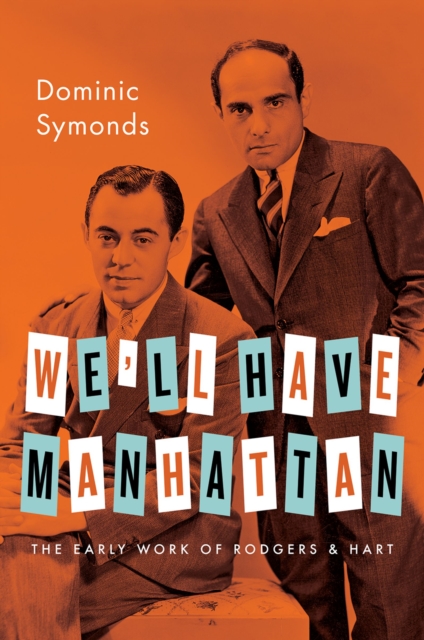
We'll have Manhattan: the early work of Rodgers and Hart, 1919-1931
Richard Rodgers and Lorenz Hart are one of the defining duos of musical theater, contributing dozens of classic songs to the Great American Songbook and working together on over 40 shows before Hart's death. With hit after hit on both Broadway and the West End, they produced many of the celebrated songs of the '20s and '30s--such as \"Manhattan,\" \"The Lady is a Tramp,\" and \"Bewitched\"--that remain popular favorites with great cultural resonance today. Yet the early years of these iconic collaborators have remained largely unexamined. We'll Have Manhattan: The Early Work of Rodgers Hart provides unprecedented insight into the first, formative period of Rodgers and Hart's collaboration. Author Dominic Symonds examines the pair and their work from their first meeting in 1919 to their brief flirtation with Hollywood in the early 1930s as they left the theater to explore sound film. During this time, their output was prodigious, progressive, and experimental. They developed their characteristic style and a new approach to musical theater writing that provided the groundwork for the development of the Broadway musical. Symonds also analyzes the theme of identity that runs throughout Rodgers and Hart's work, how the business side of the theater affected their artistic output, and their continued experimentation with a song's dramatic role within a narrative. We'll Have Manhattan goes beyond a biographical or historical look at Rodgers and Hart's early years--it's also an accessible but authoritative study of their material. Symonds documents their early shows and provides deft critical and analytical commentary on their evolving practice and its influence on the subsequent development of the American musical. Fans of musical theater and devotees of Rodgers and Hart will find this definitive exploration of their early works to be an essential addition to their Broadway library.
eBook