
Catalogue Search | MBRL


Are you sure you want to remove the book from the shelf?

{{itemTitle}}
114
result(s) for
"Tan, Kenneth Paul"
Sort by:


Singapore in 2011
In 2011, Singaporeans voted in parliamentary and presidential elections. The social networking media, dominated by alternative reporting and commentary, played a significant role in generating political interest and mobilizing oppositional thinking and support. Faced with a stronger oppositional presence and a politically emboldened electorate, the People's Action Party government won the elections but achieved its worst results ever.
Journal Article
Singapore in 2011
In 2011, Singaporeans voted in parliamentary and presidential elections. The social networking media, dominated by alternative reporting and commentary, played a significant role in generating political interest and mobilizing oppositional thinking and support. Faced with a stronger oppositional presence and a politically emboldened electorate, the People's Action Party government won the elections but achieved its worst results ever.
Journal Article

Meritocracy and Elitism in a Global City: Ideological Shifts in Singapore
The concept of meritocracy is unstable as its constituent ideas are potentially contradictory. The egalitarian aspects of meritocracy, for example, can come into conflict with its focus on talent allocation, competition, and reward. In practice, meritocracy is often transformed into an ideology of inequality and elitism. In Singapore, meritocracy has been the main ideological resource for justifying authoritarian government and its pro-capitalist orientations. Through competitive scholarships, stringent selection criteria for party candidacy, and high ministerial salaries, the ruling People's Action Party has been able to co-opt talent to form a \"technocratic\" government for an \"administrative state.\" However, as Singapore becomes more embedded in the processes of globalization, it will experience new forms of national crisis, alternative worldviews through global communications technology, and a widening income gap, all of which will force its ideology of meritocracy to unravel. /// Le concept de méritocratie est instable du fait que ses idées constitutives sont potentiellement contradictoires. Les aspects égalitaires de la méritocratie, par exemple, peuvent entrer en conflit avec ses principes d'attribution, de concurrence et de récompense du talent. Dans la pratique, la méritocratie est souvent transformée en idéologie de l'inégalité et de l'élitisme. À Singapour, la méritocratie a constitué la ressource idéologique principale pour justifier le gouvernement autoritaire et ses orientations pro-capitalistes. Par la mise en concurrence universitaire, de rigoureux critères de choix à la candidature du parti et des salaires ministériels élevés, le Parti de l'action du peuple, au pouvoir, a pu coopter les talents afin de former un gouvernement \"technocratique\" pour un \"état administratif\". Cependant, au fur et à mesure que Singapour devient davantage incorporée dans les processus de mondialisation, il va éprouver de nouvelles formes de crise nationale, des points de vue alternatifs du fait de la technologie de communication globale, et un fossé s'élargissant entre les revenus, qui amènera son idéologie de la méritocratie à s'effilocher. /// El concepto de meritocracia es inestable y sus ideas constitutivas son potencialmente contradictorias. Los aspectos igualitarios de la meritocracia pueden, por ejemplo, entrar en conflicto con su enfoque en la asignación de talento, competencia y recompensa. En la práctica, la meritocracia queda a menudo transformada en una ideología de desigualdad y elitismo. En Singapur, la meritocracia ha servido de principal recurso ideológico para justificar un gobierno autoritario y sus tendencias pro-capitalistas. Mediante una oferta de becas competitivas, unos criterios de selección rigurosos y unos elevados salarios ministeriales, el partido en el poder -- el Partido de la Acción del Pueblo -- ha sabido atraer talento con el fin de formar un gobierno \"tecnocrático\" para un \"estado administrativo\". Sin embargo, conforme Singapur se halle más inmersa en los procesos de globalización padecerá nuevas formas de crisis nacional, además de asistir a la aparición de puntos de vista alternativos gracias al crecimiento global de la tecnología de las comunicaciones y experimentar un ensanchamiento de las diferencias salariales -- todo lo cual forzará al esclarecimiento de su ideología meritocrática.
Journal Article
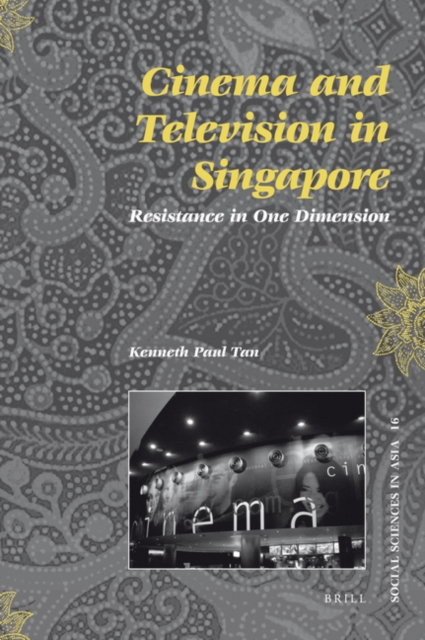
Cinema and Television in Singapore
Through close readings of contemporary made-in-Singapore films (by Jack Neo, Eric Khoo, and Royston Tan) and television programs (Singapore Idol, sitcoms, and dramas), this book analyzes the prospects of resistance in an advanced capitalist-industrial society with \"global city\" aspirations.
eBook

Singapore in 2015
In 2015, Singaporeans voted in parliamentary elections. The incumbent People's Action Party won a landslide victory, in contrast with its performance in the 2011 elections, which had been the worst since Singapore gained independence. The party successfully reinvented itself as a more left-leaning and responsive party in government. Its public image improved by its association with Lee Kuan Yew, who passed away in this jubilee year.
Journal Article
Singapore in 2015
In 2015, Singaporeans voted in parliamentary elections. The incumbent People’s Action Party won a landslide victory, in contrast with its performance in the 2011 elections, which had been the worst since Singapore gained independence. The party successfully reinvented itself as a more left-leaning and responsive party in government. Its public image improved by its association with Lee Kuan Yew, who passed away in this jubilee year.
Journal Article
Singapore in 2014
In the “new normal” following the 2011 general election, Singapore seems poised for further development toward liberal democracy. However, the ruling People’s Action Party is attempting to reinvent itself and regain its hegemonic position, which requires finding credible solutions for very challenging problems to do with policy, communication, and public image.
Journal Article
Singapore in 2014
In the “new normal” following the 2011 general election, Singapore seems poised for further development toward liberal democracy. However, the ruling People’s Action Party is attempting to reinvent itself and regain its hegemonic position, which requires finding credible solutions for very challenging problems to do with policy, communication, and public image.
Journal Article