
Catalogue Search | MBRL


Are you sure you want to remove the book from the shelf?

{{itemTitle}}
7
result(s) for
"Tarling, Nicholas author"
Sort by:
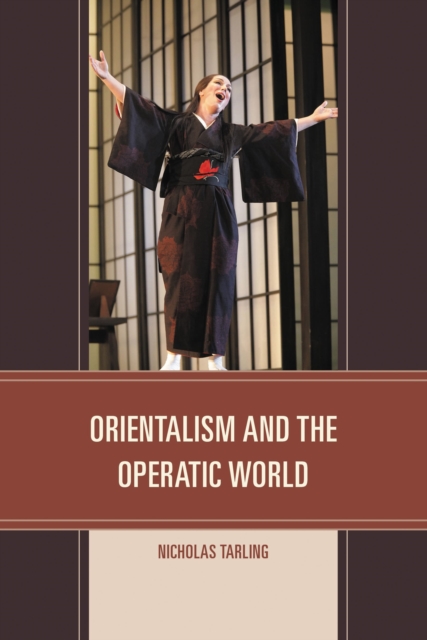
Orientalism and the operatic world
Western opera is a globalized and globalizing phenomenon and affords us a unique opportunity for exploring the concept of \"orientalism,\" the subject of literary scholar Edward Said's modern classic on the topic. Nicholas Tarling's Orientalism and the Operatic World places opera in the context of its steady globalization over the past two centuries. In this important survey, Tarling first considers how the Orient appears on the operatic stage in Britain, France, Germany, Russia, and the United States before exploring individual operas according to the region of the \"Orient\" in which the work is set.
Throughout, Tarling offers key insights into such notable operas as George Frideric Handel's Berenice, Giuseppe Verdi's Aida, Giacomo Puccini's MadamaButterfly, Pietro Mascagni's Iris, and others. Orientalism and the Operatic World argues that any close study of the history of Western opera, in the end, fails to support the notion propounded by Said that Westerners inevitably stereotyped, dehumanized, and ultimately sought only to dominate the East through art. Instead, Tarling argues that opera is a humanizing art, one that emphasizes what humanity has in common by epic depictions of passion through the vehicle of song.
Orientalism and the Operatic World is not merely for opera buffs or even first-time listeners. It should also interest historians of both the East and West, scholars of international relations, and cultural theorists.
eBook

Orientalism and the operatic world
Western opera is a globalized and globalizing phenomenon and affords us a unique opportunity for exploring the concept of \"orientalism,\" the subject of literary scholar Edward Said's modern classic on the topic. Nicholas Tarling's Orientalism and the Operatic World places opera in the context of its steady globalization over the past two centuries. In this important survey, Tarling first considers how the Orient appears on the operatic stage in Britain, France, Germany, Russia, and the United States before exploring individual operas according to the region of the \"Orient\" in which the work is set.
Book
Status and Security in Southeast Asian State Systems
Southeast Asia serves as an excellent case study to discuss major transformations in the relationship between states. This book looks at the changing nature of relationships between countries in Southeast Asia, as well as their relationships with other states in Asia and beyond.
A diverse region in many areas, open to outside influence in many fields, but not without dynamics of its own, Southeast Asia has been through centuries the site of states with very differing levels of power and in a variety of forms. It has also been exposed to powerful neighbours, seawards empires and contending world powers. Adopting a historical approach, the book analyses state relations against the background of regional and geopolitical developments from within and without. It discusses how Southeast Asian states of the 21st century can best preserve their security in the context of the rise of China, and goes on to look at the extent to which they can preserve their autonomy of action.
Offering a long-term perspective on these issues, this inter-disciplinary study is of interest to scholars and students of Southeast Asian history and politics, world history and international relations.
eBook


Nationalism in Southeast Asia
Nationalism in Southeast Asia seeks a definition of nationalism through examining its role in the history of southeast Asia, a region rarely included in general books on the topic. By developing such a definition and testing it out, Tarling hopes at the same time to make a contribution to southeast Asian historiography and to limit its 'ghettoization'.Tarling considers the role of nationalism in the 'nation-building' of the post-colonial phase, and its relationship both with the democratic aspirations associated with the winning of independence and with the authoritarianism of the closing decades of the 20th century.
eBook
