
Catalogue Search | MBRL


Are you sure you want to remove the book from the shelf?

{{itemTitle}}
200
result(s) for
"Tarlow, Sarah"
Sort by:


The Archaeology of Improvement in Britain, 1750–1850
In this innovative 2007 study, Sarah Tarlow shows how the archaeology of this period manifests a widespread and cross-cutting ethic of improvement. Theoretically informed and drawn from primary and secondary sources in a range of disciplines, the author considers agriculture and the rural environment, towns, and buildings such as working-class housing and institutions of reform. From bleach baths to window glass, rubbish pits to tea wares, the material culture of the period reflects a particular set of values and aspirations. Tarlow examines the philosophical and historical background to the notion of improvement and demonstrates how this concept is a useful lens through which to examine the material culture of later historical Britain.
eBook

Ritual, belief, and the dead in early modern Britain and Ireland
\"Drawing on archaeological, historical, theological, scientific, and folkloric sources, Sarah Tarlow's interdisciplinary study examines belief as it relates to the dead body in early modern Britain and Ireland. From the theological discussion of bodily resurrection to the folkloric use of body parts as remedies, and from the judicial punishment of the corpse to the ceremonial interment of the social elite, this book discusses how seemingly incompatible beliefs about the dead body existed in parallel through this tumultuous period. This study, which is the first to incorporate archaeological evidence of early modern death and burial from across Britain and Ireland, addresses new questions about the materiality of death: what the dead body means, and how its physical substance could be attributed with sentience and even agency. It provides a sophisticated original interpretive framework for the growing quantities of archaeological and historical evidence about mortuary beliefs and practices in early modernity\"-- Provided by publisher.
Book

The Archaeology of Emotion and Affect
The literature on the archaeology of emotion and affect is mostly quite recent and is not extensive. This review considers the main lines of approach taken so far and explores how different understandings of what constitutes an emotion underlie the work of archaeologists in this area. A distinction is made between past emotion as a subject of study and examination of the emotional subjectivity of the archaeologist as a method. The potential contribution of archaeology to emotion studies in the future includes bringing a sense of contextual historicity to the discussion and developing our knowledge of how material things and places are involved in shaping and expressing emotion. Inspired by some historians of emotion, a focus on shared emotional meanings, values, and codes seems a more productive direction than the exploration of idiosyncratic personal emotional experience.
Journal Article

The archaeology of improvement in Britain, 1750-1850
Sarah Tarlow shows how the archaeology of Britain in the period 1750-1850 manifests a widespread and cross-cutting ethic of improvement, one of the most current concepts of eighteenth and nineteenth century Britain.
Book

The Technology of the Gibbet
The practice of \"hanging in chains\" or gibbeting had been part of the punitive repertoire of the English and Welsh judicial system for centuries before the 1751–52 Murder Act specified it as one of two mandatory post-mortem punishments for murderers. The practice was not abolished until 1834. This article considers the technical and design features of the gibbet cage, through an exhaustive survey and catalogue of their surviving remains. It notes that, given the comparative rarity of hanging in chains, no chronological or regional traditions of design are evident in this kind of artifact, since blacksmiths were individually solving the problem of fulfilling the necessary functions of a gibbet cage without knowledge of previous examples and under great time pressure. The technology of the gibbet shows how state directives intersected with geographical discretion in the creation of idiosyncratic local solutions.
Journal Article

The archaeology of loss : life, love and the art of dying
A stunning blend of the personal and professional, 'The Archaeology of Loss' is Sarah Tarlow's first memoir. An accomplished archaeologist, much of Sarah's work is concerned with the ritual and belief behind the practice of grief. In 2012, she was awarded the Chair in Archaeology at the University of Leicester. But in the years that followed this appointment, Sarah's husband, Mark, would begin to suffer from a progressive but undiagnosed illness, finally resulting in his inability to drive, to walk, to taste or to care for himself. Though Sarah had devoted her professional life to the study of emotion, of how we anticipate and experience grief, nothing could have prepared her for the realities of care-giving, of losing someone you love and the helplessness attached to both.
Book
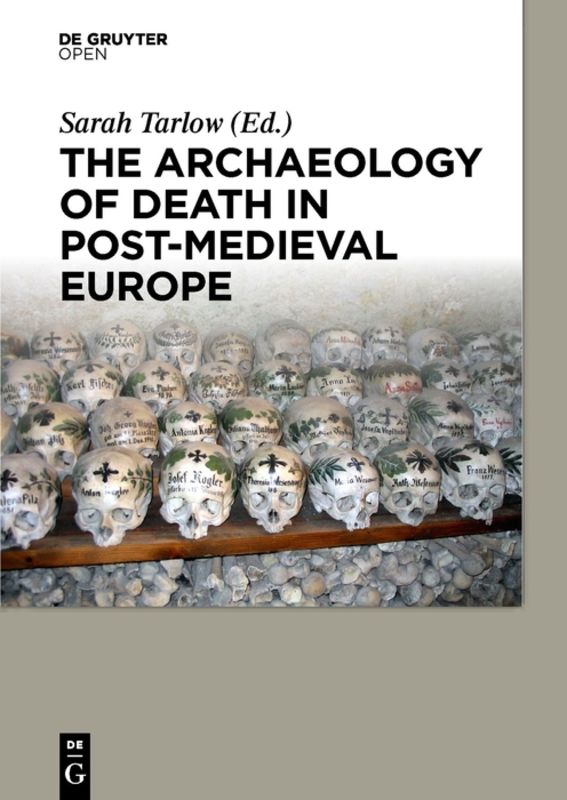
The Archaeology of Death in Post-medieval Europe
Historical burial grounds are an enormous archaeological resource and have the potential to inform studies not only of demography or the history of disease and mortality, but also histories of the body, of religious and other beliefs about death, of changing social relationships, values and aspirations. In the last decades, the intensive urban development and a widespread legal requirement to undertake archaeological excavation of historical sites has led to a massive increase in the number of post-medieval graveyards and burial places that have been subjected to archaeological investigation. The archaeology of the more recent periods, which are comparatively well documented, is no less interesting and important an area of study than prehistoric periods. This volume offers a range of case studies and reflections on aspects of death and burial in post-medieval Europe. Looking at burial goods, the spatial aspects of cemetery organisation and the way that the living interact with the dead, contributors who have worked on sites from Central, North and West Europe present some of their evidence and ideas. The coherence of the volume is maintained by a substantial integrative introduction by the editor, Professor Sarah Tarlow. “This book is a ‘first’ and a necessary one. It is an exciting and far-ranging collection of studies on post-medieval burial practice across Europe that will most certainly be used extensively” Professor Howard Williams
eBook


Ethical entanglements: human remains, museums and ethics in a European perspective
The ethical treatment of human remains after excavation is a core debate in archaeology. This project explores the treatment of human remains in some European museums with an aim to support open discussion of complex ethical issues among research and heritage professionals involved in the care of human remains.
Journal Article