
Catalogue Search | MBRL


Are you sure you want to remove the book from the shelf?

{{itemTitle}}
85
result(s) for
"Tarrant, Richard"
Sort by:

Critical Path to First-in-Human Batches of ChAdOx Vectors, Including for Emergency Response
Adenovirus-vectored vaccines played an important role in the global response to SARS-CoV-2. Adenovirus platforms have many advantages including a simple and readily transferred manufacturing process, low cost, and thermostability. Speed of production of an initial Good Manufacturing Practice (GMP)-compliant batch has, however, been viewed as a limitation of adenovirus vectors relative to mRNA platforms. Production of the initial viral starting material and release testing are key rate-limiting steps.
Production of viral starting material from DNA, and release testing in accordance with regulatory expectations, for first-in-human trials of adenovirus-vectored vaccines.
We describe experience of these stages in the production of the first GMP batches for multiple adenovirus-vectored candidates and the adaptations made for ChAdOx1 nCoV-19 (the Oxford COVID-19 vaccine) in early 2020. We also report development of a streamlined approach to starting material generation, enabling initial GMP batch availability within c. 60 days of publication of a new pathogen sequence. Using a New World arenavirus vaccine construct as a proof of concept, we demonstrate reproducible execution of this pipeline, maintaining acceptable infectivity and other quality attributes.
We discuss opportunities for additional time savings in the future. This work demonstrates suitability of an adenovirus platform to contribute to the \"100 Days Mission\" for vaccines against \"Disease X\".
Journal Article


Production, quality control, stability, and potency of cGMP-produced Plasmodium falciparum RH5.1 protein vaccine expressed in Drosophila S2 cells
Plasmodium falciparum
reticulocyte-binding protein homolog 5 (PfRH5) is a leading asexual blood-stage vaccine candidate for malaria. In preparation for clinical trials, a full-length PfRH5 protein vaccine called “RH5.1” was produced as a soluble product under cGMP using the ExpreS
2
platform (based on a
Drosophila melanogaster
S2 stable cell line system). Following development of a high-producing monoclonal S2 cell line, a master cell bank was produced prior to the cGMP campaign. Culture supernatants were processed using C-tag affinity chromatography followed by size exclusion chromatography and virus-reduction filtration. The overall process yielded >400 mg highly pure RH5.1 protein. QC testing showed the MCB and the RH5.1 product met all specified acceptance criteria including those for sterility, purity, and identity. The RH5.1 vaccine product was stored at −80 °C and is stable for over 18 months. Characterization of the protein following formulation in the adjuvant system AS01
B
showed that RH5.1 is stable in the timeframe needed for clinical vaccine administration, and that there was no discernible impact on the liposomal formulation of AS01
B
following addition of RH5.1. Subsequent immunization of mice confirmed the RH5.1/AS01
B
vaccine was immunogenic and could induce functional growth inhibitory antibodies against blood-stage
P. falciparum
in vitro. The RH5.1/AS01
B
was judged suitable for use in humans and has since progressed to phase I/IIa clinical trial. Our data support the future use of the
Drosophila
S2 cell and C-tag platform technologies to enable cGMP-compliant biomanufacture of other novel and “difficult-to-express” recombinant protein-based vaccines.
Malaria: Successful clinical trial preparation for blood-stage vaccine
A vaccine candidate for blood-stage malaria has overcome previous hurdles to enter clinical trials. The protein PfRH5 is an essential blood-stage infection facilitator of malarial parasite
Plasmodium falciparum
, and a promising target for vaccine strategies. Unfortunately, efforts to produce the protein in an immunogenic, clinically-viable way have been met with difficulty. Here, researchers led by Simon Draper, from the UK’s Jenner Institute, used a fruit fly expression system to produce over 400 mg of high-purity protein. Formulated with an immunity-boosting adjuvant, the vaccine elicited antibodies in mice that proved inhibitory to blood-stage
P. falciparum
during
in vitro
assays. The PfRH5 vaccine candidate and its adjuvant have been approved for a clinical trial in the UK, and the authors hope that the expression system used may be beneficial in the expression of other ‘difficult’ proteins.
Journal Article

T cell and antibody responses induced by a single dose of ChAdOx1 nCoV-19 (AZD1222) vaccine in a phase 1/2 clinical trial
Severe acute respiratory syndrome coronavirus 2 (SARS-CoV-2), the causative agent of Coronavirus Disease 2019 (COVID-19), has caused a global pandemic, and safe, effective vaccines are urgently needed
1
. Strong, Th1-skewed T cell responses can drive protective humoral and cell-mediated immune responses
2
and might reduce the potential for disease enhancement
3
. Cytotoxic T cells clear virus-infected host cells and contribute to control of infection
4
. Studies of patients infected with SARS-CoV-2 have suggested a protective role for both humoral and cell-mediated immune responses in recovery from COVID-19 (refs.
5
,
6
). ChAdOx1 nCoV-19 (AZD1222) is a candidate SARS-CoV-2 vaccine comprising a replication-deficient simian adenovirus expressing full-length SARS-CoV-2 spike protein. We recently reported preliminary safety and immunogenicity data from a phase 1/2 trial of the ChAdOx1 nCoV-19 vaccine (NCT04400838)
7
given as either a one- or two-dose regimen. The vaccine was tolerated, with induction of neutralizing antibodies and antigen-specific T cells against the SARS-CoV-2 spike protein. Here we describe, in detail, exploratory analyses of the immune responses in adults, aged 18–55 years, up to 8 weeks after vaccination with a single dose of ChAdOx1 nCoV-19 in this trial, demonstrating an induction of a Th1-biased response characterized by interferon-γ and tumor necrosis factor-α cytokine secretion by CD4
+
T cells and antibody production predominantly of IgG1 and IgG3 subclasses. CD8
+
T cells, of monofunctional, polyfunctional and cytotoxic phenotypes, were also induced. Taken together, these results suggest a favorable immune profile induced by ChAdOx1 nCoV-19 vaccine, supporting the progression of this vaccine candidate to ongoing phase 2/3 trials to assess vaccine efficacy.
A single dose of the ChAdOx1 nCoV-19 vaccine elicits antibodies and cytokine-producing T cells that might help control or prevent SARS-CoV-2 infection.
Journal Article
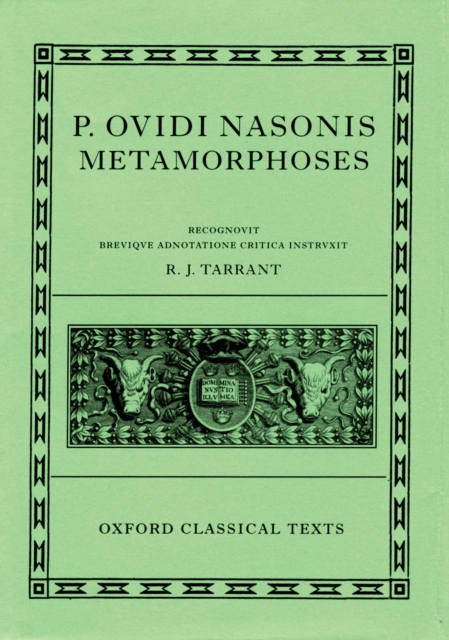
P. Ovidi Nasonis Metamorphoses
For this edition of the Metamorphoses R.J. Tarrant has freshly collated the oldest fragments and manuscripts and has drawn more fully than previous editors on the twelfth-century manuscripts, the earliest extant witnesses to many potentially original readings. He has also given more scope to conjecture than other recent editors, and has been readier than his predecessors to identify certain verses as interpolated. This edition will be indispensable for future study of Ovid's greatest work.
eBook


The Commentum Cornuti
When Wendell Clausen published his \"editio maior\" of Persius in 1956, he signalled an intention to follow it with an edition of the \"Commentum Cornuti\". Some years later, Clausen was joined in the project by his student James Zetzel. After delays caused by other commitments and the difficulty of the task, the edition was published by Teubner in 2004. The volume under review, J.E.G. Zetzel's \"Marginal Scholarship and Textual Deviance. The Commentum Cornuti and Early Scholia on Persius\", is both a supplement and a companion to the edition. It sets out in greater detail than the Teubner preface the editors' rationale in establishing the text and their evaluation of the main manuscript witnesses.
Journal Article

Flexible services for the support of research
Cloud computing has been increasingly adopted by users and providers to promote a flexible, scalable and tailored access to computing resources. Nonetheless, the consolidation of this paradigm has uncovered some of its limitations. Initially devised by corporations with direct control over large amounts of computational resources, cloud computing is now being endorsed by organizations with limited resources or with a more articulated, less direct control over these resources. The challenge for these organizations is to leverage the benefits of cloud computing while dealing with limited and often widely distributed computing resources. This study focuses on the adoption of cloud computing by higher education institutions and addresses two main issues: flexible and on-demand access to a large amount of storage resources, and scalability across a heterogeneous set of cloud infrastructures. The proposed solutions leverage a federated approach to cloud resources in which users access multiple and largely independent cloud infrastructures through a highly customizable broker layer. This approach allows for a uniform authentication and authorization infrastructure, a fine-grained policy specification and the aggregation of accounting and monitoring. Within a loosely coupled federation of cloud infrastructures, users can access vast amount of data without copying them across cloud infrastructures and can scale their resource provisions when the local cloud resources become insufficient.
Journal Article