
Catalogue Search | MBRL


Are you sure you want to remove the book from the shelf?

{{itemTitle}}
10
result(s) for
"Tavárez, David Eduardo"
Sort by:


Rethinking Zapotec Time
2023 - Best Subsequent Book - Native American and
Indigenous Studies Association 2023 - Honorable Mention, Best Book
in the Social Sciences - Latin American Studies Association, Mexico
Section 2022 - Marysa Navarro Best Book Prize - New England Council
of Latin American Studies
As the first exhaustive translation and analysis of an
extraordinary Zapotec calendar and ritual song corpus, seized in
New Spain in 1704, this book expands our understanding of
Mesoamerican history, cosmology, and culture.
In 1702, after the brutal suppression of a Zapotec revolt, the
bishop of Oaxaca proclaimed an amnesty for idolatry in exchange for
collective confessions. To evade conflict, Northern Zapotec
communities denounced ritual specialists and surrendered sacred
songs and 102 divinatory manuals, which preserve cosmological
accounts, exchanges with divine beings, and protocols of
pre-Columbian origin that strongly resemble sections of the Codex
Borgia. These texts were sent to Spain as evidence of failed
Dominican evangelization efforts, and there they remained, in
oblivion, until the 1960s.
In this book, David Tavárez dives deep into this formidable
archive of ritual and divinatory manuals, the largest calendar
corpus in the colonial Americas, and emerges with a rich
understanding of Indigenous social and cultural history,
Mesoamerican theories of cosmos and time, and Zapotec ancestor
worship. Drawing on his knowledge of Zapotec and Nahuatl, two
decades of archival research, and a decade of fieldwork, Tavárez
dissects Mesoamerican calendars as well as Native resistance and
accommodation to the colonial conquest of time, while also
addressing entangled transatlantic histories and shining new light
on texts still connected to contemporary observances in Zapotec
communities.
eBook


The Invisible War
After the conquest of Mexico, colonial authorities attempted to enforce Christian beliefs among indigenous peoples-a project they envisioned as spiritual warfare.The Invisible War assesses this immense but dislocated project by examining all known efforts in Central Mexico to obliterate native devotions of Mesoamerican origin between the 1530s and the late eighteenth century.
The author's innovative interpretation of these efforts is punctuated by three events: the creation of an Inquisition tribunal in Mexico in 1571; the native rebellion of Tehuantepec in 1660; and the emergence of eerily modern strategies for isolating idolaters, teaching Spanish to natives, and obtaining medical proof of sorcery from the 1720s onwards. Rather than depicting native devotions solely from the viewpoint of their colonial codifiers, this book rescues indigenous perspectives on their own beliefs. This is achieved by an analysis of previously unknown or rare ritual texts that circulated in secrecy in Nahua and Zapotec communities through an astute appropriation of European literacy. Tavárez contends that native responses gave rise to a colonial archipelago of faith in which local cosmologies merged insights from Mesoamerican and European beliefs. In the end, idolatry eradication inspired distinct reactions: while Nahua responses focused on epistemological dissent against Christianity, Zapotec strategies privileged confrontations in defense of native cosmologies.
eBook


Invisible wars: Idolatry extirpation projects and Native responses in Nahua and Zapotec communities, 1536–1728
This dissertation analyzes the responses of Nahua and Zapotec ritual specialists to the various educational and judiciary attempts to eradicate native ritual practices regarded as idolatrous or superstitious by ecclesiastical and civil authorities in the archbishopric of Mexico and the bishopric of Oaxaca in New Spain. This project is designed as a comparative regional analysis of ecclesiastical policies and native reactions regarding the prosecution of idolatry and superstition during several institutional cycles: the “apostolic inquisition” (1527–1571), a transitional period (1572–1600's), the rise of secular extirpation attempts (1600's–1660), and a period of institutional consolidation (1660–1728). This analysis-which rests on the examination of doctrinal, legal and ecclesiastical sources located in 29 archives in Mexico, Europe and the U.S.—also addresses the emergence of a network of Nahua and Zapotec literate ritual specialists through a study of the clandestine production and circulation of devotional and ritual texts in or near the Valley of Mexico, and in Sola and Villa Alta in Oaxaca. This analysis is complemented by the translation and discussion of several poorly known ritual and devotional texts in Classical Nahuatl and Nexitzo Zapotec.
Dissertation
La idolatría letrada: un análisis comparativo de textos clandestinos rituales y devocionales en comunidades nahuas y zapotecas, 1613-1654
El presente ensayo ofrece un análisis comparativo de la producción y circulación de textos rituales y devocionales en algunas comunidades nahuas y zapotecas entre 1613-1654, que enfatizan tres temas básicos: la relación entre transmisiones oral y escrita de conocimientos rituales indígenas, la apropiación clandestina de textos rituales y devocionales cristianos por autores indígenas, y la circulación clandestina de textos rituales indígenas. Dichos temas serán abordados por medio de tres casos: 1) la reproducción de un género oral nahua, por parte de especialistas rituales investigados por Ruiz de Alarcón de 1613-1629; 2) la producción de misceláneas devocionales en náhuatl a mitad del siglo XVII, ejemplificada por un manuscrito inédito de la Biblioteca Nacional de Francia con una interpretación en náhuatl, del zodiaco, y 3) la circulación de textos adivinatorios en San Miguel Sola (Oaxaca) entre especialistas rituales zapotecos y sus clientes, según los procesos de idolatría de Balsalobre y de otros párrocos de 1629-1657.
Journal Article
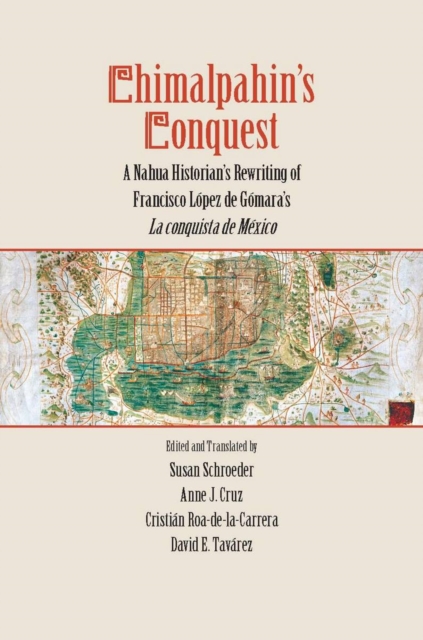
Chimalpahin's Conquest
This volume presents the story of Hernando Cortés's conquest of Mexico, as recounted by a contemporary Spanish historian and edited by Mexico's premier Nahua historian.
Francisco López de Gómara's monumental Historia de las Indias y Conquista de México was published in 1552 to instant success. Despite being banned from the Americas by Prince Philip of Spain,La conquista fell into the hands of the seventeenth-century Nahua historian Chimalpahin, who took it upon himself to make a copy of the tome. As he copied, Chimalpahin rewrote large sections ofLa conquista, adding information about Emperor Moctezuma and other key indigenous people who participated in those first encounters.
Chialpahin's Conquest is thus not only the first complete modern English translation of López de Gómara'sLa conquista, an invaluable source in itself of information about the conquest and native peoples; it also adds Chimalpahin's unique perspective of Nahua culture to what has traditionally been a very Hispanic portrayal of the conquest.
eBook

Albayzín-2014 evaluation: audio segmentation and classification in broadcast news domains
Audio segmentation is important as a pre-processing task to improve the performance of many speech technology tasks and, therefore, it has an undoubted research interest. This paper describes the database, the metric, the systems and the results for the Albayzín-2014 audio segmentation campaign. In contrast to previous evaluations where the task was the segmentation of non-overlapping classes, Albayzín-2014 evaluation proposes the delimitation of the presence of speech, music and/or noise that can be found simultaneously. The database used in the evaluation was created by fusing different media and noises in order to increase the difficulty of the task. Seven segmentation systems from four different research groups were evaluated and combined. Their experimental results were analyzed and compared with the aim of providing a benchmark and showing up the promising directions in this field.
Journal Article