
Catalogue Search | MBRL


Are you sure you want to remove the book from the shelf?

{{itemTitle}}
3,249
result(s) for
"Taylor, Lisa"
Sort by:


Variation in activity rates may explain sex-specific dorsal color patterns in Habronattus jumping spiders
In many animals, color pattern and behavior interact to deceive predators. For mimics, such deception can range from precise (near-perfect mimicry) to only subtle resemblance (imperfect mimicry) and such strategies often differ by sex because of differing ecological selection pressures. In this field study, we examine variation in behavior and ecology that may be linked with sex differences in dorsal color pattern in three sympatric species of Habronattus jumping spiders (H. clypeatus, H. hallani, H. pyrrithrix). Males of these species have conspicuous dorsal patterning that is subtly reminiscent of the general color patterns of wasps and bees, while females are cryptic. We show that, compared with females, these conspicuous males exhibited increased leg-waving behavior outside of the context of courtship; such behavior is common in jumping spiders that mimic wasps and bees presumably because a mimic's waving legs resemble antennae. Males of a fourth sympatric species (H. hirsutus) without conspicuous dorsal patterning did not exhibit increased leg-waving. These results are consistent with and offer preliminary support for the idea that male color and behavior may work together to deceive predators. We also examined whether higher movement rates of males (who must wander to find females) and/or different use of the microhabitat by the sexes could explain sexual dichromatism. We found that microhabitat use was similar for males and females, but males of all three conspicuously-colored species spent more time actively moving than females. To our knowledge, this is the first study to speculate that conspicuous male dorsal coloration in Habronattus may have a deceptive function, and to explore why dorsal coloration differs between the sexes.
Journal Article

The unfulfilled promise of press freedom in Canada
\"The Unfulfilled Promise of Press Freedom in Canada offers a vast array of viewpoints that critically analyze the application and interpretation of press freedom under the Charter of Rights. This collection, assiduously put together by editors Lisa Taylor and Cara-Marie O'Hagan, showcases the insights of leading authorities in law, journalism, and academia as well as broadcasters and public servants. The contributors explore the ways in which press freedom has been constrained by outside forces, like governmental interference, threats of libel suits, and financial constraints. These intersectional and multifaceted lines of inquiry provide the reader with a 360-degree assessment of press freedom in Canada while discouraging complacency among Canadian citizens. After all, an informed citizenry is a free citizenry.\"-- Provided by publisher.
Book

Mantidfly larvae use cues on substrate to locate and distinguish different sexes and life stages of potential spider hosts
In many animals, early-life decisions influence long-term fitness. Mantidflies are spider egg predators; their tiny larvae climb aboard spiders to find eggs, but little is known about how they find spiders. We tested the hypothesis that mantidfly larvae (
Dicromantispa sayi
) detect and respond to substrate-borne spider cues (e.g., silk and/or excreta). We presented larvae with filter paper exposed to different types of spiders (adult female, adult male, or juvenile
Habronattus trimaculatus
jumping spiders) versus a no-cue control. Larvae spent more time on filter paper with spider cues. We then tested the hypothesis that mantidflies make finer distinctions between spiders when given direct choices between these cues. Larvae did not discriminate between sexes but spent more time (and exhibited more phoretic behavior) on filter paper with female or male cues compared with juvenile cues. While this suggests that mantidflies actively seek out adult spiders, we also found that adult spiders were more active than juveniles and may have simply deposited more silk and excreta, providing a stronger cue to detect. We discuss these findings in the context of the risks and benefits of different spider hosts, and how early-life spider-searching strategies may shape a mantidfly’s long-term fitness.
Journal Article

Methods for independently manipulating palatability and color in small insect prey
Understanding how the psychology of predators shapes the defenses of colorful aposematic prey has been a rich area of inquiry, with emphasis on hypothesis-driven experiments that independently manipulate color and palatability in prey to examine predator responses. Most of these studies focus on avian predators, despite calls to consider more taxonomically diverse predators. This taxonomic bias leaves gaps in our knowledge about the generalizability of current theory. Here we have adapted tools that have been successfully used with bird predators and scaled them down and tested them with smaller predators (Habronattus jumping spiders) and small insect prey (termites, milkweed bug nymphs, pinhead crickets, fruit flies). Specifically, we test (1) the application of denatonium benzoate (DB) to the surface of live termites, crickets, and fruit flies, and (2) the effectiveness of manipulating the palatability of milkweed bug nymphs through diet. We also test the effectiveness of combining these palatability manipulations with various color manipulations. Across several experiments, we confirm that our palatability manipulations are not detectable to the spiders before they attack (i.e., they do not produce aversive odors that spiders avoid), and show that unpalatable prey are indeed quickly rejected and spiders do not habituate to the taste with experience. We also investigate limitations of these techniques by assessing possible unintended effects on prey behavior and the risk of contact contamination when using DB-treated prey in experiments. While similar tools have been used to manipulate color and palatability with avian predators and relatively large insect prey, we show how these techniques can be effectively adapted for use with small invertebrate predators and prey.
Journal Article

All the rocks we love
\"Children love rocks. Rocks appear in jacket pockets, on windowsills, in the car, in their hiding places, and most often, in their little grips. Rocks are universal--they can be found in all climates, countries, and communities--making themselves available to anyone who craves the tactile pleasure of holding a perfectly sized, unfragile, unowned object. They can be collected, compared, stacked, plunked into water, painted, and shared. This book is an appreciation of their versatility and appeal, paired with the presentation of real types of rocks and their play-worthy attributes. The back matter provides just enough extra information about each of the rocks included in the book. Written by a children's author and psychotherapist, in partnership with her geologist husband, and illustrated with both warmth and accuracy, this nonfiction ode to rocks will speak to all little hands and hearts\"-- Provided by publisher.
CHILDBOOK
Lack of neophobic responses to color in a jumping spider that uses color cues when foraging (Habronattus pyrrithrix)
Chemically defended prey often advertise their toxins with bright and conspicuous colors. To understand why such colors are effective at reducing predation, we need to understand the psychology of key predators. In bird predators, there is evidence that individuals avoid novelty—including prey of novel colors (with which they have had no prior experience). Moreover, the effect of novelty is sometimes strongest for colors that are typically associated with aposematic prey (e.g., red, orange, yellow). Given these findings in the bird literature, color neophobia has been argued to be a driving force in the evolution of aposematism. However, no studies have yet asked whether invertebrate predators respond similarly to novel colors. Here, we tested whether naive lab-raised jumping spiders ( Habronattus pyrrithrix ) exhibit similar patterns of color neophobia to birds. Using color-manipulated living prey, we first color-exposed spiders to prey of two out of three colors (blue, green, or red), with the third color remaining novel. After this color exposure phase, we gave the spiders tests where they could choose between all three colors (two familiar, one novel). We found that H . pyrrithrix attacked novel and familiar-colored prey at equal rates with no evidence that the degree of neophobia varied by color. Moreover, we found no evidence that either prey novelty nor color (nor their interaction) had an effect on how quickly prey was attacked. We discuss these findings in the context of what is known about color neophobia in other animals and how this contributes to our understanding of aposematic signals.
Journal Article
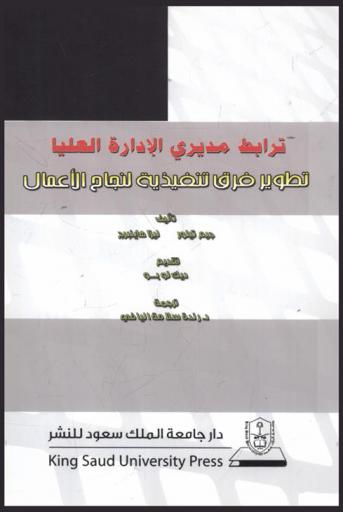
ترابط مديري الإدارة العليا : تطوير فرق تنفيذية لنجاح الأعمال
يركز هذا الكتاب على أكثر الأدوات فاعلية لتحسين أداء المدرين وتطوير أداء الفريق التنفيذي الذي يعمل معهم ويوضح الكتاب أيضا في المقام الأول أهمية تعاون أعضاء الفريق التنفيذي وبدا أن ذلك أكثر أهمية مما كان المرء يظنه وبين في المقام الثاني الكيفية التي يمكن بها ترجمة ذلك مباشرة إلى أهمية مما كان المرء يظنه.
Book
Hemipteran defensive odors trigger predictable color biases in jumping spider predators
Multimodal warning displays often pair one signal modality (odor) with a second modality (color) to avoid predation. Experiments with bird predators suggest these signal components interact synergistically, with aversive odors triggering otherwise hidden aversions to particular prey colors. In a recent study, this phenomenon was found in a jumping spider (
Habronattus trimaculatus
), with the defensive odor from a coreid bug (
Acanthocephala femorata
) triggering an aversion to red. Here, we explore how generalizable this phenomenon is by giving
H. trimaculatus
the choice between red or black prey in the presence or absence of defensive odors secreted from (1) eastern leaf-footed bugs (
Leptoglossus phyllopus
, Hemiptera), (2) grass stinkbugs (
Mormidea pama
, Hemiptera), (3) Asian ladybird beetles (
Harmonia axyridis
, Coleoptera), and (4) eastern lubber grasshoppers (
Romalea microptera
, Orthoptera). As expected, in the presence of the hemipteran odors, spiders were less likely to attack red prey (compared to no odor). Unexpectedly, the beetle and grasshopper odors did not bias spiders away from red. Our results with the hemipteran odors were unique to red; follow-up experiments indicated that these odors did not affect biases for/against green prey. We discuss our findings in the context of generalized predator foraging behavior and the functions of multimodal warning displays.
Journal Article