
Catalogue Search | MBRL


Are you sure you want to remove the book from the shelf?

{{itemTitle}}
7
result(s) for
"Teachman, Debra"
Sort by:
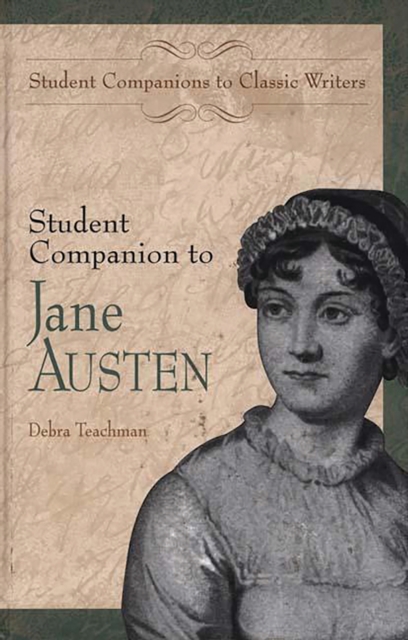
Student Companion to Jane Austen
Generations of readers and movie viewers have been drawn to the spirited heroines of ^USense and Sensibility and ^UEmma. Prepared especially for students, this full-length critical study of Jane Austen covers her six most beloved works, including the two novels ^UNorthanger Abbey and ^UPersuasion, published posthumously. Young readers will enjoy the vivid biographical account of how Austen herself was just a teenager when she took up the pen and began to write in guarded secrecy. Austen scholar Debra Teachman has a historian's eye for detail as she describes Austen's homelife in the English countryside and the social environment that were so much a part of Austen's stories. Teachman examines each novel, relating how historical context influenced the characters, events and themes that Austen developed. Teachman eloquently points out, for example, that while Austen does not overtly preach feminism in any of her novels, the lack of legal protection for women is a vital societal theme in ^USense and Sensibility. Her discussion of the economic realities at the core of Austen's novels will help readers appreciate that works like the best-selling Pride and Prejudice are more than just charming stories. In addition to analyzing the literary elements in each work of fiction by Jane Austen, this Companion also gives students an overview of Austen's literary heritage. Discussing first the novel itself as a genre, this useful chapter then identifies each sub-genre that influenced Austen: epistolary writing, the adventure novel, the gothic form, and Women's Rights novels. An extensive bibliography directs readers to biographical materials, historical documents, reviews, criticism and numerous other accessible sources that will enhance their further study of Austen's writings. For students of classic fiction, this well written critical study aids in the enjoyment and understanding of the life and works of Jane Austen.
eBook

Understanding Jane Eyre: A Student Casebook to Issues, Sources, and Historical Documents
Immediately popular when published over a century and a half ago, Jane Eyre has continued to find appreciative audiences since. This student casebook offers a unique interdisciplinary approach to the study of Charlotte Bronte's landmark novel. While it gives insightful literary analysis, it also contextualizes the novel in terms of the historical social issues it confronts. Expert commentary is supported with primary documents from legal and medical treatises, magazine articles, letters, essays and first hand accounts. A personal biography written by Elizabeth Gaskell, an acquaintance of Bronte, offers a detailed account of the Cowan Bridge School which Charlotte attended and fictionalized in Jane Eyre. Educators will find ideas for teaching these topics and for helping students see the connections between the novel and the social concerns it raises. Devoted to close examination of such topics as the diagnosis and treatment of madness and inheritance and marriage law and custom, this work will help students to understand historical cultural influences of yesterday. Contemporary issues such as education and mental illness raised by Jane Eyre are also discussed. Each section offers valuable ideas for written and oral exploration including role playing, debates, and journal writing assignments. Chapters conclude with suggestions for further reading.
eBook


Expectation and inheritance: The moral economy of Jane Austen's fiction
This dissertation examines the ways in which Austen depicts her society in her fiction, showing the dangers inherent in a social organization in which primary qualifications for ruling family, community, and even nation, are gender and birth order. An examination of eighteenth-century property and inheritance laws and customs provides an understanding of much of the knowledge available to early nineteenth-century readers, knowledge which makes its appearance--tacitly--in each of Austen's novels. Implications of actions regarding property and inheritance throughout the novels are based on such tacit knowledge. By recovering as much of this knowledge as is possible, and applying it to Austen's fiction, we are able to more accurately interpret her views of the conflicts and dangers inherent in the society about which she writes. This dissertation discusses the responsibilities of and opportunities available to individuals who fill particular roles within the family. Chapters one and two explore the role of the head of each family, his obligations, his privileges, and his training (which Austen suggests is dangerously inadequate). Chapter three focuses on the younger sons of a landed family. It examines the importance of professional activities among the younger sons and discusses the ways in which, Austen suggests, their experiences of relative deprivation and necessary self-discipline often make them more fit than their eldest brothers to manage an estate ethically and effectively. Chapter four examines the plight of women in a society in which the marriage laws and inheritance customs restrict the options for all women--even women of property. Austen does not ultimately advocate specific changes in the basic organization of her society, but she does suggest a need for finding a way to prevent inadequate heads of house from having so much control over the financial, educational, and professional opportunities of those dependent on them. She does not offer concrete solutions; her social criticism is both more subtle and more complicated.
Dissertation

Self-control, implicit alcohol associations, and the (lack of) prediction of consumption in an alcohol taste test with college student heavy episodic drinkers
The high levels of problematic drinking in college students make clear the need for improvement in the prediction of problematic drinking. We conducted a laboratory-based experiment that investigated whether implicit measures of alcohol-related associations, self-control, and their interaction predicted drinking. Although a few studies have evaluated self-control as a moderator of the relationship between implicit measures of alcohol-related associations and drinking, this study extended that work by using a previously-validated manipulation that included a more (vs. less) cognitively demanding task and incentive to restrain drinking and by evaluating multiple validated measures of alcohol-related associations. Experimental condition was expected to moderate the relationship between implicit measures of alcohol-related associations and drinking, with a more positive relationship between alcohol-related associations and drinking among participants who completed the more (vs. less) cognitive demanding task. Secondary aims were to evaluate how individual differences in control factors (implicit theories about willpower and working memory capacity) might further moderate those relationships. One hundred and five U.S. undergraduate heavy episodic drinkers completed baseline measures of: drinking patterns, three Implicit Association Tests (evaluating drinking identity, alcohol excite, alcohol approach associations) and their explicit measure counterparts, implicit theories about willpower, and working memory capacity. Participants were randomized to complete a task that was more (vs. less) cognitively demanding and were given an incentive to restrain their drinking. They then completed an alcohol taste test. Results were not consistent with expectations. Despite using a previously validated manipulation, there was no evidence that one condition was more demanding than the other, and none of the predicted interactions reached statistical significance. The findings raise questions about the relation between self-control, implicit measures of alcohol-related associations, and drinking, as well as the conditions under which implicit measures of alcohol-related associations predict alcohol consumption in the laboratory.
Journal Article
Self-control, implicit alcohol associations, and the
The high levels of problematic drinking in college students make clear the need for improvement in the prediction of problematic drinking. We conducted a laboratory-based experiment that investigated whether implicit measures of alcohol-related associations, self-control, and their interaction predicted drinking. Although a few studies have evaluated self-control as a moderator of the relationship between implicit measures of alcohol-related associations and drinking, this study extended that work by using a previously-validated manipulation that included a more (vs. less) cognitively demanding task and incentive to restrain drinking and by evaluating multiple validated measures of alcohol-related associations. Experimental condition was expected to moderate the relationship between implicit measures of alcohol-related associations and drinking, with a more positive relationship between alcohol-related associations and drinking among participants who completed the more (vs. less) cognitive demanding task. Secondary aims were to evaluate how individual differences in control factors (implicit theories about willpower and working memory capacity) might further moderate those relationships. One hundred and five U.S. undergraduate heavy episodic drinkers completed baseline measures of: drinking patterns, three Implicit Association Tests (evaluating drinking identity, alcohol excite, alcohol approach associations) and their explicit measure counterparts, implicit theories about willpower, and working memory capacity. Participants were randomized to complete a task that was more (vs. less) cognitively demanding and were given an incentive to restrain their drinking. They then completed an alcohol taste test. Results were not consistent with expectations. Despite using a previously validated manipulation, there was no evidence that one condition was more demanding than the other, and none of the predicted interactions reached statistical significance. The findings raise questions about the relation between self-control, implicit measures of alcohol-related associations, and drinking, as well as the conditions under which implicit measures of alcohol-related associations predict alcohol consumption in the laboratory.
Journal Article