
Catalogue Search | MBRL


Are you sure you want to remove the book from the shelf?

{{itemTitle}}
627
result(s) for
"Technology, Board on Army Science and"
Sort by:

Review of Department of Defense Test Protocols for Combat Helmets
Combat helmets have evolved considerably over the years from those used in World War I to today's Advanced Combat Helmet.One of the key advances was the development of aramid fibers in the 1960s, which led to today's Kevlar-based helmets.
eBook

Testing of Body Armor Materials
In 2009, the Government Accountability Office (GAO) released the report Warfighter Support: Independent Expert Assessment of Army Body Armor Test Results and Procedures Needed Before Fielding, which commented on the conduct of the test procedures governing acceptance of body armor vest-plate inserts worn by military service members. This GAO report, as well as other observations, led the Department of Defense Director, Operational Test & Evaluation, to request that the National Research Council (NRC) Division on Engineering and Physical Sciences conduct a three-phase study to investigate issues related to the testing of body armor materials for use by the U.S. Army and other military departments. Phase I and II resulted in two NRC letter reports: one in 2009 and one in 2010. This report is Phase III in the study.
Testing of Body Armor Materials: Phase III provides a roadmap to reduce the variability of clay processes and shows how to migrate from clay to future solutions, as well as considers the use of statistics to permit a more scientific determination of sample sizes to be used in body armor testing. This report also develops ideas for revising or replacing the Prather study methodology, as well as reviews comments on methodologies and technical approaches to military helmet testing. Testing of Body Armor Materials: Phase III also considers the possibility of combining various national body armor testing standards.
eBook
Assessment of Explosive Destruction Technologies for Specific Munitions at the Blue Grass and Pueblo Chemical Agent Destruction Pilot Plants
The Army's ability to meet public and congressional demands to destroy expeditiously all of the U.S. declared chemical weapons would be enhanced by the selection and acquisition of appropriate explosive destruction technologies (EDTs) to augment the main technologies to be used to destroy the chemical weapons currently at the Blue Grass Army Depot (BGAD) in Kentucky and the Pueblo Chemical Depot (PCD) in Colorado. The Army is considering four EDTs for the destruction of chemical weapons: three from private sector vendors, and a fourth, Army-developed explosive destruction system (EDS).
This book updates earlier evaluations of these technologies, as well as any other viable detonation technologies, based on several considerations including process maturity, process efficacy, process throughput, process safety, public and regulatory acceptability, and secondary waste issues, among others. It also provides detailed information on each of the requirements at BGAD and PCD and rates each of the existing suitable EDTs plus the Army's EDS with respect to how well it satisfies these requirements.
eBook
Effects of the Deletion of Chemical Agent Washout on Operations at the Blue Grass Chemical Agent Destruction Pilot Plant
The United States manufactured significant quantities of chemical weapons during the Cold War and the years prior. Because the chemical weapons are aging, storage constitutes an ongoing risk to the facility workforces and to the communities nearby. In addition, the Chemical Weapons Convention treaty stipulates that the chemical weapons be destroyed. The United States has destroyed approximately 90 percent of the chemical weapons stockpile located at seven sites.
As part of the effort to destroy its remaining stockpile, the Department of Defense is building the Blue Grass Chemical Agent Destruction Pilot Plant (BGCAPP) on the Blue Grass Army Depot (BGAD), near Richmond, Kentucky. The stockpile stored at BGAD consists of rockets and projectiles containing the nerve agents GB and VX and the blister agent mustard. Continued storage poses a risk to the BGAD workforce and the surrounding community because these munitions are several decades old and are developing leaks.
Due to public opposition to the use of incineration to destroy the BGAD stockpile, Congress mandated that non- incineration technologies be identified for use at BGCAPP. As a result, the original BGCAPP design called for munitions to be drained of agent and then for the munition bodies to be washed out using high-pressure hot water. However as part of a larger package of modifications called Engineering Change Proposal 87 (ECP-87), the munition washout step was eliminated. Effects of the Deletion of Chemical Agent Washout on Operations at the Blue Grass Chemical Agent Destruction Pilot Plant examines the impacts of this design change on operations at BGCAPP and makes recommendations to guide future decision making.
eBook
Star 21 : strategic technologies for the army of the twenty-first century
Dramatic political and economic changes throughout the world, coupled with rapid advances in technology, pose an important question for the U.S. Army: What technologies are best suited to defending U.S. interests against tomorrow's military threats?STAR 21 provides an expert analysis of how the Army can prepare itself for the battlefield of the future--where soldiers will wear \"smart\" helmets and combat chemical warfare with vaccines produced in days to counter new threats.This book summarizes emerging developments in robotics, \"brillant\" munitions, medical support, laser sensors, biotechnolgy, novel materials, and other key areas. Taking into account reliability, deployability, and other values that all military systems will need, the volume identifies new systems and emerging technologies that offer the greatest payoff for the Army.The volume addresses a host of important military issues, including the importance of mobile, rapidly deployable forces, the changing role of the helicopter, and how commercial technology may help the Army stay ahead of potential opponents.Alternative Selection, Doubleday's Military Book Club
eBook

Making the Soldier Decisive on Future Battlefields
The U.S. military does not believe its soldiers, sailors, airmen, and marines should be engaged in combat with adversaries on a \"level playing field.\" Our combat individuals enter engagements to win. To that end, the United States has used its technical prowess and industrial capability to develop decisive weapons that overmatch those of potential enemies. In its current engagement-what has been identified as an \"era of persistent conflict\"- the nation's most important weapon is the dismounted soldier operating in small units. Today's soldier must be prepared to contend with both regular and irregular adversaries. Results in Iraq and Afghanistan show that, while the U.S. soldier is a formidable fighter, the contemporary suite of equipment and support does not afford the same high degree of overmatch capability exhibited by large weapons platforms-yet it is the soldier who ultimately will play the decisive role in restoring stability.
Making the Soldier Decisive on Future Battlefields establishes the technical requirements for overmatch capability for dismounted soldiers operating individually or in small units. It prescribes technological and organizational capabilities needed to make the dismounted soldier a decisive weapon in a changing, uncertain, and complex future environment and provides the Army with 15 recommendations on how to focus its efforts to enable the soldier and tactical small unit (TSU) to achieve overmatch.
eBook
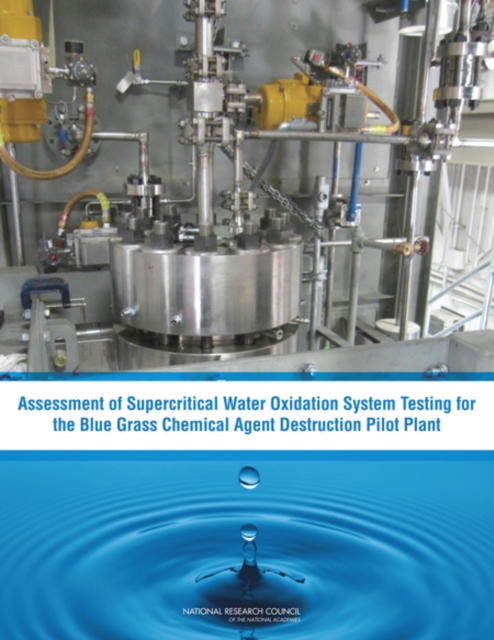
Assessment of Supercritical Water Oxidation System Testing for the Blue Grass Chemical Agent Destruction Pilot Plant
Assessment of Supercritical Water Oxidation System Testing for the Blue Grass Chemical Agent Destruction Pilot Plant reviews and evaluates the results of the tests conducted on one of the SCWO units to be provided to Blue Grass Chemical Agent Destruction Pilot Plant.
The Army Element, Assembled Chemical Weapons Alternatives (ACWA) is responsible for managing the conduct of destruction operations for the remaining 10 percent of the nation's chemical agent stockpile, stored at the Blue Grass Army Depot (Kentucky) and the Pueblo Chemical Depot (Colorado). Facilities to destroy the agents and their associated munitions are currently being constructed at these sites. The Blue Grass Chemical Agent Destruction Pilot Plant (BGCAPP) will destroy chemical agent and some associated energetic materials by a process of chemical neutralization known as hydrolysis. The resulting chemical waste stream is known as hydrolysate. Among the first-of-a-kind equipment to be installed at BGCAPP are three supercritical water oxidation (SCWO) reactor systems. These particular hydrolysate feeds present unique non-agent-related challenges to subsequent processing via SCWO due to their caustic nature and issues of salt management.This report provides recommendations on SCWO systemization testing inclusive of durability testing and discusses systemization testing objectives and concepts.
eBook

Disposal Options for the Rocket Motors From Nerve Agent Rockets Stored at Blue Grass Army Depot
The Blue Grass Chemical Agent-Destruction Pilot Plant (BGCAPP) is under construction near Richmond, Kentucky, two dispose of one of the two remaining stockpiles of chemical munitions in the United States. The stockpile that BGCAPP will dispose of is stored at the Blue Grass Army Depot (BGAD). BGCAPP is a tenant activity on BGAD.
The stockpile stored at BGAD consists of mustard agent loaded in projectiles, and the nerve agents GB and VX loaded into projectiles and M55 rockets. BGCAPP will process the rockets by cutting them, still in their shipping and firing tube (SFT), between the warhead and motor sections of the rocket. The warhead will be processed through BGCAPP. The separated rocket motors that have been monitored for chemical agent and cleared for transportation outside of BGCAPP, the subject of this report, will be disposed of outside of BGCAPP. Any motors found to be contaminated with chemical agent will be processed through BGCAPP and are not addressed in this report.
Disposal Options for the Rocket Motors From Nerve Agent Rockets Stored at Blue Grass Army Depot addresses safety in handling the separated rocket motors with special attention to the electrical ignition system, the need for adequate storage space for the motors in order to maintain the planned disposal rate at BGCAPP, thermal and chemical disposal technologies, and on-site and off-site disposal options. On-site is defined as disposal on BGAD, and off-site is defined as disposal by a commercial or government facility outside of BGAD.
eBook
Assessment of Agent Monitoring Strategies for the Blue Grass and Pueblo Chemical Agent Destruction Pilot Plants
January 2012 saw the completion of the U.S. Army's Chemical Materials Agency's (CMA's) task to destroy 90 percent of the nation's stockpile of chemical weapons. CMA completed destruction of the chemical agents and associated weapons deployed overseas, which were transported to Johnston Atoll, southwest of Hawaii, and demilitarized there. The remaining 10 percent of the nation's chemical weapons stockpile is stored at two continental U.S. depots, in Lexington, Kentucky, and Pueblo, Colorado. Their destruction has been assigned to a separate U.S. Army organization, the Assembled Chemical Weapons Alternatives (ACWA) Element.
ACWA is currently constructing the last two chemical weapons disposal facilities, the Pueblo and Blue Grass Chemical Agent Destruction Pilot Plants (denoted PCAPP and BGCAPP), with weapons destruction activities scheduled to start in 2015 and 2020, respectively. ACWA is charged with destroying the mustard agent stockpile at Pueblo and the nerve and mustard agent stockpile at Blue Grass without using the multiple incinerators and furnaces used at the five CMA demilitarization plants that dealt with assembled chemical weapons - munitions containing both chemical agents and explosive/propulsive components. The two ACWA demilitarization facilities are congressionally mandated to employ noncombustion-based chemical neutralization processes to destroy chemical agents.
In order to safely operate its disposal plants, CMA developed methods and procedures to monitor chemical agent contamination of both secondary waste materials and plant structural components. ACWA currently plans to adopt these methods and procedures for use at these facilities. The Assessment of Agent Monitoring Strategies for the Blue Grass and Pueblo Chemical Agent Destruction Pilot Plants report also develops and describes a half-dozen scenarios involving prospective ACWA secondary waste characterization, process equipment maintenance and changeover activities, and closure agent decontamination challenges, where direct, real-time agent contamination measurements on surfaces or in porous bulk materials might allow more efficient and possibly safer operations if suitable analytical technology is available and affordable.
eBook
Review of Biotreatment, Water Recovery, and Brine Reduction Systems for the Pueblo Chemical Agent Destruction Pilot Plant
The Pueblo Chemical Depot (PCD) in Colorado is one of two sites that features U.S. stockpile of chemical weapons that need to be destroyed. The PCD features about 2,600 tons of mustard-including agent. The PCD also features a pilot plant, the Pueblo Chemical Agent Destruction Pilot Plant (PCAPP), which has been set up to destroy the agent and munition bodies using novel processes. The chemical neutralization or hydrolysis of the mustard agent produces a Schedule 2 compound called thiodiglycol (TDG) that must be destroyed. The PCAPP uses a combined water recovery system (WRS) and brine reduction system (BRS) to destroy TDG and make the water used in the chemical neutralization well water again.
Since the PCAPP is using a novel process, the program executive officer for the Assembled Chemical Weapons Alternatives (ACWA) program asked the National Research Council (NRC) to initiate a study to review the PCAPP WRS-BRS that was already installed at PCAPP. 5 months into the study in October, 2012, the NRC was asked to also review the Biotreatment area (BTA). The Committee on Review of Biotreatment, Water Recovery, and Brine Reduction Systems for the Pueblo Chemical Agent Destruction Pilot Plant was thus tasked with evaluating the operability, life-expectancy, working quality, results of Biotreatment studies carried out prior to 1999 and 1999-2004, and the current design, systemization approached, and planned operation conditions for the Biotreatment process.
Review of Biotreatment, Water Recovery, and Brine Reduction Systems for the Pueblo Chemical Agent Destruction Pilot Plant is the result of the committee's investigation. The report includes diagrams of the Biotreatment area, the BRS, and WRS; a table of materials of construction, the various recommendations made by the committee; and more.
eBook