
Catalogue Search | MBRL


Are you sure you want to remove the book from the shelf?

{{itemTitle}}
2,293
result(s) for
"Thomas, Cole"
Sort by:

CEO leadership : navigating the new era in corporate governance
\"The more that board members and CEOs understand their own and each other's roles, the stronger the company's performance will be in the long term. Cole draws from his long career as a corporate lawyer to set the stage in the boardroom: what the best practices are, how boards can and should be chosen, which codes of conduct are essential to maintain trust and stability. More distinctively, he also brings an inventory of experience that enriches and illuminates the book. This book is like having a mentor in your pocket\"-- Provided by publisher.
Book

Restoring the Pitchfork Ranch
The Pitchfork Ranch is more than another dusty homestead tucked
away in a corner of the Southwest. It is a place with a story to
tell about the most pressing crisis to confront humankind. It is a
place where one couple is working every day to right decades of
wrongs. It is a place of inspiration and promise. It is an
invitation to join the struggle for a better planet. Restoring
the Pitchfork Ranch tells the story of a decades-long habitat
restoration project in southwestern New Mexico. A. Thomas Cole
explains what inspired him and his wife, Lucinda, to turn their
retirement into years dedicated to hard work and renewal. The book
shares the past and present history of a very special ranch south
of Silver City, which is home to a rare type of regional wetland, a
fragile desert grassland ecosystem, archaeological sites, and a
critical wildlife corridor in a drought-stricken landscape. Today
the 11,300 acres that make up the Pitchfork Ranch provide an
important setting for carbon sequestration, wildlife habitats, and
space for the reintroduction of endangered or threatened species.
Restoring the Pitchfork Ranch weaves together stories of
mine strikers, cattle ranching, and the climate crisis into an
important and inspiring call to action. For anyone who has wondered
how they can help, the Pitchfork Ranch provides an inspiring way
forward.
eBook

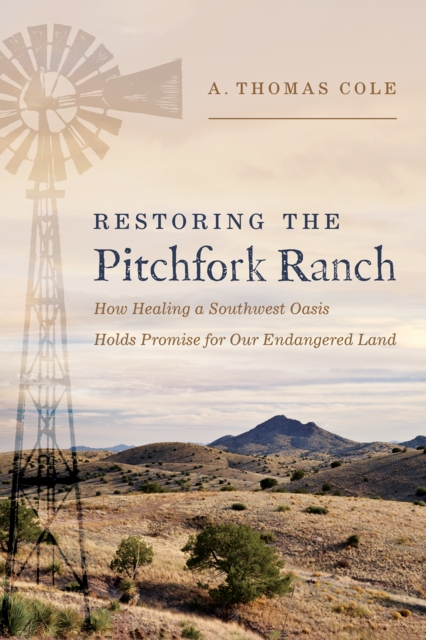
Restoring the Pitchfork Ranch: How Healing a Southwest Oasis Holds Promise for Our Endangered Planet
The Pitchfork Ranch is more than another dusty homestead tucked away in a corner of the Southwest. It is a place with a story to tell about the most pressing crisis to confront humankind. It is a place where one couple is working every day to right decades of wrongs. It is a place of inspiration and promise. It is an invitation to join the struggle for a better planet.Restoring the Pitchfork Ranch tells the story of a decades-long habitat restoration project in southwestern New Mexico. Rancher-owner A. Thomas Cole explains what inspired him and his wife, Lucinda, to turn their retirement into years dedicated to hard work and renewal. The book shares the past and present history of a very special ranch south of Silver City, which is home to a rare type of regional wetland, a fragile desert grassland ecosystem, archaeological sites, and a critical wildlife corridor in a drought-stricken landscape. Today the 11,300 acres that make up the Pitchfork Ranch provide an important setting for carbon sequestration, wildlife habitats, and space for the reintroduction of endangered or threatened species. Restoring the Pitchfork Ranch weaves together stories of mine strikers, cattle ranching, and the climate crisis into an important and inspiring call to action. For anyone who has wondered how they can help, the Pitchfork Ranch provides an inspiring way forward.
eBook

The production of medicoethical misconduct: medical ethics and vivisection in Wilkie Collins’s Heart and Science
Even as Wilkie Collins’s Heart and Science continues in the tradition of cautionary tales of medicine and science, it also integrates nineteenth-century discussions of medical ethics, vivisection and women, further building on earlier criticisms of scientific hubris. By indicting a fictional medical doctor and his methodology, Heart and Science depicts the extremes of good and bad, ethical and unethical medicine—whether the doctor can care, and not simply solve the medical enigma—in light of a changing medical field that prized objectivity and distance from the subject over the old holistic way of listening to a patient in order to understand her malady. In reading Collins within his historical context and against a changing environment within the medical sciences, literary critics discern a gendered doctor-patient relationship and observe a Victorian author’s attempts to combat the fears of scientific advancement by using or aligning himself with a proto-feminist perspective.
Journal Article

Ecosystem Carbon Stocks of Micronesian Mangrove Forests
Among the least studied ecosystem services of mangroves is their value as global carbon (C) stocks. This is significant as mangroves are subject to rapid rates of deforestation and therefore could be significant sources of atmospheric emissions. Mangroves could be key ecosystems in strategies addressing the mitigation of climate change though reduced deforestation. We quantified ecosystem C stocks at the seaward, interior, and upland edges of mangroves in the Republic of Palau and Yap, Federated States of Micronesia. The relatively high aboveground biomass coupled with carbon-rich soils resulted in the presence of large ecosystem carbon stocks compared to other tropical forests. Ecosystem C storage at the Palau site ranged from 479 Mg/ha in the seaward zone to 1,068 Mg/ha in the landward zone; in the Yap site C storage ranged from 853 to 1,385 Mg/ha along this gradient. Soils contained ~70% of the ecosystem C stocks. The elevation range of mangroves was <146 cm, suggesting that projected sea-level rise can influence a large portion of existing stands. Declines in ecosystem carbon stocks will be pronounced if mangroves are replaced by communities adapted to greater inundation such as seagrass communities, where C pools were ≤7% of that of mangroves (48 Mg C/ha).
Journal Article
Micronesian Mangrove Forest Structure and Tree Responses to a Severe Typhoon
Tropical cyclones are common disturbances that have strong effects on mangrove composition and structure. Because there are numerous ecosystem services provided by mangroves, it is important to understand their adaptations and responses to these climatic events. In April 2004, Typhoon Sudal, a category 3–4 cyclone, passed over the state of Yap, Federated States of Micronesia. For four months following the typhoon we measured forest structure, above-ground biomass, tree mortality and response in six mangroves. The sites were dominated by species common in mangroves throughout the Indo-Pacific—
Sonneratia alba, Brugueira gymnorrhiza
, and
Rhizophora apiculata.
Total above-ground biomass (TAGB) of mangrove forests ranged from 211–573 Mg ha
-1
. Tree mortality ranged from 6% to 32% among stands. Adaptations and responses to the typhoon varied by species, as well as by geographic location.
Sonneratia alba
had a higher frequency of mainstems broken (26%), but was the only species that vigorously sprouted from dormant basal or epicormic tissues. Standing live trees accounted for 80–95% of TAGB, suggesting that adaptations of mangrove trees can facilitate the persistence of an intact forest structure following typhoons of this intensity. Climatic changes such as sea level rise and increased severity of cyclonic events could alter this relationship.
Journal Article

The art of medicine: The suffering of physicians
During the past 40 years, we have become all too familiar with the dehumanisation of modern medicine: new technologies have altered the relationship between doctor and patient; specialised physicians know more and more about less and less; doctors treat diseases rather than people; medical schools teach the science but ignore the art of medicine; medical technology has outpaced moral understanding; and hospitals have become cold, impersonal mazes. Medicine is filled with many people of good will, integrity, and commitment who strive to provide compassionate and ethically sound care, teach and mentor students, maintain scientific standards of practice, keep current with the most recent literature in one's field, and undertake biomedical research. The disillusionment of many physicians in many countries derives from the imbalance between the energy and focus devoted to strategic planning and generating a financial surplus and the attention given to the primary goals of professionalism and patients' care.
Journal Article

Uganda’s endemic flora: discovery, diversity, distribution and threat status
Threats including habitat loss and overexploitation continue to endanger plant diversity in Uganda. Heightened effort is needed to more effectively protect threatened species to ensure ecosystem service provision and support of livelihoods. One important step in this direction is to identify areas locally rich in biodiversity in general, and endemism in particular, where conservation efforts may most effectively contribute to protecting global biodiversity. We analysed data on the distribution of 4,816 known species of native vascular plants of Uganda to identify the endemic and near-endemic plant taxa. Distribution data were obtained from herbarium records and online resources and more than 5,000 occurrence points of priority plant taxa in Uganda collated in a BRAHMS database. A total of 184 endemic and near-endemic taxa of vascular plants are identified and documented, of which 52 are strict-endemic and 82 are near-endemic species, with a further 15 strict-endemic and 35 near-endemic infraspecific taxa. These together represent 3.8% of the known vascular flora of Uganda, with families including Asparagaceae, Asphodelaceae and Asteraceae contributing significantly to the endemic flora. These endemics cover a wide range of growth forms, but the majority (60%) are herbaceous whilst tree taxa contribute less than 15% of the total endemic flora. Significant spatial variation in the richness of endemic species is observed. The regions with the highest endemism are the montane areas of the Albertine Rift and of Eastern Uganda. However, as botanical inventories extend to understudied areas, we might expect that species new to science continue to be described. More than 90% of the endemic flora of Uganda has been assessed for its extinction risk, of which 58% are currently assessed as threatened (VU, EN, or CR on the IUCN Red List). The results of this study highlight the significant risk faced by plants unique to Uganda and have helped to inform the identification of Important Plant Areas as a key step towards spatial conservation prioritisation for Uganda’s critical plant diversity and the ecosystem services it supports.
Journal Article

A new paradigm for leprosy diagnosis based on host gene expression
Transcriptional profiling is a powerful tool to investigate and detect human diseases. In this study, we used bulk RNA-sequencing (RNA-Seq) to compare the transcriptomes in skin lesions of leprosy patients or controls affected by other dermal conditions such as granuloma annulare, a confounder for paucibacillary leprosy. We identified five genes capable of accurately distinguishing multibacillary and paucibacillary leprosy from other skin conditions. Indoleamine 2,3-dioxygenase 1 ( IDO1 ) expression alone was highly discriminatory, followed by TLR10 , BLK , CD38 , and SLAMF7 , whereas the HS3ST2 and CD40LG mRNA separated multi- and paucibacillary leprosy. Finally, from the main differentially expressed genes (DEG) and enriched pathways, we conclude that paucibacillary disease is characterized by epithelioid transformation and granuloma formation, with an exacerbated cellular immune response, while multibacillary leprosy features epithelial-mesenchymal transition with phagocytic and lipid biogenesis patterns in the skin. These findings will help catalyze the development of better diagnostic tools and potential host-based therapeutic interventions. Finally, our data may help elucidate host-pathogen interplay driving disease clinical manifestations.
Journal Article