Catalogue Search | MBRL


Are you sure you want to remove the book from the shelf?

{{itemTitle}}
10
result(s) for
"Thomas, Hugh, 1931- author"
Sort by:

Eduardo Barreiros and the Recovery of Spain
A dramatic biography of the extraordinary Spanish industrialist and entrepreneur Eduardo Barreiros
Born in an impoverished region of Galicia, possessed of little education and less money, Eduardo Barreiros (1919-1992) rose to become an immensely successful entrepreneur and one of Spain's most prominent industrialists. In this engaging biography, the first on a Spanish entrepreneur in English, Hugh Thomas recounts Barreiros's origins as an auto mechanic, his success in the motor industry, his tragic alliance with the Chrysler Corporation, and his little-known role as a motor industry founder in 1980s Cuba. Drawing on an unrivaled knowledge of Spanish history, Lord Thomas also brings to light Barreiros's critical role in the modernization of the Spanish economy in the post-Civil War years.
The book offers a detailed portrait of Don Eduardo's personality, character, and numerous entrepreneurial endeavors, as well as a full account of the difficulties the Franco-era government threw in the path of his capitalist activities. The relationship between Barreiros and the Chrysler Corporation is also described, along with the failed Dodge Dart project that ultimately cost Barreiros his business. Finally, the book recounts Don Eduardo's late-in-life efforts to help establish a motor industry in Castro's Cuba-a paradoxical conclusion for a great capitalist.
eBook

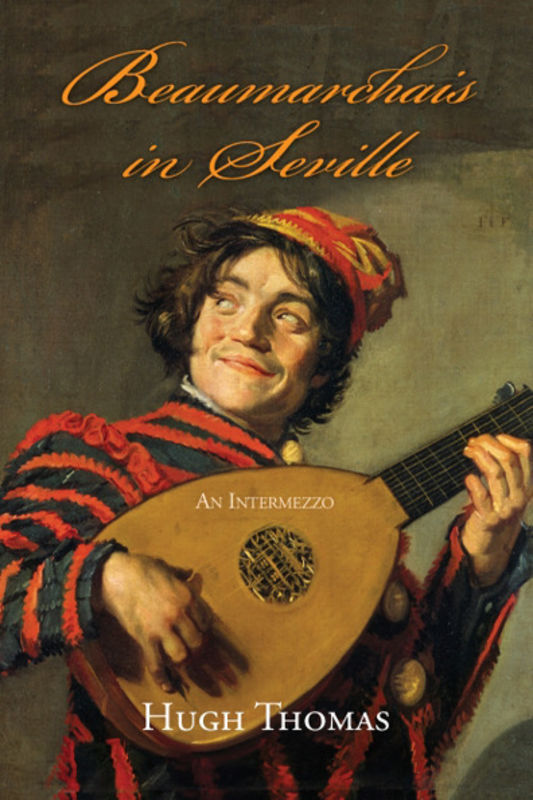
Beaumarchais in Seville
In 1764-65 the irrepressible playwright Beaumarchais traveled to Madrid, where he immersed himself in the life and society of the day. Inspired by the places he had seen and the people he had met, Beaumarchais returned home to createThe Barber of SevilleandThe Marriage of Figaro, plays that became the basis for the operas by Rossini and Mozart that continue to delight audiences today. This book is a lively and original account of Beaumarchais's visit to Madrid (he never went to Seville) and a re-creation of the society that fired his imagination.Drawing on Beaumarchais's letters and commentaries, translated into English for the first time, Hugh Thomas investigates the full range of the playwright's activities in Madrid. He focuses particular attention on short plays that Beaumarchais attended and by which he was probably influenced, and he probes the inspirations for such widely recognized characters as the barber-valet Figaro, the lordly Count Almaviva, and the beautiful but deceived Rosine. Not neglecting Beaumarchais's many other pursuits (ranging from an endeavor to gain a contract for selling African slaves to an attempt to place his mistress as a spy in the bed of King Charles III), Lord Thomas provides a highly entertaining view of a vital moment in Madrid's history and in the creative life of the energetic Beaumarchais.
eBook

The golden empire : Spain, Charles V, and the creation of America
A narrative chronicle of Spain's dominant years traces Latin America's exploration, conquest, and economic development between 1522 and 1556, offering insight into how period accomplishments remain influential in today's world.

Peripheral neurology : case studies
Peripheral Neurology was the first book to make innovative use of case presentations as a vehicle for teaching peripheral neurology. In fact, it was the first to categorize the field of peripheral neurology, as most other neurology texts concentrated on diseases of the central nervous system. This case approach has since been emulated in many other texts and on various web sitexs. Emphasizing the clinical conditoin rather than the electrodiagnostic technique, each topic is thoroughly addressed, first in the Fundamental Concepts of Part I, and then in multiple Case Studies presented in Part II. The reader is able to simulate a true clinical environment where a diagnosis has to be arrived at with no organizational clues from the text. Formulating conclusions by analysing the history, physical, and laboratory data, and linking from case to related case, this is the only text which allows this type of “interactive” reading. The book addresses many rare entities that the author is able to present based on his 30-years of experience.
eBook