
Catalogue Search | MBRL


Are you sure you want to remove the book from the shelf?

{{itemTitle}}
183
result(s) for
"Tian, Kelly"
Sort by:

Consumers’ Need for Uniqueness: Scale Development and Validation
Consumers acquire and display material possessions for the purpose of feeling differentiated from other people and, thus, are targeted with a variety of marketing stimuli that attempt to enhance self‐perceptions of uniqueness. Because the pursuit of differentness (or counterconformity motivation) varies across individuals to influence consumer responses, we develop and validate a trait measure of consumers’ need for uniqueness. Consumers' need for uniqueness is defined as an individual’s pursuit of differentness relative to others that is achieved through the acquisition, utilization, and disposition of consumer goods for the purpose of developing and enhancing one’s personal and social identity. Following assessments of the scale’s latent structure, a series of validation studies examines the scale’s validity. The presentation of empirical work is followed by a discussion of how consumers' need for uniqueness could be used in better understanding consumer behavior and the role consumption plays in people’s expression of identity.
Journal Article

Consumer-Citizens of China
A PDF version of this book is available for free in open access via www.tandfebooks.com as well as the OAPEN Library platform, www.oapen.org. It has been made available under a Creative Commons Attribution-Non Commercial-No Derivatives 3.0 license and is part of the OAPEN-UK research project. This book presents a comprehensive examination of Chinese consumer behaviour and challenges the previously dichotomous interpretation of the consumption of Western and non-Western brands in China. The dominant position is that Chinese consumers are driven by a desire to imitate the lifestyles of Westerners and thereby advance their social standing locally. The alternative is that consumers reject Western brands as a symbolic gesture of loyalty to their nation-state. Drawing from survey responses and in depth interviews with Chinese consumers in both rural and urban areas, Kelly Tian and Lily Dong find that consumers situate Western brands within select historical moments. This embellishment attaches historical meanings to Western brands in ways that render them useful in asserting preferred visions of the future China. By highlighting how Western brands are used in contests for national identity, Consumer-Citizens of China challenges the notion of the \"patriot’s paradox\" and answers scholars’ questions as to whether Chinese nationalists today allow for a Sino-Western space where the Chinese can love China without hating the West. Consumer-Citizens of China will be of interest to students and scholars of business studies, Chinese and Asian Studies and Political Science. Kelly Tian is Professor of Marketing and holds the Anderson Chair of Business at New Mexico State University. Lily Dong is Associate Professor of Marketing at the University of Alaska at Fairbanks.
eBook

Consuming to Be Good
This study reveals the therapeutic origins of the “good mother” ideal in a rarely studied context, that of transracial adoptive mothering. Using a comparative discursive analysis supplemented by illustrative case analysis, we show that what it means to be a “good mother” in transracial adoptive mothering discourse differs significantly from the ideal established in mainstream mothering discourse. The key differences uncovered relate to publicly contested challenges to legitimacy, the experience of stigma for families adopting children of difference races, and a relative dearth of market-based solutions to these challenges. We propose therapeutic ideology as a powerful macro-level theoretical construct capable of explaining the self-reinforcing cycle of mothers’ anxiety, expert advice, and market-mediated solutions.
Journal Article
The Use of Western Brands in Asserting Chinese National Identity
Chinese consumers employ Western brands to assert competing versions of Chinese national identity. These uses emerged from findings that Chinese form meanings of Western brands, drawing from select historical national narratives of East‐West relations: the West as liberator and Western brands as instruments of democratization; the West as oppressor and Western brands as instruments of domination; the West as subjugated and Western brands, by their own subjugation, as symbolically erasing China’s past humiliations; and the West as partner and Western brands as instruments of economic progress. Our emergent theory elaborates processes by which Western brands are shaped by macrolevel, sociohistorical forces to motivate consumers’ responses to them as political action tied to nation making.
Journal Article
Reconstructing the South: How Commercial Myths Compete for Identity Value through the Ideological Shaping of Popular Memories and Countermemories
This study explicates the coconstitutive relationships between commercial mythmaking and popular memory that arise through myth market competitions for identity value. We develop a genealogical analysis of the representational strategies and ideological rationales that two prominent New South mythmakers use to shape popular memories in relation to their competitive goals and to efface countermemories that contradict their mythologized representations. We then derive a conceptual model that highlights competitive, historical, and ideological influences on commercial mythmaking and their transformative effects on popular memory, which have not been addressed by prior theorizations of the meaning transfer process.
Journal Article


The Long-Term Predictive Validity of the Consumers’ Need for Uniqueness Scale
This research examines the long-term ability of the consumers’ need for uniqueness measure to predict consumers’ valued possessions, shopping behaviors, and experiences. Consumers’ need for uniqueness reflects individual differences in counterconformity motivation (i.e., the pursuit of differentness relative to others) that is manifest in consumer responses. This research reports on 2 longitudinal assessments of the scale's predictive validity using data collected at 4 stages from a consumer mail-survey sample. One year following initial responses to the trait measure, respondents participated in a second survey in which they photographed and rank ordered their valued possessions. In a third survey, the photographs served as cues to obtain responses to ratings of possession benefits and to questions regarding acquisition of the possession. Overall, the results support a number of hypotheses regarding the relation of consumers’ need for uniqueness to salient possession benefits, types of goods comprising consumers’ valued possessions, and shopping behaviors associated with acquiring valued possessions. Two years following initial responses to the trait measure, members of the consumer mail panel completed a fourth survey, indicating their participation in various uniqueness-enhancing consumer activities. Results support the stability and predictive validity of the measure over the 2-year period. Because the design of possessions and endorsed uniqueness-enhancing activities considered in the consumer mail panel studies varied across individuals, an additional study was conducted that demonstrated the scale's ability to predict individuals’ counterconformity responses to the same choice situation.
Journal Article

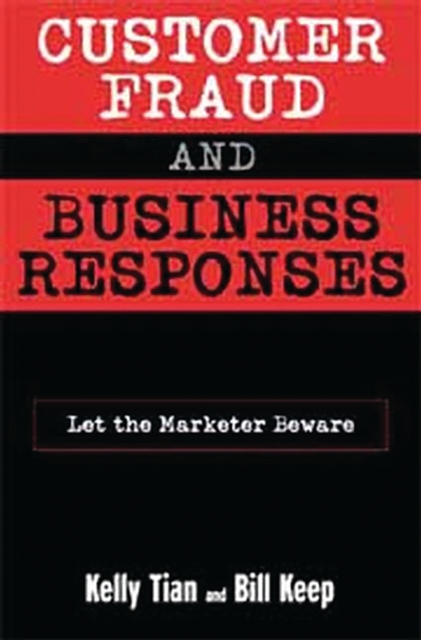
Customer fraud and business responses : let the marketer beware
From remarkably frank and credible responses to their comprehensive research questionnaire, Tian and Keep provide a unique, wide ranging catalogue of frauds that customers perpetrate on businesses--and what marketers can do to combat it. They were able to receive and analyze more than 250 written descriptions-- a 71% response rate! --of the acts that customers committed and the methods they used. Instead of merely a checklist, Tian and Keep obtained their data in the customers' own words, resulting in highly detailed and reliable insights into why customers did what they did. They find that customer fraud has emerged as a form of guerilla warfare against companies, that it is adapted to specific situations, and that underlying customers' motivation is a need to get even. Ethics has little do with it. In fact, some respondents even asserted that they had an obligation to commit fraud: they did it to retaliate against what they perceived as unethical acts that businesses committed against them. The result is a rare documentation of the specifics of fraud, how it threatens not only business but entire economies, and the actions--bold and subtle--that marketers can take in self-protective response. Not only will corporate management, particularly in marketing, get detailed descriptions of their customers' fraud strategies and tactics, but they will also receive insights into where they are vulnerable and why. Tian and Keep show that fraud has become so socially acceptable among middle class customers that they are willing to share their tactics, strategies, and secrets with their friends. With this as their foundation, the authors give practitioners an arsenal of detection and deterrence methods. Equally important, they provide ways to implement them without alienating their other, blameless customers. They also show marketers what they can do to reestablish trust in their marketing exchanges with customers, and improve relationships in ways that will diminish (if not fully eliminate) the incidence of fraud. For management generally as well as marketers in companies of all sizes and type, Tian's and Keep's book is essential, engrossing, and useful reading.
eBook