
Catalogue Search | MBRL


Are you sure you want to remove the book from the shelf?

{{itemTitle}}
413
result(s) for
"Tibi, Bassam"
Sort by:


Islam's Predicament with Modernity
Islam's Predicament with Modernity presents an in-depth cultural and political analysis of the issue of political Islam as a potential source of tensions and conflict, and how this might be peacefully resolved.
Looking at the issue of modernity from an Islamic point of view, the author examines the role of culture and religion in Muslim society under conditions of globalisation, and analyses issues such as law, knowledge and human rights. He engages a number of significant studies on political Islam and draws on detailed case studies, rejecting the approaches of both Orientalists and apologists and calling instead for a genuine Islamic pluralism that accepts the equality of others. Situating modernity as a Western product at the crux of his argument, he argues that a separation of religion and politics is required, which presents a challenge to the Islamic worldview.
This critical analysis of value conflicts, tensions and change in the Islamic world will be of interest to scholars and advanced students of international relations, social theory, political science, religion, Islamic studies and Middle Eastern studies.
'Bassam Tibi has written the rarest of books: a book of learning and a daring one as well. One of the most formidable books to appear on modern Islam in a very long time. Arguable the leading singular authority on European Islam, Professor Tibi has looked, unsentimentally, at the modern dilemma of Islam and come forth with a book of startling originality. This is scholarship of the highest level: Professor Tibi neither apologizes for Islam's troubles nor hacks away at the Islamist utopia. In this \"cool\" and authoritative book, we have an unflinching depiction of Islam's modern predicament. An exemplary work.' - Fouad Ajami, Director of Middle East Studies, the Johns Hopkins University
\"[A] wide-ranging and thought-provoking book.\" - Richard Bonney, University of Leicester; The Muslim World Book Review, Volume 31, Number 1, 2010
Bassam Tibi is Professor of International Relations at the University of Goettingen and A.D. White Professor-at-Large at Cornell University
Introduction: Cultural Tensions, Modernity, Globalization, and Conflict 1. The Predicament: The Exposure to Cultural Modernity, and the Need for an Accommodation. Religious Reform and Cultural Change in Islamic Civilization 2. Issue Areas of the Predicament I: Modernity and Knowledge. Torn Between Reason and Islamization 3. Issue Areas of the Predicament II: Cultural Modernity and Law. The Contemporary Reinvention of Shari’a for the Shari’atization of Islam 4. Issue Areas of the Predicament III: Islam, the Principle of Subjectivity and Individual Human Rights 5. Islam’s Predicament as a Source of Conflict. Cultural-Religious Tensions and Identity Politics 6. Cultural Change and Religious Reform I: The Challenge of Secularization in the Shadow of De-Secularization 7. Cultural Change and Religious Reform II: Pluralism of Religions vs. Islamic Supremacism 8. Authenticity and Cultural Legacy. The Revival of the Heritage of Islamic Rationalism: Falsafa/Rational Philosophy vs. Fiqh-Orthodoxy 9. Case Studies I. The Failed Cultural Transformation in Egypt: A Model for the World of Islam? 10. Case Studies II. The Gulf Beyond the Age of Oil: The Envisioned Cultural Project for the Future 11. Conclusions and Future Prospects. Cultural Modernity and the Islamic Dream of Semi-Modernity. Conclusions
eBook

Islamism and Islam
Despite the intense media focus on Muslims and their religion since the tragedy of 9/11, few Western scholars or policymakers today have a clear idea of the distinctions between Islam and the politically based fundamentalist movement known as Islamism. In this important and illuminating book, Bassam Tibi, a senior scholar of Islamic politics, provides a corrective to this dangerous gap in our understanding. He explores the true nature of contemporary Islamism and the essential ways in which it differs from the religious faith of Islam.
Drawing on research in twenty Islamic countries over three decades, Tibi describes Islamism as a political ideology based on a reinvented version of Islamic law. In separate chapters devoted to the major features of Islamism, he discusses the Islamist vision of state order, the centrality of antisemitism in Islamist ideology, Islamism's incompatibility with democracy, the reinvention of jihadism as terrorism, the invented tradition of shari'a law as constitutional order, and the Islamists' confusion of the concepts of authenticity and cultural purity. Tibi's concluding chapter applies elements of Hannah Arendt's theory to identify Islamism as a totalitarian ideology.
eBook

The Islamist Venture of the Politicization of Islam to an Ideology of Islamism
This article operates on the distinction between Islamism and Islam and asks questions about how this is handled in Western studies. Islam is a religion and a civilization that deserves respect, while Islamism is a political ideology to be subjected to critical inquiry. The article is based on the enlightened Muslim thought that dissociates Islamic faith from its use as a legitimation in politics. The article shares also the dismissal of orientalism and Islamophobia, but it is critical of the instrumental use of both to silence criticism, as well as their reversal into the other extreme of an orientalism in reverse (Islamophilia). I argue that the prevailing analysis in Western scholarship on Islam not only ignores the distinction between Islamism and Islam but also falls into the trap of this reversal. The article discusses Islamism and Islamist movements that succeeded in hijacking the Arab Spring in the pursuit of a shariʿa state. The prevailing narrative not only fails to understand the Islamist shariʿatization of Islam, but also that Islamist shariʿa is neither Qur'anic shariʿa, nor classical shariʿa. I conclude with the presentation of Islamology and enlightened Muslim thought as alternative approaches for the study of Islamism, pleading for freedom of speech in this field of study.
Journal Article
Islamic Humanism vs. Islamism
Some prominent discussions of contemporary Islam focus on the tradition of Shari'a reasoning. This is not without reason. Not only is this tradition important in understanding militancy; it has re-emerged in connection with the Arab Spring. The present article, however, seeks to revive an alternative tradition—namely, Islamic humanism. The importance of distinguishing this alternative is not only a matter of clarifying the intellectual heritage of Islam. Reviving Islamic humanism has social-political consequences. It makes possible a view of the modern state that is more democratic and pluralistic than the Shari'a state envisioned by Islamists.
Journal Article

The Shari'a State
Set against the backdrop of the Arab Spring, The Sharia State examines the Islamist concept of political order. This order is based on a new interpretation of sharia and has been dubbed \"the Islamic state\" by Islamists. The concept of \"the Islamic state,\" has been elevated to a political agenda and it is this agenda that is examined here.
In contrast to the prevailing view which sees the Arab Spring as a revolution, this book argues that the phenomenon has been neither a Spring, nor a revolution. The term 'Arab Spring,' connotes a just rebellion that led to toppling dictators and authoritarian rulers, yet in The Sharia State, Bassam Tibi challenges the unchecked assumption that the seizure of leadership by Islamists is a part of the democratization of the Middle East.
Providing a new perspective on the relationship between the Arab Spring and democratization, this book is an essential read for students and scholars of Middle Eastern Studies, Islamic Studies and Politics.
eBook
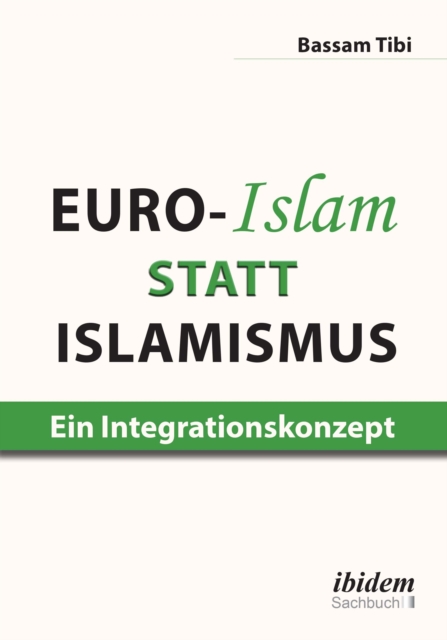
Euro-Islam Statt Islamismus
Die Zahl der Muslime in Deutschland und Europa wächst demographisch und durch Migration: Nach einer Prognose des Pew Research Center werden 2050 bis zu 20% der Bevölkerung in Deutschland islamischen Glaubens sein, in Europa insgesamt zwischen 7% und 14%. Angesichts dieser europäischen Realität ist die Förderung der Herausbildung eines Islam, der europäische Ideen wie Zivilgesellschaft, säkulare Demokratie und individuelle Menschenrechte ausdrücklich und umfassend bejaht, eine wichtige gesellschaftliche Aufgabe.
Bassam Tibi, selbst muslimischer Migrant aus Syrien und intimer Kenner des Koran (Hāfiz), entwickelt mit seiner Idee des Euro-Islam ein integratives Konzept, das sich gegen die Politisierung des Islam positioniert und sich kritisch mit der Schariatisierung und Djihadisierung auseinandersetzt. Tibi – Mitbegründer der Initiative Säkularer Islam – gibt frei von ideologischen Schablonen eine überzeugende europäische Antwort auf die Herausforderung des islamischen Fundamentalismus.
eBook

WHY THEY CAN'T BE DEMOCRATIC
[...] when one addresses the issue of democracy and its prospects within the world of Islam, it is slippery, inaccurate, and an unwarranted favor to Islamists to blur the terms Islam and Islamism, as authors such as John Voll and John Esposito do.2 We must not confuse the question \"Are Islam and democracy compatible?\" with the question \"How democratic is Islamism?\" The answer to the first question is \"yes,\" conditional upon religious reform (Salafist Islam is not compatible). 11 Yet important Muslim thinkers such as al-Farabi (ca. 870-950 C.E.) have left us bodies of thought suggesting that universal standards of good governance are knowable despite all the relativist and particularist claims of those who would dwell on authenticity to the exclusion of all else.12 The rhetoric of authenticity should not be used as a weapon against promoters of genuine democratization such as Saad Eddin Ibrahim and his Ibn Khaldun Center for Civil Society in Cairo, who outline a future far more promising than anything on the agenda of that other Cairo-founded organization, the Muslim Brotherhood.
Journal Article
Changing Islamism
Scholars, and in general writers, who critically study the politicization of religion characteristic of Islamism, are often accused of essentializing Islam. This is so, even though they are describing a process of change. Yet essentialism “precludes an investigation of change … in the name of natural and fixed characteristics” (Howarth 2010, 457). The present article argues that both Islam and Islamism are open to change. I begin with a description of the method by which such change may be identified. I then explain the way in which the argument fits with two articles previously published in Soundings, before proceeding to outline the kind of change Islamism represents and the meaning of recent changes in the program of some Islamist groups.
Journal Article