
Catalogue Search | MBRL


Are you sure you want to remove the book from the shelf?

{{itemTitle}}
266
result(s) for
"Tierney, Stephen"
Sort by:


Legal Issues Surrounding the Referendum on Independence for Scotland
The 2014 referendum: Towards a consensual process – The Edinburgh Agreement: framing the referendum process – Process rules and key issues – After the referendum: Scotland's status under international law – Secession under international law – Membership of international organisations, especially the European Union
Journal Article


The Shibboleth of Sovereignty
Sovereignty is the central tenet of modern British constitutional thought but its meaning remains misunderstood. Lawyers treat it as a precise legal concept – the doctrine of parliamentary sovereignty – but commonly fail to acknowledge that that doctrine is erected on a skewed sense of what sovereignty entails. In particular, they do not see that the doctrine rests on a particular political conviction, that the British state depends on a central authority equipped with an unlimited power. These two facets of sovereignty are now so deeply intertwined in legal consciousness that they cannot easily be unravelled and this becomes the main barrier to thinking constructively about Britain's constitutional arrangements. This article substantiates these claims by explaining how the doctrine came into being, demonstrating how it is tied to a deeper political conviction, showing that its political underpinnings have been considerably weakened over the last century, and indicating how its re-working is the precondition of constitutional renewal.
Journal Article

A theory of plural constituent power for federal systems
Federations present difficulties for prevailing theories of constituent power, which usually attribute ultimate constitution-making authority to a singular people. This article examines how a ‘pluralized’ constituent power functions in federal systems. It argues that the operation of plural constituent power in federations reflects a distinctive model of constitutional formation according to which a ‘polity of polities’ is established and sustained through the maintenance of a tension between plurality and unity.
Journal Article
Democracy in Question? Direct Democracy in the European Union
Challenges posed to European integration by exercises of direct democracy at the national or sub-state level – EU response to referendums on internal constitutional matters – Greek, Scottish and Catalan referendum processes – Resilience of state nationalism and the complex pluralisation of identities below the level of the state
Journal Article
Constitutional Referendums: A Theoretical Enquiry
In recent decades the use of referendums to settle major constitutional questions has increased dramatically. Addressing this phenomenon as a case study in the relationship between democracy and constitutional sovereignty, this article has two aims. The first is to argue that these constitutional referendums are categorically different from ordinary, legislative referendums, and that this has important implications for theories of constitutional sovereignty. Secondly, the article suggests that the power of these constitutional referendums to re-order sovereign relations raises significant normative questions surrounding the appropriateness of their use. The article engages with these normative questions, enquiring whether the recent turn in republican political theory towards deliberative democracy may offer a model through which sufficiently democratic referendum processes can be constructed.
Journal Article

Je li Pandorina kutija konacno otvorena? Kosovo i neobicna sudbina teze o dekolonizaciji u meðunarodnom pravu samoodreðenja
The article explores the process that led to Kosovo's unilateral declaration of independence and argues that the willingness of many countries to contribute to the creation of Kosovo as cannot be explained solely by humanitarian concerns, and the remedial understanding of the right to self-determination. What seems to have motivated the Western powers was also the recent memory of the UN's failure to stop the internecine wars which characterised the SFRY's dissolution (particularly the war in Bosnia), as well as the rejection on the part of the international community with the way in which Kosovan autonomy, previously entrenched in the SFRY constitution of 1974, had been emasculated from 1989 onwards by both Serbia and the FRY in a process which served to deny Kosovo Albanians both the minority rights and the right of internal self-determination. Finally, the article speculates on the long-term implications of the Kosovo intervention. Instead of being seen as a \"unique case\", the intervention in Kosovo may be seen as the consolidation of a growing European commitment to the rights of internal minorities, including the right to territorial autonomy for national minorities.
Journal Article
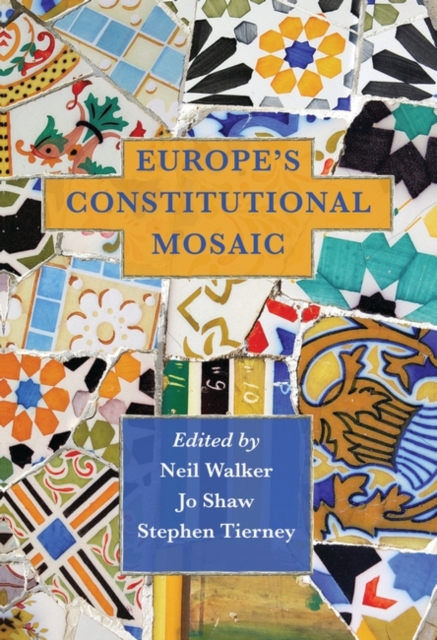
Europe’s Constitutional Mosaic
This book emerged from an extended seminar series held in Edinburgh Law School which sought to explore the complex constitutional arrangements of the European legal space as an inter-connected mosaic. There has been much recent debate concerning the constitutional future of Europe, focusing almost exclusively upon the EU in the context of the (failed) Constitutional Treaty of 2003-5 and the subsequent Treatyof Lisbon. The premise of the book is that this focus, while indispensable, offers only a partial vision of the complex constitutional terrain of contemporary Europe. In addition, it is essential to explore other threads of normative authority within and across states, embracing internal challenges to state-level constitutional regimes; the growing jurisprudential assertiveness of the Council of Europe regime through the ECHR and various democracy-building measures; as well as Europe’s ever thicker relations, both with its border regions and with broader international institutions, especially those of the United Nations. Together these developments create increasingly dense networks of constitutional authority within the European space. This fluid and multi-dimensional dynamic is difficult to classify, and indeed may seem in many ways impenetrable, but that makes the explanatory challenge all the more important and pressing. Without this fuller picture it becomes impossible to understand the legal context of Europe today or the prospects of ongoing changes. The book brings together a range of experts in law, legal theory and political science from across Europe in order to address these complex issues and to supply illustrative case-studies in the topical areas of the constitutionalisation of European labour law and European criminal law.
eBook

The Territorial Constitution and the Brexit Process
This article assesses the United Kingdom’s rapidly evolving territorial constitution through the register of federal theory. While not arguing that the UK is federal or ought to be described as federal, the article contends that federalism is a useful prism through which to assess how well the UK’s constitution accommodates autonomy on the one hand and the efficacy of union, which is the essential complement of pluralism, on the other. It then proceeds to assess the Brexit process in light of existing imbalances in the UK’s territorial arrangements. The way in which Parliament has paved the way for the United Kingdom’s withdrawal from the EU is widely considered to be deeply unpropitious for devolution. However, upon further analysis of the legal changes and internal political commitments that have been designed to facilitate Brexit, it would appear that a more balanced set of constitutional arrangements may be emerging which could in fact bolster and further embed the United Kingdom’s territorial constitutional commitments.
Journal Article