
Catalogue Search | MBRL


Are you sure you want to remove the book from the shelf?

{{itemTitle}}
361
result(s) for
"Tismaneanu, Vladimir"
Sort by:


The devil in history
The Devil in History is a provocative analysis of the relationship between communism and fascism. Reflecting the author's personal experiences within communist totalitarianism, this is a book about political passions, radicalism, utopian ideals, and their catastrophic consequences in the twentieth century's experiments in social engineering. Vladimir Tismaneanu brilliantly compares communism and fascism as competing, sometimes overlapping, and occasionally strikingly similar systems of political totalitarianism. He examines the inherent ideological appeal of these radical, revolutionary political movements, the visions of salvation and revolution they pursued, the value and types of charisma of leaders within these political movements, the place of violence within these systems, and their legacies in contemporary politics. The author discusses thinkers who have shaped contemporary understanding of totalitarian movements—people such as Hannah Arendt, Raymond Aron, Isaiah Berlin, Albert Camus, François Furet, Tony Judt, Ian Kershaw, Leszek Kolakowski, Richard Pipes, and Robert C. Tucker. As much a theoretical analysis of the practical philosophies of Marxism-Leninism and Fascism as it is a political biography of particular figures, this book deals with the incarnation of diabolically nihilistic principles of human subjugation and conditioning in the name of presumably pure and purifying goals. Ultimately, the author claims that no ideological commitment, no matter how absorbing, should ever prevail over the sanctity of human life. He comes to the conclusion that no party, movement, or leader holds the right to dictate to the followers to renounce their critical faculties and to embrace a pseudo-miraculous, a mystically self-centered, delusional vision of mandatory happiness.
eBook


Ideological Storms
This volume gathers authors who wrote important works in the fields of the history of ideologies, the comparative study of dictatorships, and intellectual history. The book is a state of the art reassessment and analysis of the ideological commitments of intellectuals and their relationships with dictatorships during the twentieth century. The contributions focus on turning points or moments of breakage as well as on the continuities. Though its focus is on an East-West comparison in Europe, there are texts also dealing with Latin America, China, and the Middle East giving the book a global outlook.
The first part of the book deals with intellectuals' involvement with communist regimes or parties; the second looks at the persistence of utopianism in the trajectory of intellectuals who had been associated earlier in their lives with either communism or fascism; the third tackles intellectuals' role in national imaginations from either the left or the right; and, the fourth ties late twentieth century phenomena to current phenomena such as the persistence of anti-Semitism in the West, the slow erosion of the values upon which the EU is built, the quagmire in Iraq, and China's rise in the post-Cold War era. The collection provides a comprehensive big-picture of intellectual genealogies and dictatorial developments.
eBook


Remembrance, History, and Justice
The twentieth century has left behind a painful and complicated legacy of massive trauma, monstrous crimes, radical social engineering, or collective/individual guilt syndromes that were often the premises for and the specters haunting the process of democratization in the various societies that emerged out of these profoundly de-structuring contexts. The present manuscript is a state of the art reassessment and analysis of how the interplay between memory, history, and justice generates insight that is multifariously relevant for comprehending the present and future of democracy without becoming limited to a Europe-centric framework of understanding. The manuscript is structured on three complementary and interconnected trajectories: the public use of history, politics of memory, and transitional justice. Key words 1. Europe, Eastern—Politics and government—1989– 2. Collective memory—Europe, Eastern. 3. Memory—Political aspects—Europe, Eastern. 4. Democratization— Social aspects—Europe, Eastern. 5. Europe, Eastern—Historiography—Social aspects. 6. Europe, Eastern—Historiography—Political aspects. 7. Social justice— Europe, Eastern. 8. Post-communism—Europe, Eastern. 9. Fascism—Social aspects—Europe, Eastern. 10. Dictatorship—Social aspects—Europe, Eastern.
eBook

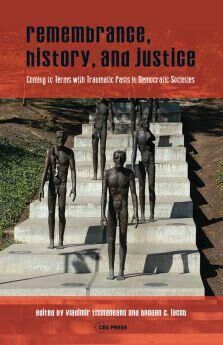
Remembrance, History, and Justice
The twentieth century has left behind a painful and complicated legacy of massive trauma, monstrous crimes, radical social engineering, or collective/individual guilt syndromes that were often the premises for and the specters haunting the process of democratization in the various societies that emerged out of these profoundly de-structuring contexts. The present manuscript is a state of the art reassessment and analysis of how the interplay between memory, history, and justice generates insight that is multifariously relevant for comprehending the present and future of democracy without becoming limited to a Europe-centric framework of understanding. The manuscript is structured on three complementary and interconnected trajectories: the public use of history, politics of memory, and transitional justice. Key words 1. Europe, Eastern-Politics and government-1989- 2. Collective memory-Europe,Eastern. 3. Memory-Political aspects-Europe, Eastern. 4. Democratization-Social aspects-Europe, Eastern. 5. Europe, Eastern-Historiography-Socialaspects. 6. Europe, Eastern-Historiography-Political aspects. 7. Social justice-Europe, Eastern. 8. Post-communism-Europe, Eastern. 9. Fascism-Socialaspects-Europe, Eastern. 10. Dictatorship-Social aspects-Europe, Eastern.
eBook

Romania confronts its communist past : democracy, memory, and moral justice
Reckoning with mass crimes perpetrated by an ideologically driven regime entails engaging in a thorough exploration of its utopian foundations. In the case of Romania, such an analysis requires an interpretation of the role of personality in the construction of a uniquely grotesque and unrepentant forms of neo-Stalinist despotism. Of all the revolutions of 1989, the only violent one took place in Romania. Confronting its Community past therefore involves addressing the abuses committed by the Communist regime up until its very last day, its failure to engage in Round Table-type agreements with democratic representatives, and the repression during the first post-Communist years--a direct legacy of the old regime. This book shows how moral justice can contribute to a restoration of truth and a climate of trust in politics, in the absence of which any democratic polity remains exposed to authoritarian attacks--back cover.
Book

The End and the Beginning
A fresh interpretation of the contexts, meanings, and consequences of the revolutions of 1989, coupled with state of the art reassessment of the significance and consequences of the events associated with the demise of communist regimes. The book provides an analysis that takes into account the complexities of the Soviet bloc, the events’ impact upon Europe, and their re-interpretation within a larger global context. Departs from static ways of analysis (events and their significance) bringing forth approaches that deal with both pre-1989 developments and the 1989 context itself, while extensively discussing the ways of resituating 1989 in the larger context of the 20th century and of its lessons for the 21st. Emphasizes the possibility for re-thinking and re-visiting the filters and means that scholars use to interpret such turning point. The editors perceive the present project as a challenge to existing readings on the complex set of issues and topics presupposed by a re-evaluation of 1989 as a symbol of the change and transition from authoritarianism to democracy.
eBook