
Catalogue Search | MBRL


Are you sure you want to remove the book from the shelf?

{{itemTitle}}
150
result(s) for
"Todoroki, Emiko"
Sort by:

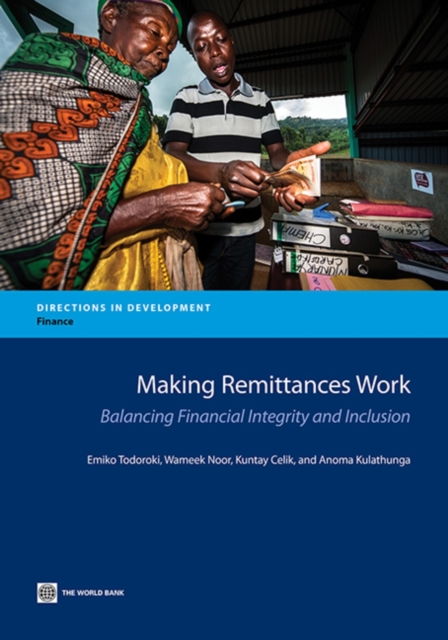
Making remittances work
The September 11, 2001, terrorist attacks on the United States exposed the use of remittance channels for financing terrorism. Acting on this, the international community, through the financial action task force (FATF), issued first international standard to require the licensing or registration of money transfer businesses (MTBs) and to make them subject to anti-money laundering and combating the financing of terrorism (AML and CFT) requirements. This study aims to assess current practices, draw lessons learned, and assist policy makers in designing an effective regulatory and supervisory framework governing remittances that not only meets AML and CFT international standards, but also supports a country's overall financial inclusion objectives. The study's assessments and recommendations are based on extensive research and analysis, including primary survey data received from 26 remittance sending and receiving countries. The report follows on the 15 bilateral remittance corridor analyses (BRCAs) undertaken during 2004-10 by the financial market integrity (FMI) unit of the World Bank and three BRCAs undertaken by the Government of the Netherlands using the methodology developed by the FMI unit of the World Bank. The study is organized as follows: chapter one analyzes the various business models for remittance services currently in existence, and the various types of agent networks of MTBs available for the distribution of remittances. Chapter two elaborates on AML and CFT risks related to products, market structure, regulation, and supervision; discusses how innovative products and services for remittance transfers such as mobile money and internet-based money transfer may pose new threats and risks; and includes a discussion on the appropriate risk mitigation techniques so as not to constrain the remittance market from developing and innovating. Chapter three describes the various regulatory frameworks that MTBs encounter around the world, including different types of laws and regulations affecting them, sheds light on how AML and CFT requirements can be implemented, and provides a comprehensive analysis of customer due diligence (CDD) requirements as a crucial element to effectively fight money laundering and the financing of terrorism. Chapter four discusses licensing and registration regimes for, and appropriate regulatory approaches toward, MTBs; examines the conditions that must be fulfilled in order to apply for licensing or registration. Chapter five discusses the various AML and CFT supervisory models and identifies potential strengths and weaknesses in each of these models; elaborates on the supervisory practices of competent authorities, along with the challenges faced by MTBs in implementing relevant supervisory requirements; and discusses the risk-based approach (RBA) to supervision of MTBs. Finally, chapter six focuses on establishing an effective AML and CFT regime while supporting broader financial inclusion and highlights key policy recommendations underlined by a RBA that encourages flexible implementation of the AML and CFT framework.
eBook


The Canada-Caribbean remittance corridor : fostering formal remittances to Haiti and Jamaica through effective regulation
Several economies in the Caribbean region, especially from the lower income group, are highly dependent on remittances. Between 1991 and 2006, the combined flows of total remittances reaching the Caribbean have seen almost a 17% average annual growth rate, surpassing USD 6billion in 2005 and overtaking ODA and FDI into the region. In addition, remittances represent more than 20% of the domestic gross domestic product (GDP) in some Caribbean countries and have played a significant role in lessening both balance of payment deficits and the impact of natural disasters to which the region is particularly vulnerable. Given the importance of such remittance flows, this study undertakes an analysis of the various dynamics underlying the Canada-Caribbean remittance corridor, including Caribbean migration issues, remittance market landscapes and regulatory frameworks. This study is intended to assist Canadian and Caribbean national authorities in their mandate of providing incentives for the continued growth and competitiveness of their remittance industries, while protecting remittance markets from being abused by criminals.
eBook

The Canada-Caribbean Remittance Corridor
The World Bank has been at the global forefront in research on remittances. Studying over twelve bilateral remittance corridors thus far, the financial market integrity unit has focused its research on remittance market integrity issues and the specific incentives influencing the choices of channels to send money home. Initially conducted at the request of Department of Finance, Canada, this corridor, Canada-Caribbean, has clearly distinguished itself from other bilateral remittance corridors studied in the past. At the originating end of this corridor, these distinguishing features include a country that, throughout its history, has made immigration one of its primary social and economic building blocks. This corridor focuses on Jamaica and Haiti, two of the Caribbean's primary labor exporters and also the countries with the two largest Caribbean communities in Canada. Given the importance of remittances in the region, there is a need for effective, yet proportionate regulation. Risk must be effectively mitigated along potentially vulnerable routes, while innovation, competition and transparency in the remittance markets must be encouraged. Regulatory frameworks that reflect local conditions and are proportionate to the risks involved will facilitate the provision of services of the highest quality to migrants and their families. It is hoped that research provided from this study will generate policy dialogues among all relevant stakeholders, and assist national authorities in their efforts to effectively regulate and supervise the remittance markets. National authorities should continue to encourage the use of formal transfers and develop more reliable and competitive remittance channels. These channels must efficiently meet the varied needs of Caribbean migrant workers and their families in the safest and most secure environment possible.
Book

The Canada-Caribbean remittance corridor
Several economies in the Caribbean region, especially from the lower income group, are highly dependent on remittances. Between 1991 and 2006, the combined flows of total remittances reaching the Caribbean have seen almost a 17% average annual growth rate, surpassing USD 6billion in 2005 and overtaking ODA and FDI into the region. In addition, remittances represent more than 20% of the domestic gross domestic product (GDP) in some Caribbean countries and have played a significant role in lessening both balance of payment deficits and the impact of natural disasters to which the region is parti
Book

The Malaysia-Indonesia remittance corridor : making formal transfers the best option for women and undocumented migrants
In Malaysia, Indonesian migrants are showing an increasingly clear preference for informal transfer mechanisms compared to their counterparts in other countries. A little less than half of all Indonesian migrants overseasthought to be around 2 millionare working in Malaysia. An increasing number of migrants are women, and the corridor is also marked by a high number of undocumented migrants. Despite the increasing flows of migrants, only about 10 percent of the estimated flow of remittances into Indonesia from Malaysia is transferred through the formal system. The extent of the preference for the informal sector is unique in this corridor. Indonesian migrants in other countries are using the formal sector far more than the migrants in Malaysia. In addition, Indonesian women and undocumented migrants in Malaysia especially find formal sector transfers either hard to access or inappropriate for their needs. To this end, the study assists policymakers efforts to increase the impact of remittances on economic development and poverty reduction in Indonesia and to investigate options for attracting more migrants to use the formal financial sector. The report provides a descriptive overview of the MalaysiaIndonesia remittance corridor and suggests policy avenues for improving access to formal remittance transfer channels; increasing the transparency of the flows and the cost structure; and facilitating remittance transfers, particularly for undocumented and female migrant workers.
eBook