
Catalogue Search | MBRL


Are you sure you want to remove the book from the shelf?

{{itemTitle}}
434
result(s) for
"Tollison, Robert D."
Sort by:

Intellectual Collaboration
Intellectual collaboration in science includes formal coauthorship as well as presentation of papers at workshops, seminars, and professional meetings and informal commentary from colleagues, journal referees, and editors. While the incidence and extent of formal coauthorship are greater in biology than in economics, the extent of intellectual collaboration is greater in economics than in biology. Intellectual property rights to coauthored papers in economics tend to be assigned alphabetically, whereas biology is characterized by a strong merit‐based (nonalphabetical) assignment of intellectual property rights. These patterns do not result from differences in the relative importance of funding/physical capital.
Journal Article

The economic theory of rent seeking
Tullock's concept of rent seeking was the first statement of a quantitative principle about the social costs of such activities as lobbying and favor seeking. As such, this part of Tullock's legacy to modern economics is one of his most important contributions.
Journal Article
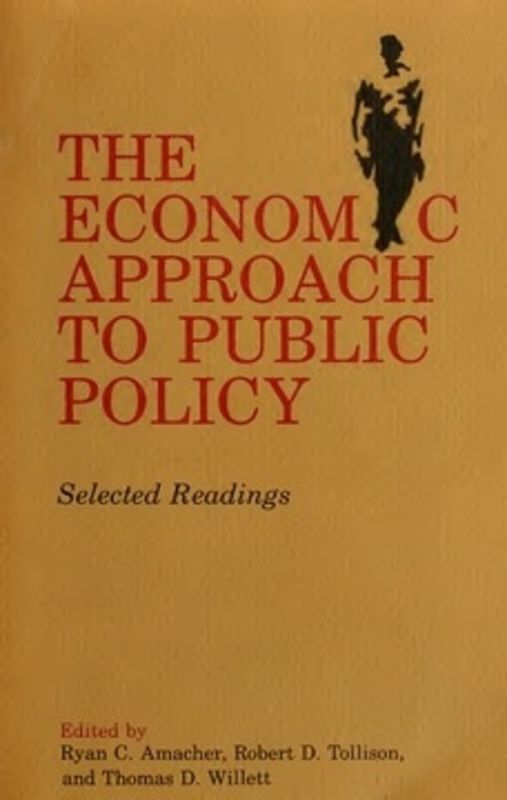
The Economic Approach to Public Policy
Can traditional economic theory help to solve today's vexing social problems? This unique collection of thirty-six papers strongly suggests that it can. The economic approach is applied imaginatively by the authors to a wide range of contemporary issues, such as crime, higher education, the environment, revenue sharing, equity, justice, and the distribution of income. The articles also deal with governmental behavior and the role of the economist as governmental adviser.
Shaped during the preparation and teaching of college classes, the book is well suited for courses in principles of economics, microeconomics, price theory, and public policy development and analysis. It should also prove a useful reference work for policy makers.
eBook

Remembering Gordon Tullock
Issue Title: Special Issue in Memory of Gordon Tullock: The Man and His Ideas This is a short tribute to Gordon Tullock, and the unique approach to bioeconomic issues that he took. The example used is hoarding behavior by various species of squirrels.
Journal Article
Charles K. Rowley: In Memoriam
Charles K. Rowley had a distinguished career on both sides of the Atlantic. He served as department head and named chair at Newcastle upon Tyne in England, and he held a named chair and several administrative positions at George Mason University in the United States. An obituary for him is presented.
Journal Article
Crime on the Court, Another Look: Reply to Hutchinson and Yates
McCormick and Tollison respond to a critique of their article \"Crime on the Court\" by Kevin P. Hutchinson and Andrew J. Yates.
Journal Article


On the extraordinary scholarly life and times of Gordon Tullock
Gordon Tullock, who passed away at the age of 92 on November 3, 2014, ranks justly near the top of the list of the “founding fathers” of the public choice research program. Most widely known in the academy as coauthor of
The Calculus of Consent
(Buchanan and Tullock
1962
), Professor Tullock was not named, unfairly in our joint opinion, as co-recipient of James Buchanan’s 1986 Nobel Prize in Economic Sciences. A good case nevertheless can be made that Gordon earned Nobel laurels on his own account for groundbreaking contributions to the literatures on, among other topics of scholarly study, rent seeking, autocracy, bureaucracy, war and revolution, law and economics and bio-economics. This essay celebrates Gordon Tullock’s major influences on the field of public choice, including his launching of
Public Choice
, the journal for which both of us have served as editors, and his impacts on scholars working at the many and obviously fruitful intersections of economics and political science.
Journal Article
1966
I first encountered The Calculus of Consent in September 1966 as a first-year graduate student at the University of Virginia. I chose Virginia because it was the first school to which I applied that offered me a fellowship. I could have equally gone to North Carolina or Duke had I waited. I literally knew very little about the work that was being done by the faculty at these schools. Little did I realize at the time that I had made a fortuitous choice. In 1966 both of the authors of the Calculus were in residence in Charlottesville as members of the Economics Department. The book was not formally assigned as a reading in any of my classes, but it was a commonly and much discussed topic among the graduate students. The book did not have an immediate effect on my work or me. It was more like osmosis, whereby gradually over time ideas and thoughts gel and insights develop. Looking back, however, I can see that the path I have taken is directly related to the early influence of the Calculus. Early reviews and critiques of the book stressed the need to follow a work of pure theory with empirical testing. This was an idea that captured my imagination, and so in the mid-1970s, I began my work in empirical public choice. The idea was simply to find testable implications in public choice theory and to confront them with data. With the help of co-workers I think that I can fairly claim a modicum of success in this enterprise. Topics on which I (we) have reported empirical findings include: legislator pay, interest groups, term limits, campaign spending, redistricting, voting behavior, public spending, taxes, deficits, bureaucracy, regulation, bicameralism, and still others. Had I gone to another graduate program, no doubt none of this work would have been done. So I would say that the Calculus had a big impact on my work, as did the luck (serendipity) of going to a graduate program that was unique, vital, and competitive, with really fine students. Charlottesville and Buchanan and Tullock opened my eyes to a world of possibilities that turned into a life of scholarship, good times, and enjoyable colleagues and students. I do not know what the road not taken (opportunity cost) would have been like, but I cannot imagine anything better than the one I did take. In fact, I probably otherwise would have ended up teaching four courses a semester at a small college. Adapted from the source document.
Journal Article
Regulators and Redskins
We examine the correlation between federal government activity and performance of the capital's National Football League team, the Washington Redskins. We find a positive, non-spurious, and robust correlation between the Redskins' winning percentage and bureaucratic output, measured by pages published in the Federal Register. Because the Redskins' performance is prototypically exogenous, we give this result a causal interpretation and provide a plausible, causal mechanism: bureaucrats must make \"logrolling\" deals to expand their regulatory power, and a winning football team offers a shared source of optimism to lubricate such negotiations. We do not find the same correlation when examining congressional activity.
Journal Article